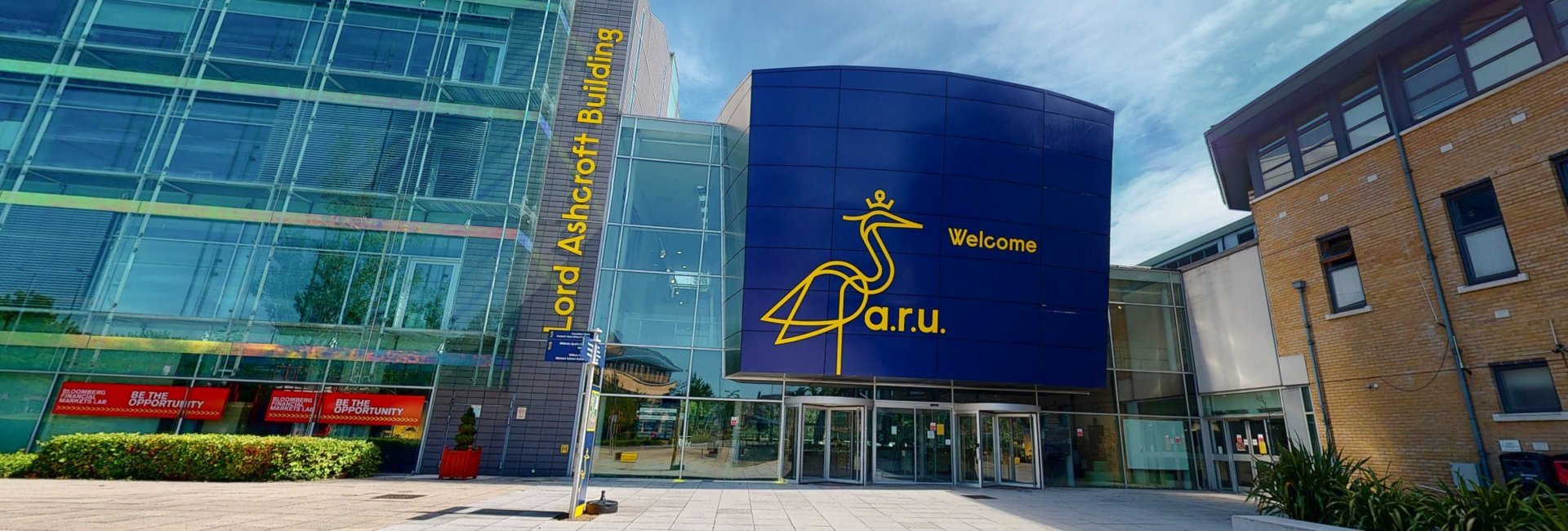
Anglia Ruskin University - Undergraduate Open Day - Writtle
6 Jun 2026, 09:00
Writtle, Chelmsford

Study the workings of society and governments around the globe, including questions of power, justice, democracy, empire, security, revolution, activism, and identity.
Our curriculum stretches from Africa to America to Britain and Europe. You’ll gain insights into change and continuity in national and global governance, how leaders and politicians have influenced such processes, and how the directions and decisions of political parties and institutions have affected the lives of ordinary people.
You’ll explore the impact of individual leaders like Tony Blair and Vladimir Putin alongside the role of international organisations and alliances, as well as wider issues of international conflict and world peace, consumption and trade, crime and terrorism, and media and communication. At every level history and historical theories of change will be integrated into your understanding.
In addition to the focus on politics and international relations, you’ll also gain a range of transferable skills to equip you for your graduate future. Your use of data analysis and different sources from government documents to focus groups plus innovative assessments that include, but go far beyond, the traditional essay, will give you an impressive narrative to tell in future job applications.
Gain important transferable skills for your career, including research and data analysis.
Take innovative assessments that include but also go beyond the traditional essay, like blogs, podcasts, presentations and letters.
Learn from expert tutors including historians, sociologists and political scientists.
Attend events with key political figures organised by our Labour History Research Unit.
Study in Cambridge, with its impressive collection of museums, libraries, archives and political clubs.
*Careers
As a BA (Hons) Politics and International Relations graduate, you could go on to work in a variety of fields, including local government, charities, NGOs, and European and international organisations and agencies. You might also explore career paths in public service, the criminal justice system, future energy policy and planning, security, negotiation and peacekeeping, or communication and media.
As part of your degree you have the option to learn a language, through our Anglia Language Programme. This can boost your employability in international areas such as UN conflict resolution and diplomacy.
You could also learn more, develop a specialism or start an exciting career in research with our MA International Relations, MA Sociology or MA Criminology. Take advantage of our Alumni Scholarship and get 20% off your fees.
*=optional.
Year 1: Introduction to Politics and International Relations; Global Affairs; A History of Now; Political Thought; Into ARU.
Year 2: From World War to Cold War; Give Peace a Chance: Fundamental Issues and Perspectives on Contemporary International Relations; Researching Society and Culture; Ruskin Module; The United States in the 20th Century *; Intoxicants and Intoxication *; The British Empire 1783-1919 *; International Human Rights Law *; Welfare State to European State: Britain 1906-1975 *; Mobilities and Migration *; Ireland and the Irish after Independence *.
Year 3: Placement.
Year 4: Undergraduate Major Project; Hitler to the Hashtag: Political Communication in Peace and War; From Theory to Practice International Relations in the 21st Century; A Global History of Government and Society, 1945-1999; Research Communication; Gender and Sexuality in Britain: 1880-2000 *; Race, Racism and Ethnic Identity *; From Communism to Consumerism: Russia since 1917 *; Global Feminisms *; From Workhouses to Universal Credit: The Past, Present and Future of the British Welfare State *; The Era of Thatcher and Blair *; The Making of Modern Media *; Comparative and Global Criminal Justice *; Counter-Terrorism Policing *; Organised Crime *.
You'll show your progress using a combination of essays, exams, case studies, optional work experience and presentations.
This is the equal consideration deadline. You can still apply after this date, but your application may not receive guaranteed consideration.

Anglia Ruskin University has participated in the Teaching Excellence Framework. These ratings were awarded in 2023, for four years.
See why these ratings were awarded
What does this TEF outcome mean?
The following entry points are available for this course:
Find out more about qualification requirements for this course.
ARU operates a policy of making contextualised offers for this course which may be a reduced conditional offer or an unconditional offer, using data from UCAS to make our assessment. We consider that this approach promotes the equality of educational opportunity for applicants from low participation groups in HE. ARU welcomes students from diverse backgrounds and helping them achieve their full potential. The offer of a place through the contextual offer process is at the discretion of ARU.
This section shows the range of grades students (with UK A-Levels or Pearson BTEC Level 3 National Extended Diplomas) who received offers were previously accepted with (learn more). It is designed to support your research but does not guarantee whether you will or won't get a place. Admissions teams consider various factors, including interviews, subject requirements, and entrance tests. Check all course entry requirements for eligibility.
We are unable to show previous accepted grades for this course. This could be because the course is new, it's a postgraduate course, there isn't enough historical data, or the provider has opted out of sharing their entry grades data for this course - learn more.
| Location | Fee | Year |
|---|---|---|
| England | £9790 | Year 1 |
| Northern Ireland | £9790 | Year 1 |
| Scotland | £9790 | Year 1 |
| Wales | £9790 | Year 1 |
| Channel Islands | £9790 | Year 1 |
| Republic of Ireland | £9790 | Year 1 |
Tuition fee status depends on a number of criteria and varies according to where in the UK you will study. For further guidance on the criteria for home or overseas tuition fees, please refer to the UKCISA website.
Please visit our website for further information on fees for the Placement year:
https://www.aru.ac.uk/study/tuition-fees
https://www.aru.ac.uk/student-life/preparing-for-study/help-with-finances
https://www.aru.ac.uk/student-life/support-and-facilities/careers-and-employability/placements
East Road
Cambridge
CB1 1PT
Visit our website Visit our course page
Email:answers@aru.ac.uk
Phone:01245 68 68 68
At Anglia Ruskin University