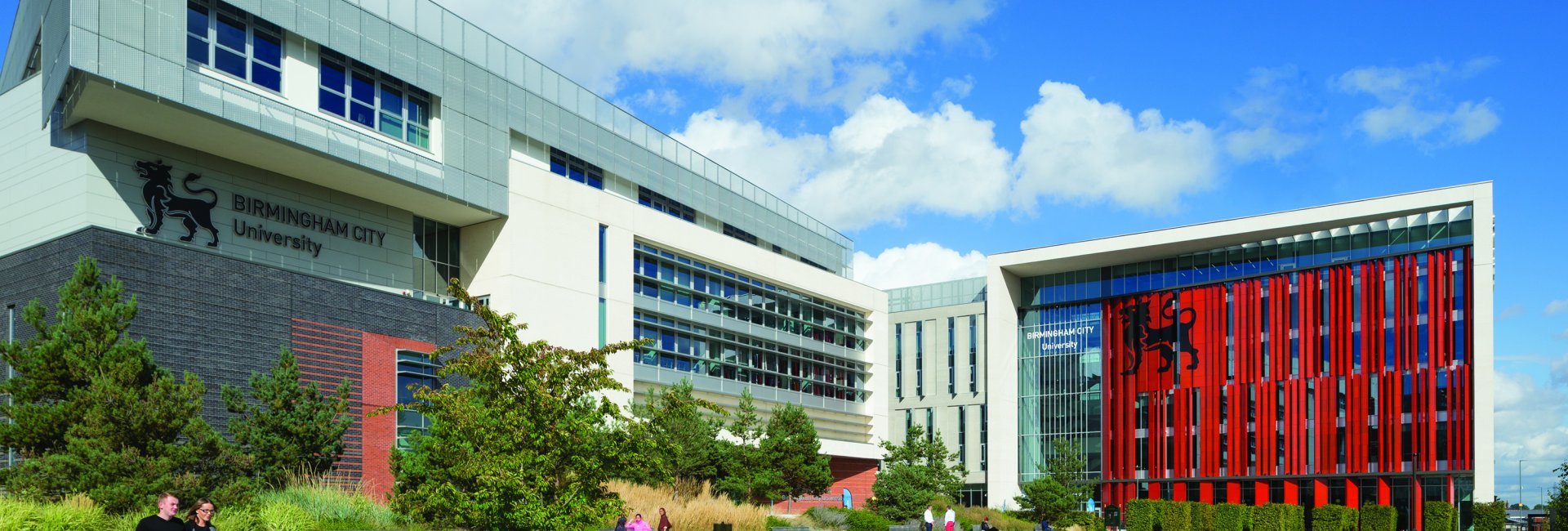
Birmingham City University
Curzon Building
4 Cardigan Street
Birmingham
B4 7BD
Visit our website Visit our course page
Course contact details
Course Enquiries Team
Email:courseenquiries@bcu.ac.uk
Phone:0121 331 6295

Developing skills in artificial intelligence is one of the biggest challenges facing industries both globally and nationally today. This BSc Artificial Intelligence degree is designed to tackle industry demands and equip you with cutting-edge skills in deep learning, natural language processing, computer vision, cloud computing, and Generative AI. These capabilities will enable you to deliver intelligent software solutions that power innovation across the modern economy and contribute towards the future of society. You will graduate prepared for careers like Artificial Intelligence Engineer, Machine Learning Specialist, Data Scientist, and Natural Language Processing Developer.
What's covered in this course?
Throughout the course, you will have opportunities to interact with a curriculum that is supported by commercial and industrial content and partners.
In your first year, modules at the start of the course are mostly common with other Computing and AI courses to ensure a strong technical foundation in the field. You will develop an understanding of programming, algorithms and data structure, computer systems, and web development, while also being introduced to artificial intelligence, and innovation through dedicated projects.
In your second year, you’ll study specialised modules in artificial intelligence and machine learning, natural language processing, computer vision, and software deployment using machine learning operations. You'll also gain solid experience in backend development, object-oriented programming, and database engineering, enabling you to build and train intelligent systems.
In your final year, you will explore advanced AI technologies such as deep neural networks, generative AI, cloud computing, deep neural networks and ethics, and modern data storage systems - as well as ethical and societal implications of AI solutions. A major highlight of your final year is the individual project, where you'll tackle a real-world AI problem, applying your knowledge to research, design, implement, and evaluate a comprehensive solution. This capstone project helps prepare you for professional roles and demonstrates your capabilities to future employers.
Additionally, you will have the opportunity to take a professional placement year between your second and third year, which we highly recommend, as it will give you an invaluable opportunity to hone your expertise, try out a potential career path and get relevant workplace experience that is valued by many employers, boosting your CV.
Professional Placement year
This course offers an optional professional placement year. This allows you to spend a whole year with an employer, following successful completion of your second year, and is a great way to find out more about your chosen career. Some students even return to the same employers after completing their studies.
If you choose to pursue a placement year, you will need to find a suitable placement to complement your chosen area of study. You will be able to draw on the University’s extensive network of local, regional, and national employers, and the support of our Careers teams. If you are able to secure a placement, you can request to be transferred to the placement version of the course.
Please note that fees are payable during your placement year, equivalent to 20% of the total full-time course fee for that year.
This is the equal consideration deadline. You can still apply after this date, but your application may not receive guaranteed consideration.

Birmingham City University has participated in the Teaching Excellence Framework. These ratings were awarded in 2023, for four years.
See why these ratings were awarded
What does this TEF outcome mean?
The following entry points are available for this course:
Welsh Baccalaureate: 112 UCAS tariff points. Considered with two A Levels or equivalent level 3 qualifications. Required subjects: One from Technology, Science, Mathematics or Computing.
OCR Cambridge Technical qualifications: 112 UCAS tariff points. Accepted subjects: Technology, Science, or Computing.
NCFE CACHE Level 3 qualifications: 112 UCAS tariff points. Considered alongside A Levels or equivalent level 3 qualifications, one of which must be Technology, Science, or Computing.
WJEC Level 3 qualifications: 112 UCAS tariff points. Considered alongside A Levels or equivalent level 3 qualifications, one of which must be Technology, Science, or Computing.
| Test | Grade | Additional details |
|---|---|---|
| IELTS (Academic) | 6 | overall with no less than 5.5 in each band. |
This section shows the range of grades students (with UK A-Levels or Pearson BTEC Level 3 National Extended Diplomas) who received offers were previously accepted with (learn more). It is designed to support your research but does not guarantee whether you will or won't get a place. Admissions teams consider various factors, including interviews, subject requirements, and entrance tests. Check all course entry requirements for eligibility.
We are unable to show previous accepted grades for this course. This could be because the course is new, it's a postgraduate course, there isn't enough historical data, or the provider has opted out of sharing their entry grades data for this course - learn more.
| Location | Fee | Year |
|---|---|---|
| England | £9535 | Year 1 |
| Northern Ireland | £9535 | Year 1 |
| Scotland | £9535 | Year 1 |
| Wales | £9535 | Year 1 |
| EU | £18570 | Year 1 |
| International | £18570 | Year 1 |
Tuition fee status depends on a number of criteria and varies according to where in the UK you will study. For further guidance on the criteria for home or overseas tuition fees, please refer to the UKCISA website.
*The Government is proposing to apply an inflationary increase to regulated tuition fees for 2026/27 and the University is planning on increasing fees to that maximum level once confirmed.
Curzon Building
4 Cardigan Street
Birmingham
B4 7BD
Visit our website Visit our course page
Email:courseenquiries@bcu.ac.uk
Phone:0121 331 6295
At Birmingham City University