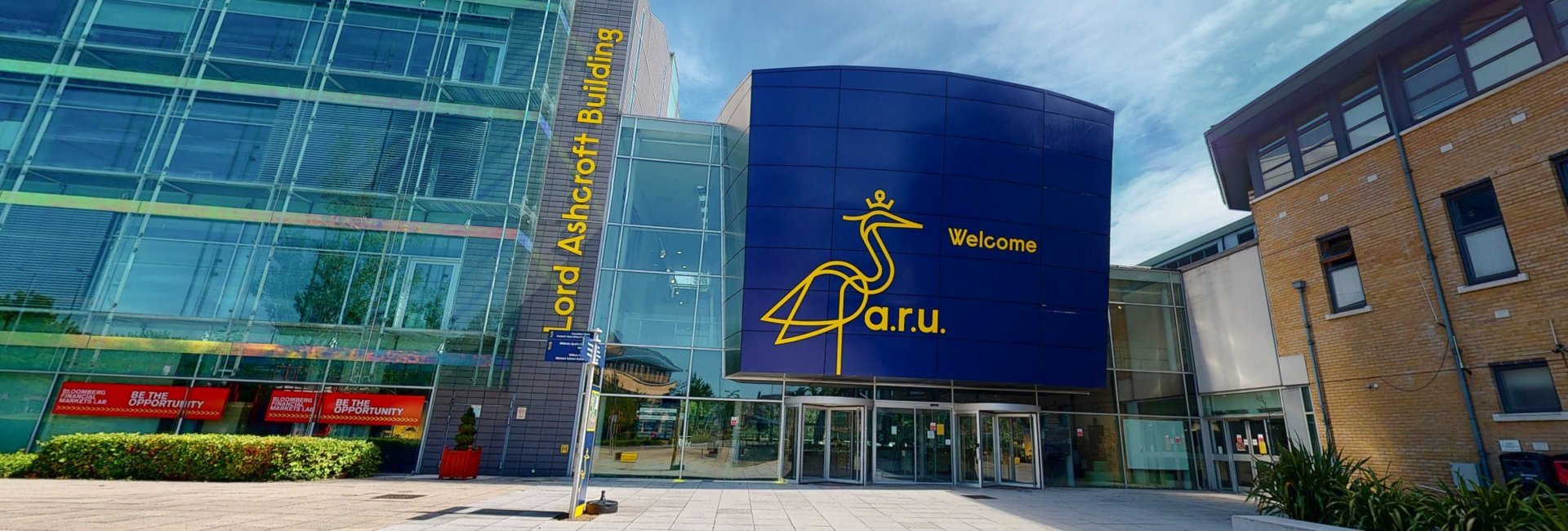
Anglia Ruskin University - Undergraduate Open Day - Cambridge
6 Jun 2026, 09:00
Cambridge

Explore pressing crime and social issues and prepare for careers including policing, probation, youth offending and government.
On this degree you'll discover the most recent ideas, issues and debates in criminology and sociology. These could include the media and moral panics; sexual violence and offender profiling; youth offending; war, terror and genocide – giving you a specialist perspective on crime and society.
You can tailor your degree to your interests and career goals through a range of optional modules. For example, you could focus on issues of corporate crime or human rights, or examine the link between intoxicants or religion and crime.
Learn from staff with real-world experience, with modules delivered by policing and criminal justice practitioners.
Build a portfolio and CV, hear from key criminal justice professionals, and attend employment fairs.
Use our links to local and national organisations, including police forces, to find work placements and engage with professionals.
Attend events organised by our International Policing and Public Protection Research Institute.
Join a university at the forefront of shaping cultural change in uniformed services, with our record £11million research grant.
Careers
Prepare for your career from the first semester: build a portfolio and CV, attend volunteer and employment fairs, take part in our annual Criminology conference, and hear from key figures in criminal justice including authors of important criminology texts.
Specialist modules in years 2 and 3 and our excellent links with employers such as Cambridgeshire Police, the National Crime Agency and the Probation Service will help you tailor your degree towards your career goals.
As well as developing your knowledge of sociology and criminology, this degree will equip you with skills in independent, creative, critical and analytical thinking. These are valued in industries as wide-ranging as:
journalism and the media
business administration and management
health management
the Civil Service
teaching
social care
social research
the police, prison and probation services.
You might decide to stay at ARU and study for a Masters, such as MA Sociology or MA Criminology. Take advantage of our Alumni Scholarship and get 20% off your fees.
Teaching
In Year 1 you’ll discover key ideas in sociology and criminology. These include the relations that connect individuals, groups and institutions within societies, and the inner workings, strengths and weaknesses of the criminal justice system in England and Wales.
In Year 2 you’ll explore how migration shapes societies and lives, how schooling systems and strategies shape individual and collective identities, and how you how can make a difference in the world.
Finally, you’ll consider issues of race and racism and how agencies use criminological theories, before pooling your learning in a Major Project.
*=optional
Year 1: Introduction to Contemporary Issues in Criminology (30 credits); Criminal Justice in England and Wales; Sociology in Action; Into ARU; Media, Society and Crime *; Global Affairs *
Year 2: Mobilities and Migration; Sociology of Education; Researching Society and Culture; Ruskin Module; Cybercrime and Policing *; Intoxicants and Intoxication *; Revolving Doors: Punishment and Rehabilitation *; Spirituality, Religion and the Secular *; Sociology of Health Inequalities *; Violence and Confrontation *; Violence, Gender and Victimisation *; Lessons Learned: Inquests, Tribunals and Truth *; Dark Web Policing and Control *; Hanging, Prisons and Community Service: Crime and Punishment in Britain throughout the Ages *; Introduction to Youth Work and Safeguarding ; Anglia Language Programme
Year 3: Undergraduate Major Project; Race, Racism and Ethnic Identity; Criminology and Policing in Policy and Practice; Comparative and Global Criminal Justice *; Investigative Psychology *; Organised Crime *; Police and Counter-terrorism *; Global Feminisms *; Concepts of Good and Evil *; Sexuality and Social Control *; Environment, Nature and Society *; Youth, Crime and Aggression *; Exploitation, Trafficking and Sexual Violence *; Politics and Social Media *; Sport, Globalisation and International politics *; Anglia Language Programme *; Crime and Data Science *
You’ll show your progress through a combination of case studies, presentations, essays, patchwork texts (short pieces of writing, or ‘patches’, built up week-by-week), portfolios, poster presentations, data analysis exercises, exams and group projects.
This is the equal consideration deadline. You can still apply after this date, but your application may not receive guaranteed consideration.

Anglia Ruskin University has participated in the Teaching Excellence Framework. These ratings were awarded in 2023, for four years.
See why these ratings were awarded
What does this TEF outcome mean?
The following entry points are available for this course:
We welcome applications from international and EU students, and accept a range of international qualifications.
We accept A Levels, T Levels, BTECs, OCR, Access to HE and most other qualifications within the UCAS Tariff.
96 UCAS Tariff Points from a minimum of 2 A levels (or equivalent).
UCAS Tariff Points accepted.
3 GCSEs at grade C, or grade 4, or above which must include English Language or English Literature.
Find out more about qualification requirements for this course.
ARU operates a policy of making contextualised offers for this course which may be a reduced conditional offer or an unconditional offer, using data from UCAS to make our assessment. We consider that this approach promotes the equality of educational opportunity for applicants from low participation groups in HE. ARU welcomes students from diverse backgrounds and helping them achieve their full potential. The offer of a place through the contextual offer process is at the discretion of ARU.
This section shows the range of grades that students who received offers were previously accepted on to this course with (learn more).
It is designed to support your research but does not guarantee whether you will or won't get a place.
Admissions teams consider various factors, including interviews, subject requirements, and entrance tests. Check all course entry requirements for eligibility.
We are unable to show previous accepted grades for this course. This could be because the course is new, it's a postgraduate course, there isn't enough historical data, or the provider has opted out of sharing their entry grades data for this course - learn more.
| Location | Fee | Year |
|---|
Tuition fee status depends on a number of criteria and varies according to where in the UK you will study. For further guidance on the criteria for home or overseas tuition fees, please refer to the UKCISA website.
https://www.aru.ac.uk/student-life/preparing-for-study/help-with-finances/undergraduate
https://www.aru.ac.uk/study/tuition-fees
Email:answers@aru.ac.uk
Phone:01245 683680
East Road
Cambridge
CB1 1PT
At Anglia Ruskin University