Course contact details
Applicant Services
Email:applicantservices@falmouth.ac.uk
Phone:01326 213730
Falmouth University
Woodlane
Falmouth
TR11 4RH

Succeed as a confident, exciting, contemporary performer.
This is an acting degree for the contemporary performer. From the outset, you’ll be focusing on the in-depth training and practical techniques needed for stage, film, television and digital media, giving you the skills to succeed as a confident and versatile actor.
You’ll be encouraged to collaborate with other disciplines across our vibrant university community, broadening your acting repertoire. You could work with writers, filmmakers, game writers and artists to produce material that is engaging and unique; developing your individual voice as an actor through experimentation with different mediums.
You will be studying in professional-standard facilities – including a public performance venue – alongside a creative and collaborative community where you can combine practice and research, working with supportive industry professionals to help you prepare for a career in the performing arts.
You will:
Gain, develop and apply acting techniques and approaches to prepare for a professional career
Focus on specific industry skills to support you as a performer for stage, screen, and digital work
Engage with working practitioners through practical sessions and intensive performance projects
Collaborate with students within AMATA as well as those specialising in film, television and games, gaining industry-relevant training
Showcase your work through live and digital performances
Benefit from being located in a working performance venue offering a year-round programme
Have access to a host of resources including green screen and motion-capture facilities
This course is an accredited degree with Spotlight and Equity. Students are eligible to join Spotlight in the first term of their final year. Inclusive of their membership, they have a wealth of support, content and events tailored explicitly towards this membership group from Spotlight.
Focusing on practical skills, you'll learn from working industry professionals while studying acting approaches, voice, text analysis, movement and character physicality, and imaginative. You’ll also be studying a range of acting techniques in live and digital performances such as film, TV, stage, gaming, and voiceover.
Year one
In your first year with us will be focused on gaining: gaining an appreciation for the work required to succeed, gaining collaboration opportunities with students on this and wider courses, and gaining support for what you want to achieve. Your degree starts here, and the course team is here to support you.
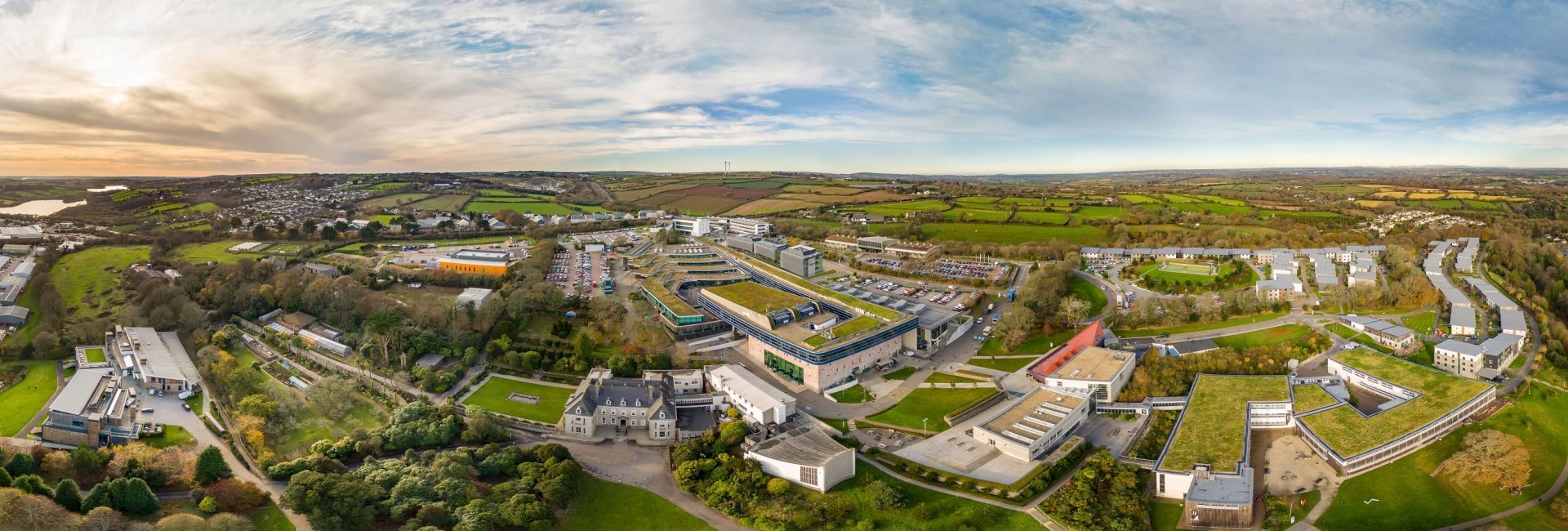
You also be gaining one of the most beautiful locations in the world to train, by studying Acting at Falmouth. With opportunities to explore the local environment, you can use this as inspiration for your practice as an actor.
Modules
Approaches to Acting
Voice and Movement 1
Culture and Contexts: Stage and Screen
Character Improvisation
Voice and Movement 2
Live Performance Project 1
Year two
In your second year, you’ll examine your own artistic development: introducing new areas of rehearsal and performance practice. You’ll look to develop your work through the exploration, application and implementation of skills gained in your first year.
You'll develop connections within the university, and work across disciplines. There are also more experiences of performing to an audience and fostering a growing awareness of potential areas within the acting profession to explore.
Modules
Screen Acting
Voice and Movement 3
Live Performance Project 2
Playful Performer
Classical and Contemporary
Character Research
Year Three:
You’ll be responsible for finding your own placement, with support from the employability team. Choosing this option will enhance your industry experience and skills while studying.
How you’ll study during your professional placement
You’ll spend time working in a professional context, as part of a business or organisation. This can be in one role, or up to three, and must be for a minimum of 24 weeks.
You’ll develop in-demand workplace skills, deepen your insight into industry and grow your network of contacts, all of which could help you get ahead in your career after graduation.
Throughout this year, you’ll develop a portfolio of work that includes critical self-reflection on what has been learned from the experience. You’ll be required to evidence your experiences, the skills you’ve learned and your professional growth. h.
Year four
The final year of the course focuses on applying the skills you have gained and developed on the course in a variety of different contexts. There will be opportunities to apply these skills for rehearsals and recorded and public performances.
Students will be prepared for their future aspirations and ambitions with a detailed knowledge of the professional industry they will be entering, with a portfolio and CV to support the move to professional actor.
Modules
Acting in Digital Modes
The Thinking Practitioner
Screen Project
Professional Preparation & Employment
Live Performance Project 3
As part of our process of continuous improvement, we routinely review course content to ensure that all our students benefit from a high-quality and rewarding academic experience. As such, there may be some changes made to your course which are not immediately reflected in the content displayed on our website. Any students affected will be informed of any changes made directly.
Assessments across the course are a mixture of practical and portfolio-based (inc. practical elements) and written content.
Assessments are designed in a variety of formats, which assess understanding, knowledge, skill, technique, creativity, artistry and application. These include but are not limited to:
Practical activities (group and/or individual)
Performances
Workshops (applied, educational, creative)
Industry and professional live briefs
Digital outputs
Performance texts/scores/plays
Presentations
Essays
Critical/reflective evaluations
Journals/portfolios
Research projects (practical and/or written)
Feedback is given as a mix of verbal (face-to-face) and written depending on the assessment within the module.
This is the equal consideration deadline. You can still apply after this date, but your application may not receive guaranteed consideration.

Falmouth University has participated in the Teaching Excellence Framework. These ratings were awarded in 2023, for four years.
See why these ratings were awarded
What does this TEF outcome mean?
The following entry points are available for this course:
If English is not your first language, you will need to demonstrate English language skills that are sufficiently developed for successful completion of your studies. We accept a range of recognised English language qualifications that are equivalent to the International English Language Testing System (IELTS) Academic minimum score of 6.0 overall, with a minimum of 5.5 in Reading, Writing, Speaking and Listening.
Through the award of international scholarships, we aim to support academic enrichment by encouraging diversity and excellence at Falmouth. For details of our international scholarships, and how to apply for them, please visit our website at www.falmouth.ac.uk.
We welcome A Levels in a wide range of subjects, especially in those relevant to the course for which you apply.
We accept BTEC Extended Diplomas in a wide range of subjects, especially those relevant to the course you are applying to.
60 credits (with a minimum of 45 credits achieved at level 3) in a relevant subject.
Acceptable when combined with other qualifications
Acceptable when combined with other qualifications
Acceptable when combined with other qualifications
We accept BTEC Extended Diplomas in a wide range of subjects, especially those relevant to the course you are applying to.
Accepted with other qualifications
Acceptable with UCAS tariff points from the Supporting Qualifications
Acceptable with UCAS tariff points from the Supporting Qualifications
Acceptable when combined with other qualifications
Accepted
Accepted
At Falmouth, we recognise excellence in many forms, and we see the whole you.
Our diverse community is creative, innovative and entrepreneurial.
We recognise that these qualities aren’t always shown in academic grades alone. That’s why, while many of our applicants achieve high academic grades, we also welcome those who can demonstrate their potential through an exceptional portfolio or performance.
At a minimum, we typically require the equivalent of 64 UCAS Tariff points for undergraduate courses where we can review a portfolio or audition, or a minimum of 96 UCAS points for those courses that do not require a portfolio or audition. For our Integrated Foundation Year courses, we typically require a minimum of 32 UCAS points for courses where we can review a portfolio or audition, or 64 UCAS points for those that do not require a portfolio or audition.
To support this approach, during a friendly conversation with our academic team, we’ll consider your ideas, your creative output and your ambition to ensure you’ll thrive at Falmouth.
If you are able to demonstrate relevant, current, equivalent experience instead of formal qualifications, we encourage you to apply. Please contact our Applicant Services team before applying, for advice regarding your individual experience and eligibility.
If you are an international applicant and require a Student visa to study in the UK, you must have a recognised English language test approved and vouched for by the University at the appropriate level. You can see what we accept on our website https://www.falmouth.ac.uk/study/international/english-language-requirements Our Applicant Services team can help you with any general questions you may have about study visas or suitable language tests. For more specific advice, we recommend you also consult UKCISA http://www.ukcisa.org.uk/
Find out more about qualification requirements for this course.
View our list of accepted English language tests and qualifications using the link belowhttps://www.falmouth.ac.uk/study/international/english-language-requirements
At Falmouth University, we take a rounded approach to admissions. Instead of focusing on criteria like grades alone, we operate a contextual admissions policy, where we look at you as a person: your talents, your experiences and your potential. Every offer we make is shaped around you and your circumstances, and our conditional offers are always intended to be realistic and achievable.
This section shows the range of grades that students who received offers were previously accepted on to this course with (learn more).
It is designed to support your research but does not guarantee whether you will or won't get a place.
Admissions teams consider various factors, including interviews, subject requirements, and entrance tests. Check all course entry requirements for eligibility.
We are unable to show previous accepted grades for this course. This could be because the course is new, it's a postgraduate course, there isn't enough historical data, or the provider has opted out of sharing their entry grades data for this course - learn more.
No fee information has been provided for this course
Tuition fee status depends on a number of criteria and varies according to where in the UK you will study. For further guidance on the criteria for home or overseas tuition fees, please refer to the UKCISA website.
No additional fees or cost information has been supplied for this course, please contact the provider directly.
Email:applicantservices@falmouth.ac.uk
Phone:01326 213730
Woodlane
Falmouth
TR11 4RH
At Falmouth University