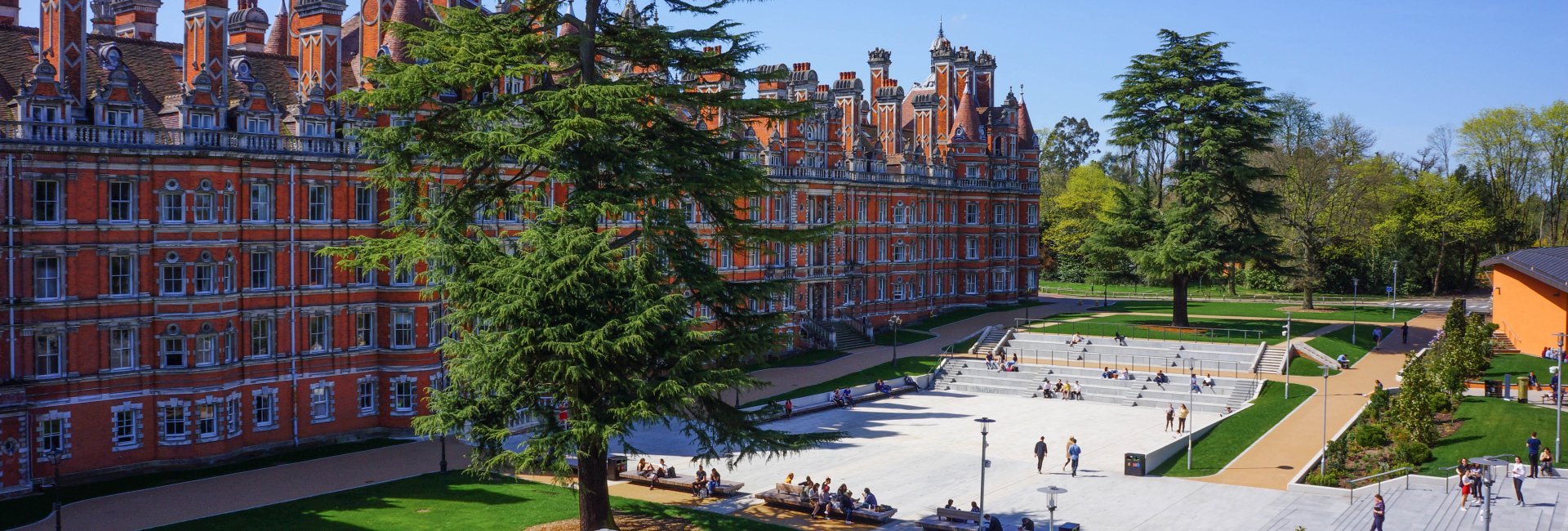
Postgraduate webinar series: Royal Holloway's London experience – Life on our London campus
5 Mar 2026, 10:00
Egham

Politics, International Relations and Modern Languages explores the key areas of contemporary European politics and international relations and combines these with the in-depth study of Italian language, society and culture. Taught in partnership between the Department of Politics and International Relations and the School of Modern Languages, Literatures and Cultures, this course is informed by the outstanding research and international outlook of both departments.
The politics element of the course provides an introduction to the working of international relations and the growth of Europe as a political entity. This includes research into areas such as Brexit, the European Union’s Budget, the European Parliament, security, international diplomacy, and the use of military force, as well as European languages and cultures. Your second and final year courses in European politics and international relations will be taught by Giacomo Benedetto, who holds a Jean Monnet professorship in European integration awarded by the European Union.
As a modern linguist, you will not only learn to speak and write fluently, you will also develop excellent communication and research skills and combine language proficiency with cross-cultural perspectives.
As a part of Royal Holloway’s close-knit international community, based in our beautiful historic campus, you will be within easy reach of London. You will also have the exciting opportunity to spend a year working, teaching or studying in Italy, when you will immerse yourself in the language and culture and truly broaden your horizons. Among the insitutions we have exchange links with is Siena, one of Italy’s most respected universities for politics and international relations, located in the heart of historic Tuscany.
In the event of a no-deal Brexit, we will commit to providing 2019 and 2020 entry students with a subsidy equivalent to current Erasmus+ funding (where this would have previously been funded by the Erasmus+ scheme). To find out more visit the Erasmus+ page.
Study with leading experts on Brexit and EU Budgets.
Taught in partnership with the School of Modern Languages, Literatures and Cultures.
Spend a year of study and/or work in Italy.
Gain written and verbal fluency in Italian.
Other language options in German (R200), French (R100) and Spanish (R401).
Core Modules
Year 1
Introduction to International Relations
Introduction to Politics and Government
You will take one of the following modules in Italian depending on your language proficiency:
Italian Language: Culture and Translation
Italian Ab Initio Written I
Italian Ab Initio Oral I
Italian Advanced Written I
Italian Advanced Oral I Year 2
Understanding the European Union: Politics and Theory You will take one of the following:
You will take one of the following modules in Italian depending on your language proficiency:
Advanced Italian II for Post Beginners
Advanced Italian II
Advanced Italian Translation: Skills and Practice
Year 3
Year Abroad Year 4
European Union Public Policy
You will take the following module in Italian:
Advanced Italian III
Optional Modules
There are a number of optional course modules available during your degree studies. The following is a selection of optional course modules that are likely to be available. Please note that although the College will keep changes to a minimum, new modules may be offered or existing modules may be withdrawn, for example, in response to a change in staff. Applicants will be informed if any significant changes need to be made.
Year 1
Optional modules in Italian may include:
Heritage of Dante
Fascist Italy
Building the Italian Nation
Year 2
International Relations Theory
Democracy in Britain
Contemporary Political Theory
International Political Economy
Political Behaviour
War and Security in World Politics
Modern Political Thought
International Organisations
The Politics of Human Rights
Introduction to Political Communication
Optional modules in Italian may include:
Postwar Italian Cinema: the Auteur Tradition
Art and Literature in Renaissance Florence
Italian Crime Fiction
Year 4
European Union Foreign Policy
Power and Money in the European Union
Politics and/or International Relations Dissertation
The British in India: a Social and Political History
Contemporary Middle East Politics
US Foreign Policy
Comparative Foreign Policy
Young People's Politics
Leadership, Power and the British Prime Minister
Visual Politics
Understanding China's Rise: Domestic Politics and Foreign Policy
Global Energy Policy
Refugees and Migration in World Politics
American Political Development
The Politics of Russia and Eastern Europe
The Politics of International Development
Issues in Democratic Theory
Political Theories of Freedom
Defence and Security Governance
Military Change in the 21st Century
Leaders and Political Communication
Global Healthy Policy
Political Protest
Optional modules in Italian may include:
Dante: Divine Comedy 2
Of Women, Knights, Weapons and Loves: the Italian Chivalric Tradition
The Postmodern in Italian Literature: Pioneers, Practitioners and Critics
Shooting History: Dictatorship, Terror and Crime in Italian Film
The course has a modular structure, whereby you will take 14 units at the rate of four per year in the first, second and fourth years, plus two in the third year, which is spent working or studying abroad. Most modules contain an element of assessed coursework, which contributes to the final mark awarded.
Your first year is formative, though your results will determine whether you can progress to the second year. Your second and fourth year results, alongside those of the third year spent abroad, will contribute to your final degree classifcation. Work completed in your fourth year will count for a larger proportion of the result.
You will be assigned a personal tutor who will provide you with support, guidance and advice throughout your studies.
You will also have access to the comprehensive e-learning facility Moodle, which features lecture handouts and other supporting materials, such as lecture slides, quizzes, video clips, and links to relevant academic journal articles.
This is the equal consideration deadline. You can still apply after this date, but your application may not receive guaranteed consideration.

Royal Holloway, University of London has participated in the Teaching Excellence Framework. These ratings were awarded in 2023, for four years.
See why these ratings were awarded
What does this TEF outcome mean?
The following entry points are available for this course:
Combinations of qualifications will be considered on an individual basis, please contact us at admissions.enquiries@rhul.ac.uk to discuss your situation.
Find out more about qualification requirements for this course.
At Royal Holloway, we know every student approaches university with different experiences and backgrounds. We look at each application individually, and different factors can affect the exact offer a student receives. For instance, our contextual offer scheme means students from disadvantaged socio-economic background can receive a different offer. For full details please see our website.
Learn more on the Royal Holloway, University of London website
This section shows the range of grades students (with UK A-Levels or Pearson BTEC Level 3 National Extended Diplomas) who received offers were previously accepted with (learn more). It is designed to support your research but does not guarantee whether you will or won't get a place. Admissions teams consider various factors, including interviews, subject requirements, and entrance tests. Check all course entry requirements for eligibility.
Students aged 17/18 who applied to this course were offered a place.
See how students with your grades have been accepted onto this course in the past.
Operated by the Office for Students
Employment after 15 months (Most common jobs)
Go onto work and study
The number of student respondents and response rates can be important in interpreting the data – it is important to note your experience may be different from theirs. This data will be based on the subject area rather than the specific course. Read more about this data on the Discover Uni website.
| Location | Fee | Year |
|---|---|---|
| EU | £26800 | Year 1 |
| Republic of Ireland | £9535* | Year 1 |
| England | £9535* | Year 1 |
| Northern Ireland | £9535* | Year 1 |
| Scotland | £9535* | Year 1 |
| Wales | £9535* | Year 1 |
| Channel Islands | £9535* | Year 1 |
| International | £26800 | Year 1 |
* This is a provisional fee and subject to change.
Tuition fee status depends on a number of criteria and varies according to where in the UK you will study. For further guidance on the criteria for home or overseas tuition fees, please refer to the UKCISA website.
Home (UK) students tuition fee per year*: £9,535
EU and international students tuition fee per year**: £26,800
Other essential costs***: There are no single associated costs greater than £50 per item on this course.
*The tuition fee for Home (UK) undergraduates is controlled by Government regulations. This figure is the fee for the academic year 2025/26 and is shown as a guide. The fee for the academic year 2026/27 has not yet been announced.
**This figure is the fee for EU and international students on this course in the academic year 2026/27.
Royal Holloway reserves the right to increase tuition fees annually for all students. For further information see: https://www.royalholloway.ac.uk/studying-here/fees-and-funding/
*** These estimated costs relate to studying this particular degree at Royal Holloway during the 2026/27 academic year. Costs, such as accommodation, food, books and other learning materials and printing, have not been included.
Egham
TW20 0EX
Visit our website Visit our course page
Email:Admissions.Enquiries@RoyalHolloway.ac.uk
Phone:01784 414944