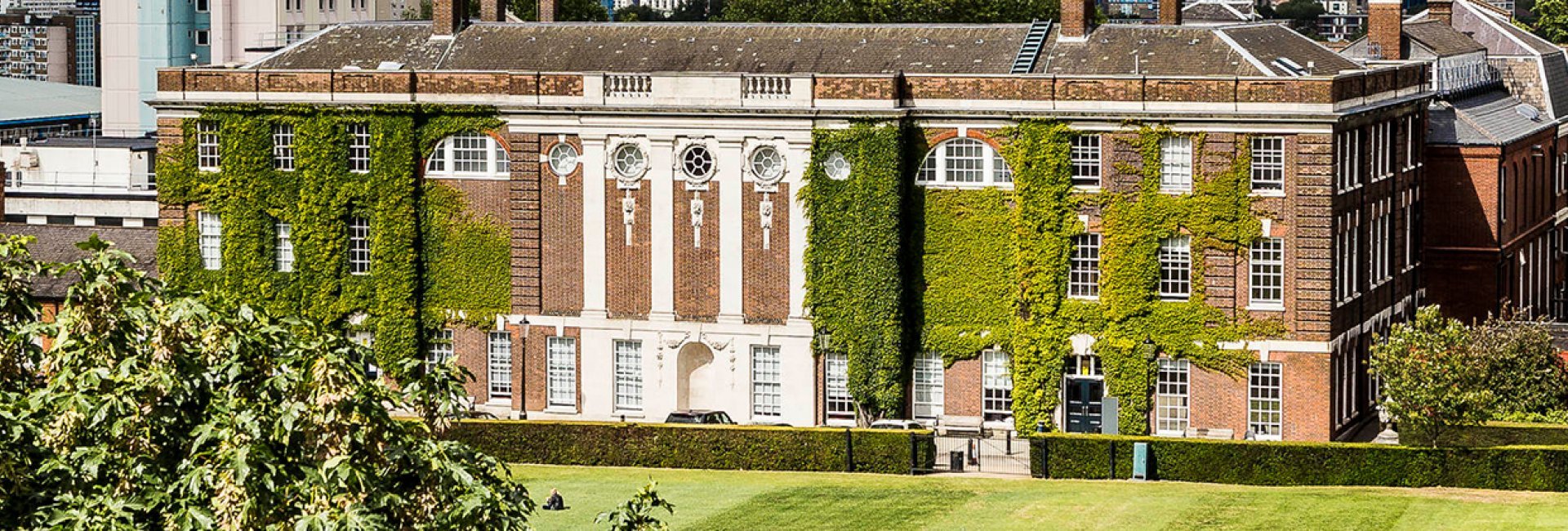
Goldsmiths, University of London - Virtual Campus Tour
25 Nov 2025, 12:00
London

This degree programme introduces you to sociological ways of thinking about the world around you and will give you the resources to think critically and creatively about a wide range of contemporary social issues.
Why study BA Sociology (with Integrated Foundation Year) at Goldsmiths
Sociology at Goldsmiths is internationally renowned for its inventive and imaginative approach to studying Sociology
If you do not have the required qualifications for degree-level study, our BA Sociology (with Integrated Foundation Year) offers an alternative entry route.
The Foundation Year is closely aligned with our undergraduate programmes, teaching you a foundational knowledge of the subject and helping you develop the necessary academic skills. You will select the undergraduate degree you wish to study at the point of application but are able to change as you progress through the foundation pathway if your interests change
Learn about different sociological theories including life course sociology, cultural sociology, and material culture. An understanding of these theories will leave you well-placed to continue on to our sociology degree programmes
You’ll study contemporary local and global events to explore diverse issues, such as:
how social inequalities operate and how they might be overcome
how concepts of citizenship and human rights are contested
how social and technological practices impact health
how historical processes such as colonialism continue to shape today’s societies
how the climate crisis requires us to develop new ways of thinking and acting.
Discover how history, gender, race, and class shape our lives
We help you to discover the type of sociologist you want to be. You’ll ‘get messy’ with hands-on research methods modules after your Foundation Year. In your final year, you’ll design and carry out your own research project based on your own interests. Recent projects ranged from Social Influencers as Digital Capitalists, to Conventional Beauty Standards and Black Women’s Hair Practices.
After successfully passing your Foundation Year, you'll tailor your journey from your Year 1 by choosing from a wide range of option modules. Our options are grouped together under three research-led pathways meaning you'll be working directly with experts on Culture, Identity & Inequalities; Law, Rights & Justice; and Health Environment & Global Change. You'll also have the opportunity to do a work placement and to take a module in another department
Learn directly from experts in small cohorts, so you won't just be a face in the crowd
Our staff are specialists and pioneers in their fields. They write the books that are on reading lists across the country, and you’ll be working with them directly
Gain both subject-specific and transferable skills to prepare for undergraduate study and to enhance your career prospects
Have the chance to continue your learning off-campus through possible visits to museums, archives or other cultural organisations to enrich your studies in the classroom
Join our Sociology Society to be part of a forward-thinking community of students, and get involved in the academic life of the College by attending talks, events and film screenings
Develop your academic skills by learning how to effectively communicate information, arguments, and analysis in written form. You will learn how to successfully deploy techniques such as source evaluation, critical judgment and referencing
Year 0 Foundation Year
Alongside direct preparation for an undergraduate degree in Sociology, you will take two modules with our Centre for Academic Language and Literacies (CALL). These modules will help you develop the broader academic and research skills required for undergraduate study.
You'll take these modules:
Reading and Writing Your World
Building Your Research World
Culture and Society in Postwar Britain
Our Lives through Objects
Empires, Nations and Lines on the Map: Postcolonial Perspectives on Global History
Year 1
You'll take the following compulsory modules.
Methods of Worldmaking 1
Modern Knowledge, Modern Power
Critical Readings: the Emergence of the Sociological Imagination 1A
Culture and Society
Critical Readings: the Emergence of the Sociological Imagination 1B
Culture and Society B
Year 2
You will take the following compulsory modules:
Methods of Worldmaking 2
Philosophy and Methodology of the Social Sciences
Central Issues in Sociological Analysis
The Goldsmiths Elective
Optional modules
You also choose 3 Sociology options. Those recently available have included:
Law and Contemporary Society
Crimes Against Humanity
Social Change and Political Action
London
Food and Taste
Knowledge and Subjectivity
Gender, ‘Race’ and Crime
Year 3
You will take the following compulsory modules:
Dissertation
Confronting climate crisis
Identity and Contemporary Social Theory
Optional modules
You'll then take 4 optional modules, which can include a Sociology Work Placement (if not taken in year 2).
Optional modules change on an annual basis, and recent options have included:
Race, Racism and Social Theory
Law, Identity and Ethics
Globalisation, Crime and Justice
Crimes of the Powerful
Privacy, Surveillance and Security
Visual Explorations of the Social World
Childhood Matters: Society, Theory and Culture
Thinking Animals
Migration, Gender and Social Reproduction
Please note that due to staff research commitments not all of these modules may be available every year.
You’ll be assessed by a variety of methods that broaden your academic skillset depending on your module choices . These include coursework assignments such as essays, presentations, critical commentaries, and personal reflections as well as seen examinations.
This is the equal consideration deadline. You can still apply after this date, but your application may not receive guaranteed consideration.

Goldsmiths, University of London has participated in the Teaching Excellence Framework. These ratings were awarded in 2023, for four years.
See why these ratings were awarded
What does this TEF outcome mean?
The following entry points are available for this course:
You are also required to have achieved a Level 2 qualification in GCSE English at Grade 4 or above.
For candidates who have not studied any Level 3 qualifications in the last two years, there are no formal qualifications required for admission, but you will need to demonstrate that you can benefit from the programme by undertaking an additional admissions process. This may involve an interview or request for the submission of written information used to assess suitability to study.
We’ll pay particularly careful attention to your personal statement, which is your opportunity to demonstrate your interest in the subject you’ve applied for. Your referees are also welcome to include any relevant contextual comments around your academic achievements. We’ll look at all these things when making a decision on your application, as well as your qualifications and grades.
This section shows the range of grades students (with UK A-Levels or Pearson BTEC Level 3 National Extended Diplomas) who received offers were previously accepted with (learn more). It is designed to support your research but does not guarantee whether you will or won't get a place. Admissions teams consider various factors, including interviews, subject requirements, and entrance tests. Check all course entry requirements for eligibility.
We are unable to show previous accepted grades for this course. This could be because the course is new, it's a postgraduate course, there isn't enough historical data, or the provider has opted out of sharing their entry grades data for this course - learn more.
No fee information has been provided for this course
Tuition fee status depends on a number of criteria and varies according to where in the UK you will study. For further guidance on the criteria for home or overseas tuition fees, please refer to the UKCISA website.
To find out more about fees and funding, please check our undergraduate fees guidance or contact the Fees Office https://www.gold.ac.uk/ug/fees-funding/
New Cross
Lewisham
SE14 6NW
Visit our website Visit our course page
Email:course-info@gold.ac.uk
Phone:020 7078 5300
At Goldsmiths, University of London