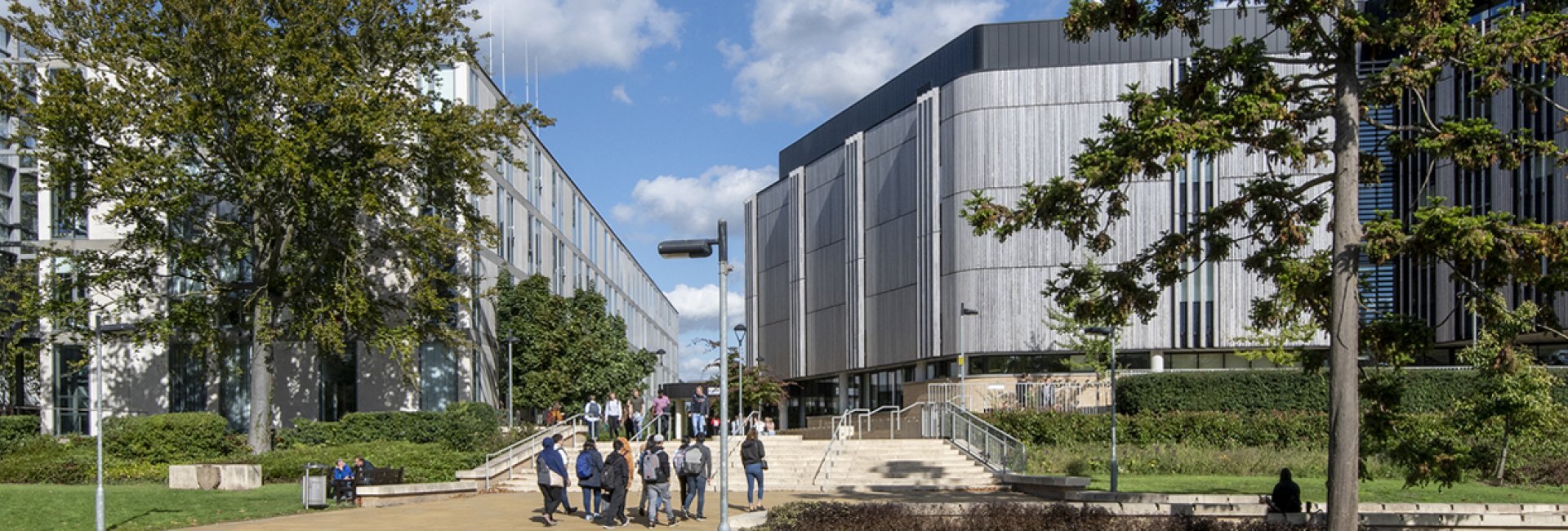
University of Southampton - Open Day
27 Jun 2026, 09:00
Southampton

This highly technical four-year MEng Electrical Engineering degree builds on the BEng programme and develops the cross-disciplinary skills you will need to tackle diverse advanced engineering topics from bionanotechnology through to high voltage engineering. We will provide you with the analytical skills to design and develop the technology of tomorrow using our outstanding experimental facilities, including our high-voltage laboratory. Individual project work with one of our research groups will allow you to work at the frontier of knowledge.
You’ll study in facilities with an unrivalled reputation. We have recently invested £8m in our teaching labs. We also have a £100m state-of-the-art interdisciplinary clean room complex and high-voltage laboratory.
You’ll be prepared to work in a wide variety of areas and fields; we have strong relationships with employers, and our graduates are particularly in demand for their understanding of organisations and their practical abilities in the workplace. We have our own Careers Hub website, run an annual careers fair and have a dedicated startup incubator, Future Worlds, to support student enterprise.
Our MEng Electrical and Electronic Engineering degrees are accredited by the Institution of Engineering and Technology (IET), and we are members of the UK Electronics Skills Foundation (UK-ESF) and IET Power Academy.
This four-year MEng programme will enable you to pursue a career in any area of the electrical engineering industry. It has been designed to maximise student choice by allowing you to tailor the degree structure to suit your own interests.
During the first two years you will undertake a series of core modules, for example Circuits, Electronic Systems, Programming, Digital Systems and Devices, Fields, Forces and Materials, and Mathematics.
In your third and fourth years you can choose from a wide range of optional modules that reflect the specialist areas of electrical engineering that will take you to the leading edge of technology sought by industry. You will also work on an individual project with one of our research groups which will allow you to work at the frontier of knowledge. This programme can also be offered with a year in industry .
For further details of our optional modules:
https://www.southampton.ac.uk/courses/electrical-engineering-degree-meng#modules
A range of assessment methods are used on this programme to enable students to demonstrate their achievement of the intended learning outcomes. These include written examinations and assessments, in-class tests, design exercises, programming exercises, oral presentations, assessed laboratories and group work exercises.
Professionally accredited courses provide industry-wide recognition of the quality of your qualification.
This is the equal consideration deadline. You can still apply after this date, but your application may not receive guaranteed consideration.

University of Southampton has participated in the Teaching Excellence Framework. These ratings were awarded in 2023, for four years.
See why these ratings were awarded
What does this TEF outcome mean?
The following entry points are available for this course:
Find out about equivalent entry requirements and qualifications for your country: https://www.southampton.ac.uk/uni-life/international/your-country.page
A*AA including mathematics (minimum grade A) and either physics, electronics or further mathematics (minimum grade A).
A pass in the science Practical is required where it is separately endorsed. Offers typically exclude General Studies and Critical Thinking. Applicants who have not studied the required subjects at A-level can apply for the Engineering/Physics/Mathematics Foundation Year.
If you are taking an EPQ in addition to 3 A levels, you will receive the following offer in addition to the standard A level offer: AAA including mathematics and either physics, electronics or further mathematics, plus grade A in the EPQ.
We are committed to ensuring that all applicants with the potential to succeed, regardless of their background, are encouraged to apply to study with us. The additional information gained through contextual data allows us to recognise an applicant's potential to succeed in the context of their background and experience. Applicants who are highlighted in this way will be made an offer which is lower than the typical offer for that programme.
We normally consider applicants who offer at least 1 Advanced Higher. Applicants presenting with only Highers will be considered on a case by case basis. Where Highers are taken over two years it might be expected that higher grades are achieved, particularly in any specific subjects required. For example, S5 – S6 (2 years): AABBB (A in specific subject) or S6 (1 year): ABBBB (A in specific subject).
Unless a more advanced level (Higher or Advanced Higher) is specified in the stated entry requirements, all applicants will be required to have achieved a pass in Mathematics and English at Standard Grade, Grade 3 or National 5, Grade C, the equivalent of GCSE Grade C/ Grade 4"
We are committed to ensuring that all learners with the potential to succeed, regardless of their background, are encouraged to apply to study with us. The additional information gained through contextual data allows us to recognise a learner's potential to succeed in the context of their background and experience. Applicants who are highlighted in this way will be made an offer which is lower than the typical offer for that programme.
D in the BTEC National Extended Certificate plus grades AA from two A-levels including mathematics and either physics, electronics or further mathematics or D in the BTEC National Extended Certificate plus grades AA from two A-levels including mathematics and either physics, electronics or further mathematics.
A pass in the science Practical is required where it is separately endorsed. Offers typically exclude General Studies and Critical Thinking. Applicants who have not studied the required subjects at A-level can apply for the Engineering/Physics/Mathematics Foundation Year.
We are committed to ensuring that all learners with the potential to succeed, regardless of their background, are encouraged to apply to study with us. The additional information gained through contextual data allows us to recognise a learner’s potential to succeed in the context of their background and experience. Applicants who are highlighted in this way will be made an offer which is lower than the typical offer for that programme.
D in the Pearson BTEC Subsidiary Diploma (QCF) plus grades AA from two A-levels including mathematics and either physics, electronics or further mathematics or D in the Pearson BTEC Subsidiary Diploma (QCF) plus grades AA from two A-levels including mathematics and either physics, electronics or further mathematics.
A pass in the science Practical is required where it is separately endorsed. Offers typically exclude General Studies and Critical Thinking. Applicants who have not studied the required subjects at A-level can apply for the Engineering/Physics/Mathematics Foundation Year.
We are committed to ensuring that all learners with the potential to succeed, regardless of their background, are encouraged to apply to study with us. The additional information gained through contextual data allows us to recognise a learner’s potential to succeed in the context of their background and experience. Applicants who are highlighted in this way will be made an offer which is lower than the typical offer for that programme.
Offers will be based on exams being taken at the end of S6. Subjects taken and qualifications achieved in S5 will be reviewed. Careful consideration will be given to an individual’s academic achievement, taking in to account the context and circumstances of their pre-university education. Please see the University of Southampton’s Curriculum for Excellence Scotland Statement for further information. Applicants are advised to contact their Faculty Admissions Office for more information.
Pass, with 38 points overall with 19 points required at Higher Level including 6 at Higher Level in Mathematics (Analysis and Approaches) or 7 at Higher Level in Mathematics (Applications and Interpretation), and 6 at Higher Level in physics.
Applicants who have not studied the required subjects at Higher Level can apply for the Engineering/Physics/Mathematics Foundation Year.
We are committed to ensuring that all learners with the potential to succeed, regardless of their background, are encouraged to apply to study with us. The additional information gained through contextual data allows us to recognise a learner’s potential to succeed in the context of their background and experience. Applicants who are highlighted in this way will be made an offer which is lower than the typical offer for that programme.
Offers will be made on the individual Diploma Course subject(s) and the career-related study qualification. The CP core will not form part of the offer. Where there is a subject pre-requisite(s), applicants will be required to study the subject(s) at Higher Level in the Diploma course subject and/or take a specified unit in the career-related study qualification. Applicants may also be asked to achieve a specific grade in those elements. Please see the University of Southampton International Baccalaureate Career-Related Programme (IBCP) Statement for further information. Applicants are advised to contact their Faculty Admissions Office for more information.
AAA including mathematics (minimum grade A) and either physics, electronics or further mathematics (minimum grade A)
or
AA from two A-levels including mathematics and either physics, electronics or further mathematics, and A from the Advanced Skills Baccalaureate Wales.
A pass in the science Practical is required where it is separately endorsed. Offers typically exclude General Studies and Critical Thinking. Applicants who have not studied the required subjects can apply for the Engineering/Physics/Mathematics Foundation Year.
AAA including mathematics (minimum grade A) and either physics, electronics or further mathematics (minimum grade A) or AA from two A-levels including mathematics and either physics, electronics or further mathematics, plus A from the Advanced Welsh Baccalaureate Skills Challenge Certificate.
A pass in the science Practical is required where it is separately endorsed. Offers typically exclude General Studies and Critical Thinking. Applicants who have not studied the required subjects at A-level can apply for the Engineering/Physics/Mathematics Foundation Year.
We are committed to ensuring that all learners with the potential to succeed, regardless of their background, are encouraged to apply to study with us. The additional information gained through contextual data allows us to recognise a learner’s potential to succeed in the context of their background and experience. Applicants who are highlighted in this way will be made an offer which is lower than the typical offer for that programme.
If you are taking an EPQ in addition to 3 A levels, you will receive the following offer in addition to the standard A level offer: AAA including mathematics and either physics, electronics or further mathematics, plus grade A in the EPQ.
A pass in the science Practical is required where it is separately endorsed. Offers typically exclude General Studies and Critical Thinking. Applicants who have not studied the required subjects at A-level can apply for the Engineering/Physics/Mathematics Foundation Year.
H1 H1 H1 H2 H2 H2 including mathematics, applied mathematics and physics
D2, D3, D3 in three Principal subjects including mathematics and either physics or further mathematics.
Cambridge Pre-U's can be used in combination with other qualifications such as A levels to achieve the equivalent of the typical offer, where D2 can be used in lieu of A-level grade A* or grade D3 can be used in lieu of A-level grade A. Applicants who have not studied the required Principal subjects can apply for the Engineering/Physics/Mathematics Foundation Year.
We are committed to ensuring that all learners with the potential to succeed, regardless of their background, are encouraged to apply to study with us. The additional information gained through contextual data allows us to recognise a learner’s potential to succeed in the context of their background and experience. Applicants who are highlighted in this way will be made an offer which is lower than the typical offer for that programme.
Applicants must hold GCSE English language (or GCSE English) (minimum grade 4/C) and mathematics (minimum grade 4/C)
If you are not sure that your qualifications meet the requirements of this course please contact our Admissions Teams.
Find out more about qualification requirements for this course.
| Test | Grade | Additional details |
|---|---|---|
| IELTS (Academic) | 6.5 | with no component below 6.0 |
Find out more about the University’s English Language requirementshttps://www.southampton.ac.uk/studentadmin/admissions/admissions-policies/language.page
Most of the students who previously enrolled on this course joined us with grades lower than our published entry criteria. After receiving their grades, we carefully considered each students’ individual circumstances before confirming their place on their chosen course.
We encourage everyone with the potential to succeed to apply, regardless of their background. Applicants who qualify for contextual admissions will be made an offer lower than the typical offer for that programme.
This section shows the range of grades that students who received offers were previously accepted on to this course with (learn more).
It is designed to support your research but does not guarantee whether you will or won't get a place.
Admissions teams consider various factors, including interviews, subject requirements, and entrance tests. Check all course entry requirements for eligibility.
We are unable to show previous accepted grades for this course. This could be because the course is new, it's a postgraduate course, there isn't enough historical data, or the provider has opted out of sharing their entry grades data for this course - learn more.
| Location | Fee | Year |
|---|
* This is a provisional fee and subject to change.
Tuition fee status depends on a number of criteria and varies according to where in the UK you will study. For further guidance on the criteria for home or overseas tuition fees, please refer to the UKCISA website.
Please see our website for further details and updates: www.southampton.ac.uk/uni-life/fees-funding.page
At University of Southampton