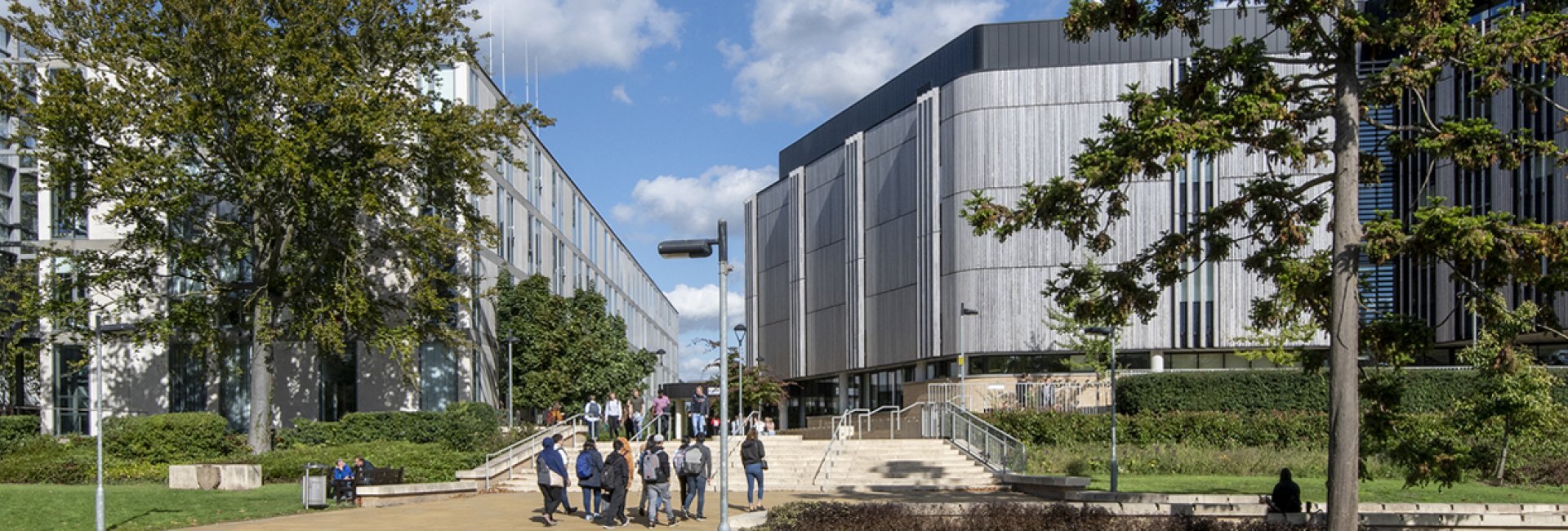
Winchester School of Art - Open Day
6 Jun 2026, 09:00
Winchester

About this course
Geography can be used to understand the complexities of our world. On your three-year BA Geography degree you'll learn how economic, social, and cultural processes affect health and wellbeing and will study human-environment relations and the market-economy.
You'll study both human and physical geography whilst specialising in human geography issues in higher years. This will appeal to you if you have a preference for human geography whilst also
enjoying the breadth of the discipline. You'll learn to use tools such as Geographical Information Systems (GIS) to explore the similarities, differences, and challenges of people living across our inter-connected planet and will be able to adapt your degree programme to fit your interests and academic passions. You'll graduate with the skills and experiences needed to excel in your career, joining recent graduates who now work in careers including public policy, teaching, environmental consultancy, financial services, retail, marketing, town-planning, GIS-related and government advisory roles.
Key features of the course:
Travel to a location such as Amsterdam for your optional year two residential field course (included in course fees)
Embark on further optional overseas field courses in the diverse and unique environments that European, southeast Asian, and south African locations offer
Benefit from a highly flexible degree, enabling you to tailor your module choices to your interests, with the option to swap between the BA and BSc Geography degrees after the first year.
Join a University where 100% of our Geography graduates were in employment or further study 15 months after graduation, with 90% in professional destinations (Graduate Outcomes 2022/2023).
Student support
Your Personal Academic Tutor will work with you throughout your degree. They will act as your first point of contact for pastoral support. They will also help you decide on optional modules, and discuss your future career plans.
The degree is orientated to employability, and your core modules and assessments are aligned with the needs and practices of the professional sector. You can further enhance your degree by working in paid internships, completing a minor, studying abroad for a semester, and/or doing a year in employment.
Further information
This course is open to UK and international applicants and is accredited by the Royal Geographical Society.
We have a mix of physical and human geography modules with specialisation in human geography in the higher years. From year 2 you will be able to tailor your degree with a range of optional modules not only from geography but from across the university, depending on your interest.
Year 1: An introduction to the foundation of Human and Physical geography topics, understanding global processes, landscapes, hazards alongside developing core study skills, basic research techniques and field experience.
Year 2: Develop knowledge on various subfields of human geography, such as wellbeing, health, economies, cultural and urban geography, with dedicated research training integrating GIS tools, and the option to go to Amsterdam. You have the option to take two modules in physical geography or from outside geography, covering a wide range of subjects.
Year 3: Develop specialisation from social justice, migration, creative economy to climate change, hazards, food security and health, alongside optional fieldtrips to International destinations. Delve into an independent research project to advance your enquiry in a specialised subfield of geography. You have the option to take two modules in human geography or from outside geography, covering a wide range of subjects.
The full list of modules is available on the course page on our website.
Your learning is delivered, and assessed, through a wide range of methods to ensure you develop a broad variety of skills that will set you up for success after graduation.
The learning activities for this course include lectures, classes and tutorials and coursework.
We’ll assess you through developing websites, essays, individual and group projects, oral presentations and written and practical exams.
Throughout, you'll be supported by a personal academic tutor, your peers, and have access to a senior tutor.
This is the equal consideration deadline. You can still apply after this date, but your application may not receive guaranteed consideration.

University of Southampton has participated in the Teaching Excellence Framework. These ratings were awarded in 2023, for four years.
See why these ratings were awarded
What does this TEF outcome mean?
The following entry points are available for this course:
GCSE :Applicants must hold GCSE English language (or GCSE English) (minimum grade 4/C) and mathematics (minimum grade 4/C).
Find out more about qualification requirements for this course.
| Test | Grade | Additional details |
|---|---|---|
| IELTS (Academic) | 6.5 | Band C: 6.5 with 6.0 in each component |
Find out more about the University’s English Language requirements https://www.southampton.ac.uk/studentadmin/admissions/admissions-policies/language.page
Most of the students who enrolled on this course in previous years met their offer conditions at our published entry criteria, securing their place on their chosen course. We encourage all applicants with the potential to succeed, regardless of their background, to apply to study with us. Applicants who qualify for contextual admissions will be made an offer which is lower than the typical offer for that programme.
This section shows the range of grades students (with UK A-Levels or Pearson BTEC Level 3 National Extended Diplomas) who received offers were previously accepted with (learn more). It is designed to support your research but does not guarantee whether you will or won't get a place. Admissions teams consider various factors, including interviews, subject requirements, and entrance tests. Check all course entry requirements for eligibility.
We are unable to show previous accepted grades for this course. This could be because the course is new, it's a postgraduate course, there isn't enough historical data, or the provider has opted out of sharing their entry grades data for this course - learn more.
| Location | Fee | Year |
|---|---|---|
| England | £9535* | Year 1 |
| Northern Ireland | £9535* | Year 1 |
| Scotland | £9535* | Year 1 |
| Wales | £9535* | Year 1 |
| Channel Islands | £9535* | Year 1 |
| Republic of Ireland | £9535* | Year 1 |
| EU | £31000 | Year 1 |
| International | £31000 | Year 1 |
* This is a provisional fee and subject to change.
Tuition fee status depends on a number of criteria and varies according to where in the UK you will study. For further guidance on the criteria for home or overseas tuition fees, please refer to the UKCISA website.
Please see our website for further details and updates: www.southampton.ac.uk/uni-life/fees-funding.page
Highfield
Southampton
SO17 1BJ
Visit our website Visit our course page
Email:admissions@soton.ac.uk
Phone:023 8059 4732
Email:AdmissionsUG.ELS@soton.ac.uk
Phone:023 8059 4732
At University of Southampton