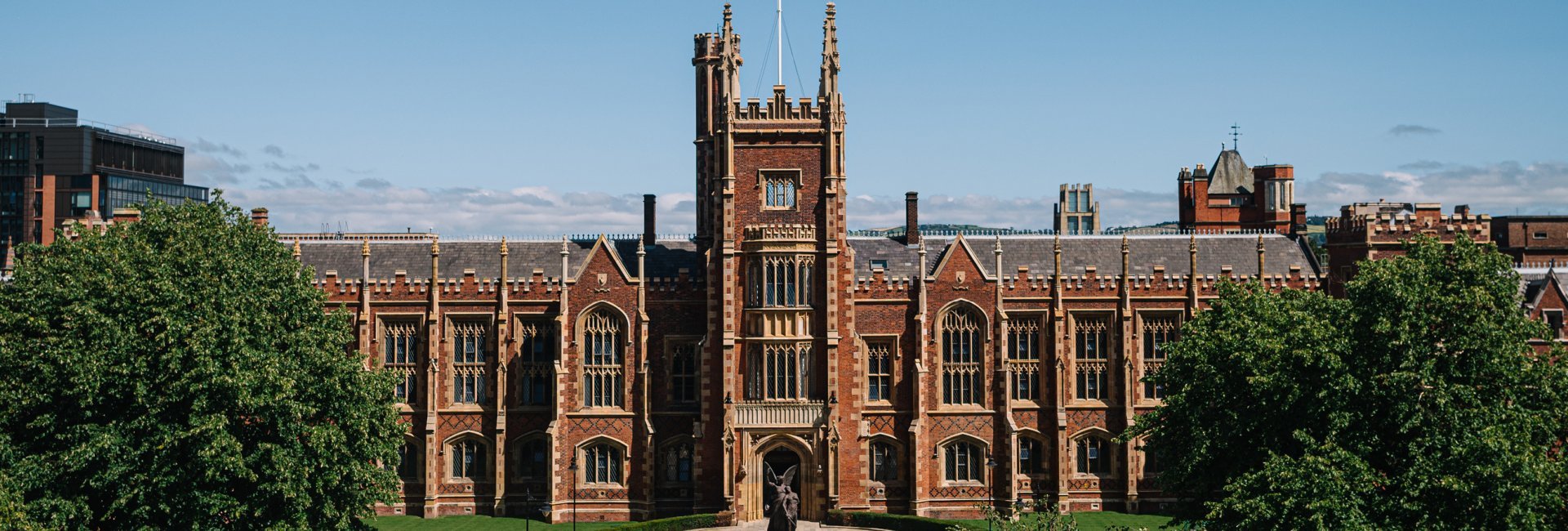
Queen's University Belfast
University Road
Belfast
BT7 1NN
Course contact details
Admissions and Access Service
Email:admissions@qub.ac.uk
Phone:028 9097 3838

This Programme is designed to enable students to gain an understanding of the multi-disciplinary field of Education, and of patterns of social life and social change more broadly. The course structure offers a broad and balanced curriculum of research-informed modules which are firmly rooted in the disciplines of education and sociology. Students will become critical thinkers who can engage with theoretical knowledge and research evidence from education, sociology, and related fields, with relevance to the United Nations Sustainable Development Goals, both locally and globally. This includes the development of discipline-specific skills such as the ability to draw on a range of primary and secondary sources, and to analyse data.
Graduates will be equipped with advanced skills in analysing and evaluating complex issues within and across educational and social systems. They will become familiar with methodologies relevant to investigating problems and identifying best practice across social contexts, including education. Students will have opportunities to gain experiences within organisations across civil society and in a range of education and related sectors. Teaching is embedded within a strong research culture, which is supported by the School’s research centres and networks. Curriculum and assessment for each module is tailored to provide learners with knowledge and skills which will prepare them to pursue careers across education and sociology, as well as related fields. Our graduates will be equipped to undertake social research from sociological and educational perspectives, and will have the ability to support the ambitions of a whole range of organisations in these areas.
To work as a teacher at a state school in England or Wales, you will need to achieve qualified teacher status (QTS). This is offered on this course for the following level:
The following entry points are available for this course:
Find out more about qualification requirements for this course.
This section shows the range of grades students (with UK A-Levels or Pearson BTEC Level 3 National Extended Diplomas) who received offers were previously accepted with (learn more). It is designed to support your research but does not guarantee whether you will or won't get a place. Admissions teams consider various factors, including interviews, subject requirements, and entrance tests. Check all course entry requirements for eligibility.
We are unable to show previous accepted grades for this course. This could be because the course is new, it's a postgraduate course, there isn't enough historical data, or the provider has opted out of sharing their entry grades data for this course - learn more.
| Location | Fee | Year |
|---|---|---|
| England | £9250* | Year 1 |
| Scotland | £9250* | Year 1 |
| Wales | £9250* | Year 1 |
| Channel Islands | £9250* | Year 1 |
| Northern Ireland | £4750 | Year 1 |
| Republic of Ireland | £4750 | Year 1 |
| EU | £20800 | Year 1 |
| International | £20800 | Year 1 |
* This is a provisional fee and subject to change.
Tuition fee status depends on a number of criteria and varies according to where in the UK you will study. For further guidance on the criteria for home or overseas tuition fees, please refer to the UKCISA website.
The tuition fees quoted above for NI and ROI are the 2024/25 fees and will be updated when the new fees are known. In addition, all tuition fees will be subject to an annual inflationary increase in each year of the course. Fees quoted relate to a single year of study unless explicitly stated otherwise.
Further information on Fees and Funding can be found at: https://www.qub.ac.uk/Study/Feesandfinance/.
University Road
Belfast
BT7 1NN
Email:admissions@qub.ac.uk
Phone:028 9097 3838
At Queen's University Belfast