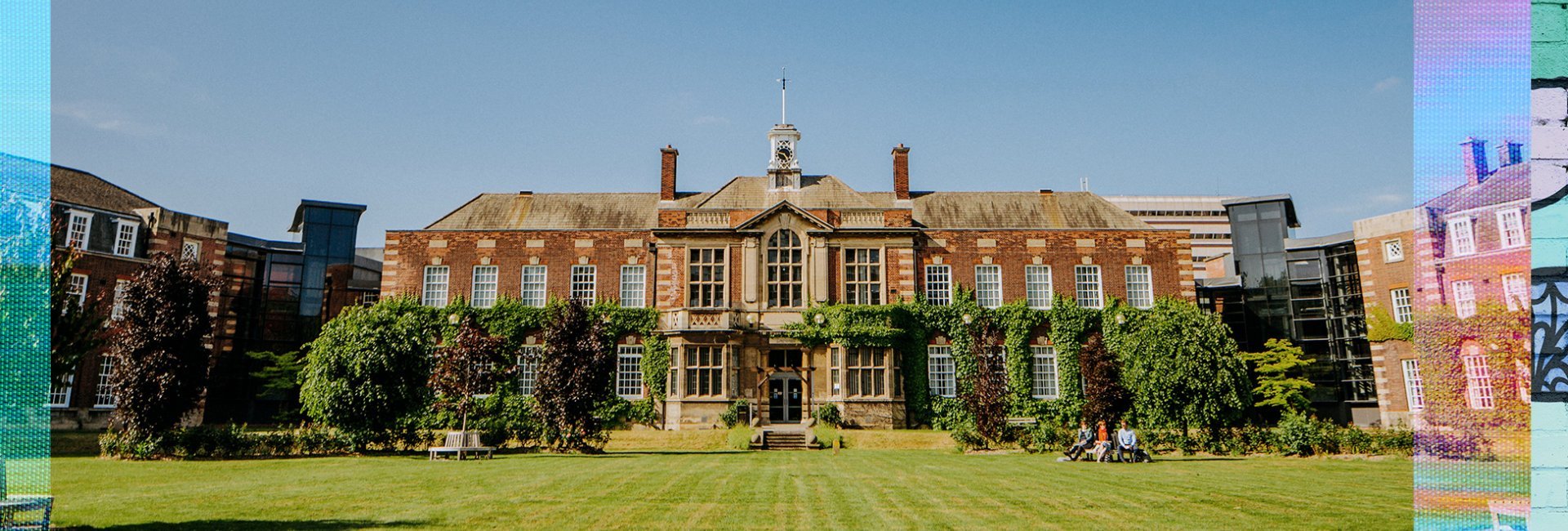
University of Hull - Open Day Event - 11th July 2026
11 Jul 2026, 09:00
Kingston upon Hull

Our fully accredited degree builds on your theoretical and mathematical talent. Study fundamental physics and maths, and develop investigative skills for exploring new areas in science, technology, and business.
Research opportunities include advanced materials, lasers, and space, tackling significant scientific queries. You’ll also learn transferable data science skills like Python programming, and improve communication, teamwork, and problem-solving skills.
Receive personalised tutorials and feedback from top academics and take part in over 100 annual events. Plus, join a diverse student community and explore career options through the White Rose Industrial Physics Alliance.
Why study at Hull?
Supercomputing: You’ll have access to Viper – the highest-spec computer at any university in the North of England
Diverse student population: Our physics courses have some of the most diverse student populations in the country thanks to our award-winning Changing Face of Physics Campaign
Institute of Physics accredited: We’re part of the professional body for physics in the UK and Ireland, putting you on track to receive Chartered Physicist status
Where could this take me?
Graduating from Hull’s theoretical physics degree opens doors to a variety of careers in research, telecommunications, IT, education, data science, engineering, medical physics, nuclear technology, media, and finance. Our alumni work at companies like Rolls-Royce, Thales, and QinetiQ, or join training programs at the National Grid and NHS. This degree puts you on the pathway to become a Chartered Physicist, offering opportunities for advanced studies and rewarding careers in research and industry.
Core modules include:
Experimental and Computational Methods for Physics
Astronomy and Optics
Properties of Matter and Concepts in Quantum Mechanics
Statistical Physics, Thermodynamics and Special Relativity
Scientific Computing and Advanced Quantum Mechanics
Optional modules include:
Nuclear Physics and Elementary Particles
Differential Geometry and Topology
Extreme Astrophysics
Lasers, Superconductivity and Magnetism
Nanophysics
You'll be assessed through a combination of written, practical and coursework assessments throughout your degree.
Written assessment typically includes exams and multiple choice tests.
Practical is an assessment of your skills and competencies. This could include presentations, school experience, work experience or laboratory work.
Coursework typically includes essays, written assignments, dissertations, research projects or producing a portfolio of your work.
Professionally accredited courses provide industry-wide recognition of the quality of your qualification.
This is the equal consideration deadline. You can still apply after this date, but your application may not receive guaranteed consideration.

University of Hull has participated in the Teaching Excellence Framework. These ratings were awarded in 2023, for four years.
See why these ratings were awarded
What does this TEF outcome mean?
The following entry points are available for this course:
Points can be from any qualification on the UCAS tariff, but must include at least 80 points from
A levels
BTEC Subsidiary Diploma, Diploma or Extended Diploma
OCR Cambridge Technical Introductory Diploma, Diploma or Extended Diploma
CACHE Diploma or Extended Diploma
Irish Leaving Certificate
Scottish Highers
Welsh Baccalaureate Advanced Diploma
or a combination of appropriate Level 3 qualifications
B in Maths and B in Physics including a pass in the practical element
Pass Access to HE Diploma overall with a minimum 118 UCAS tariff points including a minimum of 18 credits at Merit in Maths and 18 credits at Merit in Physics
Including grade 6 in Higher Level Maths and grade 6 in Higher Level Physics
Only acceptable if studied in addition to A level Physics and Maths at grade B
Applicants with other qualifications are welcome to apply.
| Test | Grade | Additional details |
|---|---|---|
| IELTS (Academic) | 6 | This course requires IELTS 6.0 overall, with at least 5.5 in each skill. For other English language proficiency qualifications accepted by the University please visit www.hull.ac.uk |
| Institution's Own Test | 60% overall (with minimum 55% in each skill) |
Please click below for a list of the English language qualifications we accept.https://www.hull.ac.uk/Choose-Hull/Study-at-Hull/Admissions/English-language-requirements.aspx
We’re helping more people to find their extraordinary.
Students often face barriers that make it more difficult for them to access higher education. That’s why we’ve introduced our contextual offers. By providing offers that take your background and experiences into account, we are helping to break down those barriers for all aspiring university students.
This section shows the range of grades that students who received offers were previously accepted on to this course with (learn more).
It is designed to support your research but does not guarantee whether you will or won't get a place.
Admissions teams consider various factors, including interviews, subject requirements, and entrance tests. Check all course entry requirements for eligibility.
We are unable to show previous accepted grades for this course. This could be because the course is new, it's a postgraduate course, there isn't enough historical data, or the provider has opted out of sharing their entry grades data for this course - learn more.
| Location | Fee | Year |
|---|
Tuition fee status depends on a number of criteria and varies according to where in the UK you will study. For further guidance on the criteria for home or overseas tuition fees, please refer to the UKCISA website.
No additional fees or cost information has been supplied for this course, please contact the provider directly.
Email:study@hull.ac.uk
Phone:01482 466100
Admissions Office
Cottingham Road
Hull
HU6 7RX
At University of Hull