Course contact details
Course enquiries
Phone:01273 644644
University of Brighton
Mithras House
Lewes Road
Brighton
BN2 4AT

Our Architecture BA(Hons) degree, validated by the Royal Institute of Architects (RIBA), provides the first step in qualifying as a professional architect in the UK and overseas and prepares you for many different roles within the architectural and design field.
At Brighton you’ll be part of a community that helps you grow, no matter what your background. Our integrated foundation year course offers an extra year to prepare you for study at degree level.
This degree gives you the design, technical and critical-thinking skills to turn your ideas into spaces that respond to real-world challenges. You’ll also take part in field trips, public exhibitions and our end-of-year show, graduating with the confidence and experience for Part 2 study. Our inclusive approach to learning will help you go further; we’ll make sure you play to your strengths and learn in ways that suit you best.
Brighton graduates have gone into both local and internationally renowned practices. These include Norman Foster/Foster + Partners – one of the world’s most influential practices and designer of the Millenium Bridge and the iconic 30 St Mary Axe (Gherkin) building – as well as Rogers Stirk Harbour + Partners (Richard Rogers) and David Chipperfield Architects.
Top reasons to choose this course
Foundation year that offers a route into architecture if you don’t have the required qualifications, are changing career or returning to study.
Explore architectural thinking across design, history, theory, technology and sustainability.
Study a degree validated by the Royal Institute of British Architects (RIBA) so when you graduate you’ll have completed the first stage to becoming a qualified architect both in the UK and internationally.
Prepare for practice through mentoring and mock interviews with professionals from RIBA South East and a degree that’s aligned to the Architects Registration Board (ARB).
Work on live briefs and community projects and build a portfolio to impress future employers.
Collaborate in our studio space with students from all years of the course and develop your creative voice.
Showcase your work throughout the course and in the end-of-year show.
Design with sustainability, wellbeing and community impact in mind with real-world projects focused on the climate crisis, housing shortage and forced displacement.
Get hands-on experience from day one in the workshop and studio to develop your physical modelling skills, supported by our brilliant technicians.
Develop your digital design skills using industry-standard software including Revit, Rhino and Grasshopper.
Access our specialist facilities which include model-making and construction workshops, photographic studios, laser cutting and 3D printing and rapid prototyping.
Why Brighton is a great place to study Architecture
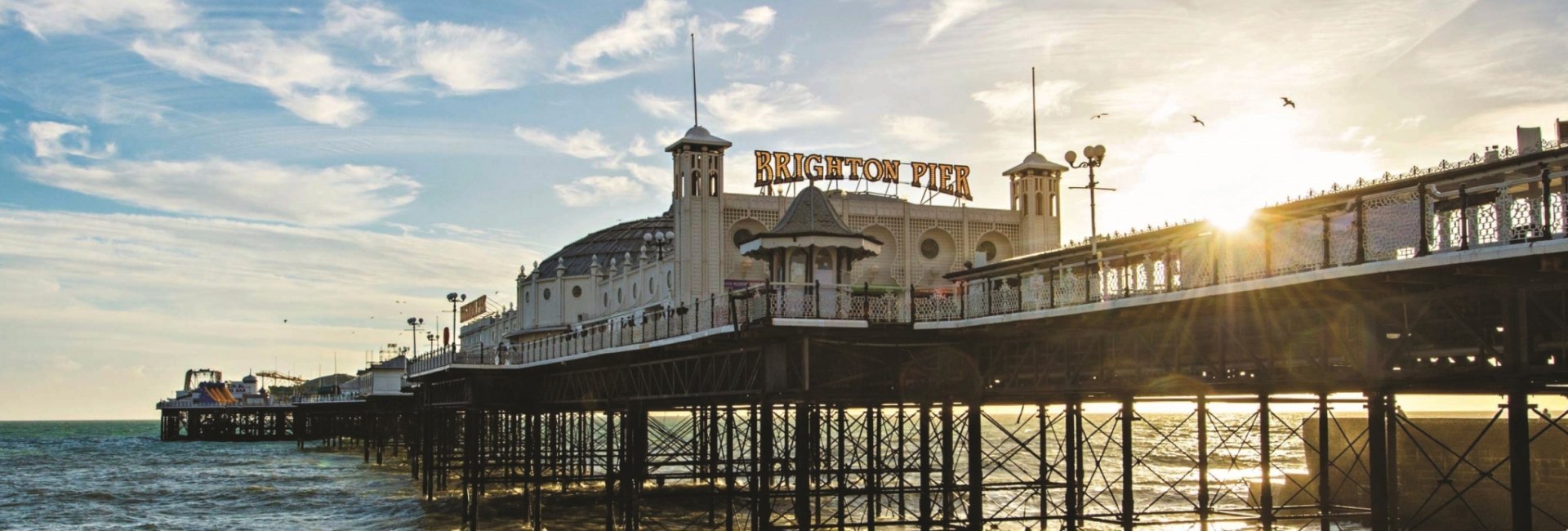
Brighton & Hove is a creative city with a progressive design culture that values sustainability and community. It’s where historic architecture meets contemporary design – perfect for testing ideas in real contexts.
Named one of the best cities on the planet and the third best city in the UK by Time Out, Brighton is just under an hour from central London and the capital’s global architecture practices.
Foundation year
Term 1 will focus on analogue skills, introducing you to observational and hand-drawing skills as well as physical/3D modelling techniques, enabling you to understand different scales.
In term 2, you’ll build on the skills you’ve learned and combine these with digital practice. You’ll be introduced to digital drawing, modelling and fabrication, and representation and communication techniques. Projects will develop your knowledge of the design process and your technical ability.
Term 3 focuses on a final project within your chosen discipline and course. You’ll produce a portfolio where you’ll document your development and your final design project. The project will be specific to your discipline and draw together all the skills learnt over the year, preparing you for your degree. It will include physical hand drawings, photography, models, digital work and discipline-specific outputs.
Year 1
You’ll build the core skills of architecture – from drawing and model-making to spatial thinking and digital design. Through design projects and critical study, you will learn how culture, technology and sustainability shape meaningful places.
Core modules
Introducing Architecture
Architecture Criticism 1
Technology: Principles
Architectural Design
Year 2
You’ll deepen your design thinking by responding to real contexts – from retrofit and reuse to user needs and locality. Through studio projects, technology strategies and critical research, you will learn to shape sustainable architecture that engages with global social and environmental challenges.
Core modules
Design Studio: Context
Technology: Strategies
Vertical Design Studio 1
Architecture Criticism 2
Final year
You will work on a design project incorporating technological strategies and detailed drawings of your proposal. You’ll integrate technological strategies with the design project, addressing environmental performance, material selection, construction methods, structure and sustainable design. Through a self-directed research project, you’ll be able to focus on a specific subject, theme or issue within the field of architecture which is of particular interest to you so you can identify areas you want to specialise in. Your studies will culminate in your final project which you will showcase at the graduate show.
Core modules
Design and Technology
Architecture Criticism 3
Professional Practices
Vertical Design Studio 2
This is the equal consideration deadline. You can still apply after this date, but your application may not receive guaranteed consideration.

University of Brighton has participated in the Teaching Excellence Framework. These ratings were awarded in 2023, for four years.
See why these ratings were awarded
What does this TEF outcome mean?
The following entry points are available for this course:
Level 3 Key Skills and General Studies will count towards the tariff.
| Test | Grade | Additional details |
|---|---|---|
| IELTS (Academic) | 6 | 6.0 overall with a minimum of 5.5. in each element, or equivalent English Language qualification. |
Review our English Language requirementshttps://www.brighton.ac.uk/international/applying-here/how-to-apply/english-language-requirements/index.aspx
At Brighton we recognise that not everyone's background provides the same advantages, and we know that grades are not the only indicator of potential.
If you meet our contextual admissions criteria we will make you an offer which is at least 16 UCAS points lower than our standard offer. You may also be eligible for additional financial and practical support from us through the Brighton Boost cost of living support package.
This section shows the range of grades that students who received offers were previously accepted on to this course with (learn more).
It is designed to support your research but does not guarantee whether you will or won't get a place.
Admissions teams consider various factors, including interviews, subject requirements, and entrance tests. Check all course entry requirements for eligibility.
We are unable to show previous accepted grades for this course. This could be because the course is new, it's a postgraduate course, there isn't enough historical data, or the provider has opted out of sharing their entry grades data for this course - learn more.
| Location | Fee | Year |
|---|
Tuition fee status depends on a number of criteria and varies according to where in the UK you will study. For further guidance on the criteria for home or overseas tuition fees, please refer to the UKCISA website.
Fees are payable each year and will increase annually in line with inflation.
Tuition fees for full-time UK / Home undergraduate students in academic year 2026–27
Annual course fees:
Honours degree £9,790
Placement year £1,958
Integrated foundation year (except the School of Business and Law) £9,790
Integrated foundation year in the School of Business and Law* £5,760*
*The £5,760 fee is for the foundation year only. Subsequent years are charged at the regulated undergraduate fee.
Many courses include the option of a salaried placement year. Tuition fees for a placement year are charged at a lower rate.
Regulated fees:
Tuition fees for UK / Home students on undergraduate courses in England are set by the UK government and are known as regulated fees. From academic year 2026–27 onwards, regulated fees will increase annually in line with forecast inflation. The regulated fee will be £9,790 in academic year 2026–27 and £10,050 in academic year 2027–28 (subject to parliamentary approval).
Standard tuition fees for full-time international students in academic year 2026–27:
Classroom-based courses £17,796–19,692
Laboratory or studio-based courses £17,796–19,692
Placement year £1,958
Phone:01273 644644
Mithras House
Lewes Road
Brighton
BN2 4AT
At University of Brighton