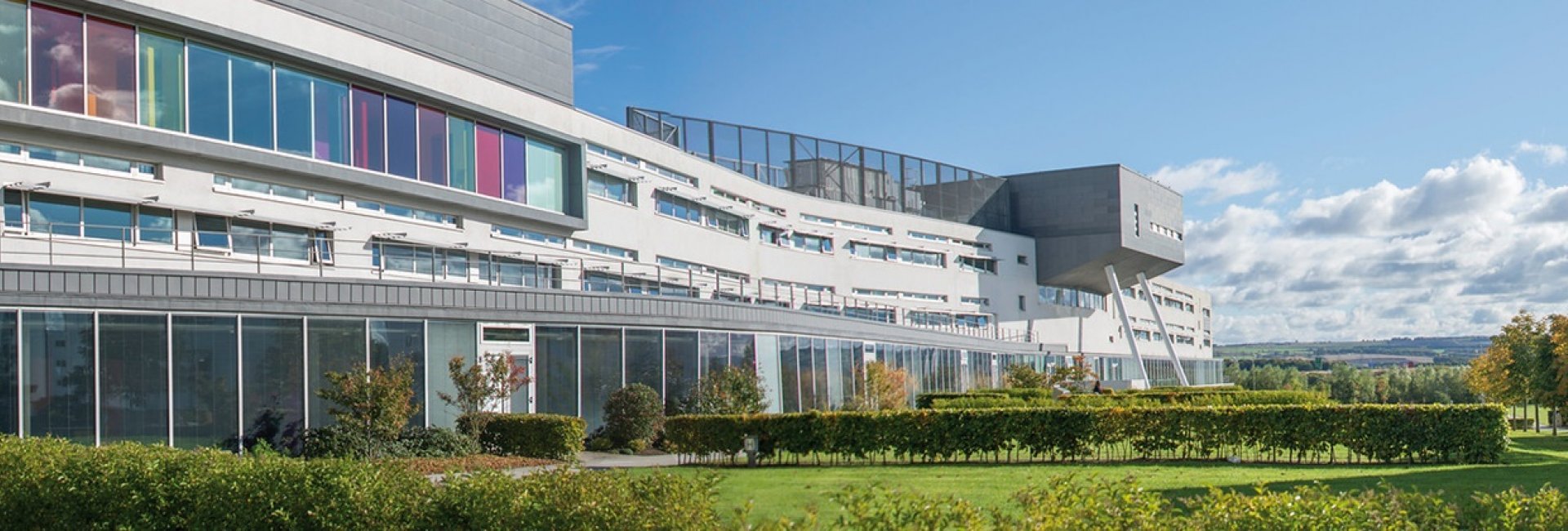
Queen Margaret University, Edinburgh - open day event
26 Sept 2026, 10:00
Musselburgh

On this highly respected vocational course you’ll learn how to research, design and construct costumes for performers of many kinds. You’ll work on live projects with renowned creative companies, and the course has a strong graduate employment record.
Think of a dramatic performance that you loved and you can probably picture the characters’ costumes. Costume design and construction are vital when it comes to creating successful theatre, film and TV productions. It’s a creative and challenging career: you need to know the theory and history of costume design, how to make costumes physically and how to manage the wardrobe of a live production wider world.
At the heart of the course are six professional practice modules (two of them in each of the first three years of the degree). In these, you will work as part of a team delivering the costumes for a series of live projects working in collaboration with partner organisations and companies.
Supporting this practical learning in Years One and Two are a series of modules which will develop your research and design skills, your analytic and writing skills, and your construction and wardrobe management expertise.
In Year Three you can begin to specialise by working in greater depth on two or more of the varieties of pathways that costume practice offers — perhaps masks, puppets and soft props, or the design of costume for film, or historical cut and construction.
You can extend your knowledge of these chosen skills in your industry placement and in your independent research and construction project. You will also fulfil key production roles in live projects, at QMU and with partner companies and organisers, as a designer, supervisor or specialist maker. In Year Four if you decide to undertake the honours year as many of our students do, the emphasis is on refining your chosen areas of future practice, using the independent professional practice options to gain practical experience and make contacts in the wider world.
Year One
Introduction to Theatre Production
The Origins of Theatre
Introduction to Wardrobe Practice (including Professional Practice)
Introduction to Costume Design
Year Two
Advanced Costume Design
Advanced Costume Techniques
Professional Practice as a Wardrobe Assistant
Year Three
Professional Practice in a Lead Role
Practice Informed Research Project
Creating in Context: Design Project
Theatre of Ideas – Introduction to European Theatre
Elective 1
Year Four
Honours study
Creative Enterprise in the Performing Arts
Creating your Career, Work-based Learning
Elective 2
The modules listed here are correct at time of posting (April 2021) but may differ slightly to those offered in 2022. Please check back here for any updates.
You will be taught in lectures, seminars and practical workshops. You will work in a team delivering the costumes for live productions with well-known companies.
Below you can read about Teaching and Learning Activities and Assessment Activities. We believe this will give you a good indication of what the course will be like, but the exact balance of activities may differ depending on the academic year and on the modules you choose.
Teaching and learning activities
Our Teaching and Learning Activities are focused on building your confidence, developing your problem-solving skills and preparing you for a successful career. Here you can read about how much time you should expect to spend undertaking these activities for this course along with a general description of the activity for all courses.
Teaching
You are taught through a combination of lectures, seminars and in some cases practical workshops or laboratories. Seminars enable you to discuss and develop your understanding of topics covered in lectures in smaller groups.
Year One: 44%
Year Two: 55%
Year Three: 39%
Year Four: 8%
Independent Learning
When not attending lectures, seminars, practicals or other timetabled sessions you will be expected to continue learning independently through self-study. Typically, this will involve reading journal articles and books, working on individual and group projects, undertaking research in the Learning Resource Centre, preparing coursework assignments and presentations, and preparing for examinations. You independent learning is supported by a range of excellent facilities, including the Learning Resource Centre and the Hub.
Year One: 56%
Year Two: 45%
Year Three: 61%
Year Four: 70%
Placement
Courses with placements give you the opportunity to put what you are learning into practice and to observe and work with a wide range of individuals and groups of people in diverse settings. Some courses offer placement opportunities in the UK and overseas.
Year One: 0%
Year Two: 0%
Year Three: 0%
Year Four: 22%
Assessment Activities
Assessment Activities provide you with opportunities to test your understanding of the subject and receive feedback on your performance. Here you can read about how much of your final mark is based on each type of formal assessment for this course along with a general description of the activity for all courses.
Exams
Assessment by written examinations normally takes place at the end of each module or semester, but they may also happen during modules.
Year One: 17%
Year Two: 0%
Year Three: 0%
Year Four: 0%
Coursework
Coursework assessments take place in a variety of ways, including assignments, essays, reports, portfolios, project output and your level 4 Honours project. We aim to provide you with feedback on your assessment within 20 working days of the submission date.
Year One: 58%
Year Two: 47%
Year Three: 83%
Year Four: 87%
Practical
Practical assessments can include oral presentations, performance, practical skills assessment, costume design and construction, film making, lab work or clinical practical skills depending on the nature of the course.
Year One: 25%
Year Two: 53%
Year Three: 17%
Year Four: 13%
NB This data is based on activity undertaken by students during academic year 2018/9. Updates will be made shortly.
To work as a teacher at a state school in England or Wales, you will need to achieve qualified teacher status (QTS). This is offered on this course for the following level:
This course is not accepting applications at this time. Please contact the provider to find out more.
The following entry points are available for this course:
Two discursive subjects required from English/History/Drama as well as one artistic/creative subject required such as Art/Design or Textiles or equivalent at A level.
English required and Maths preferred at GCSE with grade C.
Two discursive subjects required from English/History/Drama as well as one artistic/creative subject such as Art/Design or Textiles or equivalent at Scottish Higher.
English required and Maths preferred at Nat5 with grade C.
English required at Standard with grade 5.
English/History/Drama required as well as one artistic/creative subject such as Art/Design or Textiles or equivalent at IB.
Two discursive subjects required from English/History/Drama as well as one artistic/creative subject such as Art/Design or Textiles or equivalent at Higher level.
English is required with grade O4 or H5 and Maths is preferred.
HNCs are considered on an individual basis.
Please note, due to a very limited number of spaces on this course, we generally cannot offer advanced entry to year 2 and 3.
HNDs are considered on an individual basis.
Please note, due to a very limited number of spaces on this course, we generally cannot offer advanced entry to year 2 and 3.
We accept many different qualifications, but cannot list them all here. Please contact the Admissions Team for further information or advice if you are thinking of taking a course of study. We welcome applications from international and EU applicants and you can find information on specific entry requirements by country here: https://www.qmu.ac.uk/study-here/international-students/information-for-your-country/. We also welcome applications from mature students, or people holding qualifications such as Access courses or OU modules. The Scottish Wider Access Partnership (SWAP) offers a range of local Access courses and those that are accepted for entry are listed here: https://www.qmu.ac.uk/college-qualifications
Two discursive subjects required from English/History/Drama as well as one artistic/creative subject such as Art/Design or Textiles or equivalent at Scottish Higher.
English is required and Maths preferred at Nat5 with grade C.
QMU English Language Requirementshttps://www.qmu.ac.uk/study-here/international-students/english-language-requirements/
This section shows the range of grades that students who received offers were previously accepted on to this course with (learn more).
It is designed to support your research but does not guarantee whether you will or won't get a place.
Admissions teams consider various factors, including interviews, subject requirements, and entrance tests. Check all course entry requirements for eligibility.
We are unable to show previous accepted grades for this course. This could be because the course is new, it's a postgraduate course, there isn't enough historical data, or the provider has opted out of sharing their entry grades data for this course - learn more.
| Location | Fee | Year |
|---|
Tuition fee status depends on a number of criteria and varies according to where in the UK you will study. For further guidance on the criteria for home or overseas tuition fees, please refer to the UKCISA website.
For the 2026 intake, students from England, Northern Ireland, Wales and Republic of Ireland will be charged for the first three years of study and the fourth year is free. For the 2027 intake onwards, tuition fees will be due to be charged for all four years of study.
Email:admissions@qmu.ac.uk
Phone:0131 474 0000
Fax: 0131 474 0001
Queen Margaret University Drive
Musselburgh
Edinburgh
EH21 6UU
At Queen Margaret University, Edinburgh