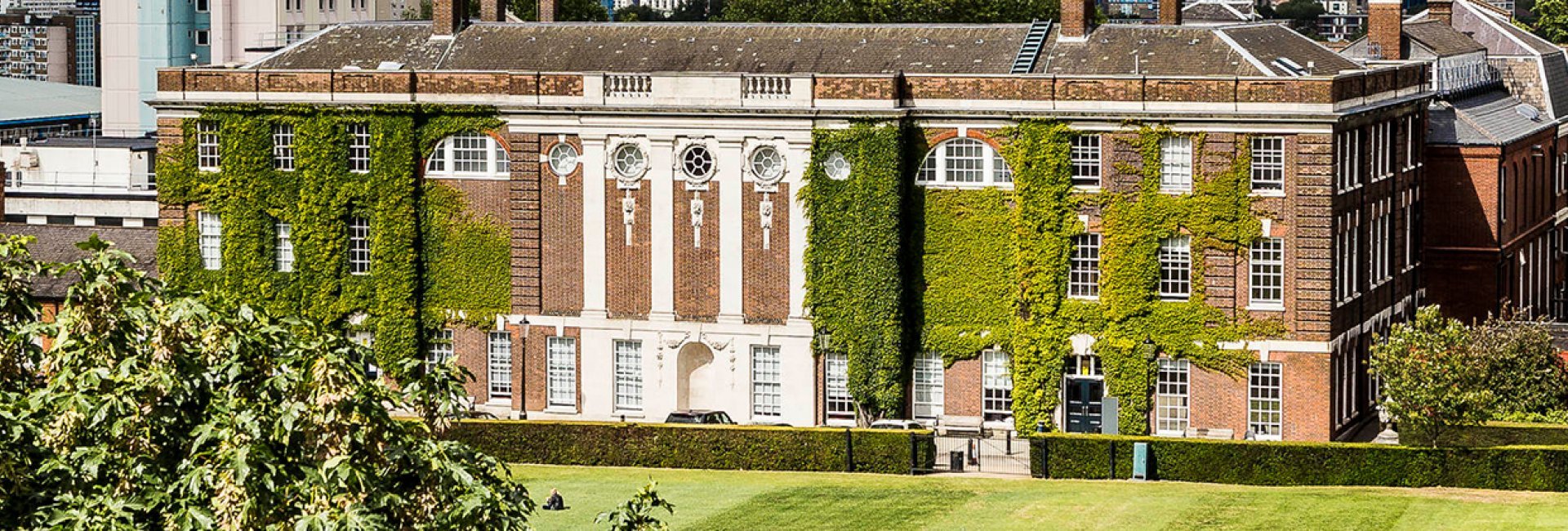
Goldsmiths, University of London - Virtual Campus Tour
25 Nov 2025, 12:00
London

If you have been out of education or do not have the required A-level qualifications for degree-level study, this four-year course can help you realise your academic potential.
Why study BA English (with Integrated Foundation Year) at Goldsmiths
Goldsmiths is dedicated to widening participation and supporting students from non-traditional backgrounds to transition to university-level study. If you do not have the required qualifications for degree-level study, our BA in English with Integrated Foundation Year offers an alternative entry route
The Foundation Year is closely aligned with our undergraduate English programmes, teaching you a foundational knowledge of the subject, and helping you develop the academic skills necessary to progress to the first year of the BA
You will select the undergraduate degree you wish to study at the point of application but can change your choice as you progress through the foundation pathway if your interests change
In your Foundation Year, you will learn about significant literary movements from distinct periods, including the English Renaissance, literature of World War I, post-war drama and poetry, feminist fiction, and themes of race and class in the late 20th Century
You will develop your ability to identify characteristics of historical periods and significant developments in literature and be able to explain the relationship of literary works to the relevant historical periods studied
You will hone vital skills in critical reading, analysis and written communication
Following the Foundation Year, you will progress to study the BA English. Bold, flexible, and richly diverse – our BA English degree will take you on a thrilling intellectual and imaginative journey.
We ask big questions. We challenge you to read literature in all its cultural, artistic, and political contexts and you will engage in debates about what it means to be human across time.
We are diverse. You will travel across histories, cultures and languages, and explore evolving genres such as epic, tragedy and the novel. You will learn about the history of British literature, explore theoretical approaches such as feminism and postcolonialism, and investigate literary engagements with the Transatlantic slave trade, climate change, and political activism. You will be able to study American literature, Black British literature, Caribbean writing and indigenous literatures.
We are critical and creative. Our staff undertake cutting edge research in the fields of gender studies; environmental humanities; Caribbean literature; linguistics; Shakespeare studies; American studies, translation studies; contemporary literature; life writing; Decadence; trauma studies; critical theory; modernism; visual culture; Romantic and Victorian literature; and the novel. Home to the Goldsmiths Prize and the Goldsmiths Writers' Centre, the Centre for Comparative Literature, the Centre for Caribbean and Diaspora Studies, and the Decadence Research Centre, Goldsmiths English is at the forefront of critical and creative practice.
We are relevant. Our research-led teaching is informed by current debates about canon formation, decolonisation, the role of the arts in cultural and political life and the politics of the archive.
We help you succeed. We will help you to grow and develop as a critical thinker and writer. You will have the opportunity to submit drafts of your work for in-term feedback and attend 1-2-1 Effective Academic Writing sessions.
Year 0 Foundation Year
Developing your academic skills
Alongside direct preparation in the study of English Literature, you will take two modules with our Centre for Academic Language and Literacies (CALL). These modules will help you develop the broader academic and research skills required for undergraduate study.
You will also learn how key social and political movements of the period have influenced the world we live in today through a cross-disciplinary module: Culture and Society in Post-war Britain. This module will cover topics such as 'Windrush and Migration', 'Irish Colonisation', 'Second-wave Feminism', 'Protest and Punk' and 'South-Asian Britain'.
Reading and Writing Your World
Building Your Research World
Culture and Society in Postwar Britain
English Literature From the Renaissance to the Late 20th Century
Year 1
You will take the following compulsory modules:
Explorations in Literature
Approaches to Text
Genre
Ideas in Practice
Creative-Critical Project
Year 2
Students take these compulsory modules:
Reading the Past: from Bede to Sterne
The Long Nineteenth Century
You will also choose one of the following modules:
The Goldsmiths Project
or
Work Placement (English)
You will have the opportunity to take the module 'Communicating the Climate Crisis' as part of the Goldsmiths Connected Curriculum or you can choose another 15-credit Goldsmiths Elective Module.
Optional modules
You will also choose 2 optional modules from a list provided by the Department of English and Creative Writing. Modules vary from year to year, but may include the following:
Homer and Contemporary Literature
Poetry since 1945
American Gothic
Language and Society
Creative and Life Writing
Shakespeare(s): Then and Now
Aesthetics
Black British Literature
Music in Literature
Year 3
In your final year, you will take two compulsory modules:
Challenging World Literature: Diversity and Difference
Modern and Contemporary Literatures
Optional modules
You will also take 2 to 4 optional modules to the total of 60 credits, chosen from a list provided by the Department of English and Creative Writing.
Modules may vary from year to year, and examples have included the below:
Caribbean Women Writers
Decadence
Writing Lives
Shakespeare’s Sisters: Contemporary Women’s Writing 1960s to the present
Contemporary Indigenous Literatures and Cultures
American Crime Fiction
Literary London
Language and Gender
Please note that due to staff research commitments not all of these modules may be available every year.
You’ll be assessed by a variety of methods that broaden your academic skillset and depend on your module choices. These include coursework assignments such as essays, critical commentaries, presentations and personal reflections, group work and projects.
This is the equal consideration deadline. You can still apply after this date, but your application may not receive guaranteed consideration.

Goldsmiths, University of London has participated in the Teaching Excellence Framework. These ratings were awarded in 2023, for four years.
See why these ratings were awarded
What does this TEF outcome mean?
The following entry points are available for this course:
Candidates who have studied level 3 qualifications within the last two years will be expected to have achieved the equivalent of two passes (E or better) at A2 level, BTEC or equivalent and have achieved a level 2 qualification in GCSE English at Grade 5 or above.
For candidates who have not studied any level 3 qualifications in the last two years, there are no formal qualifications required for admission, but you will need to demonstrate that you can benefit from the programme by undertaking an additional admissions process. This may involve an interview or request for the submission of written information used to assess suitability to study.
The programme is delivered in English, and whilst language support is available at the college, we would normally expect candidates for whom English is an additional language to have a competency level equivalent to an IELTS score of 6.0
We’ll pay particularly careful attention to your personal statement, which is your opportunity to demonstrate your interest in the subject you’ve applied for. Your referees are also welcome to include any relevant contextual comments around your academic achievements. We’ll look at all these things when making a decision on your application, as well as your qualifications and grades.
This section shows the range of grades students (with UK A-Levels or Pearson BTEC Level 3 National Extended Diplomas) who received offers were previously accepted with (learn more). It is designed to support your research but does not guarantee whether you will or won't get a place. Admissions teams consider various factors, including interviews, subject requirements, and entrance tests. Check all course entry requirements for eligibility.
We are unable to show previous accepted grades for this course. This could be because the course is new, it's a postgraduate course, there isn't enough historical data, or the provider has opted out of sharing their entry grades data for this course - learn more.
No fee information has been provided for this course
Tuition fee status depends on a number of criteria and varies according to where in the UK you will study. For further guidance on the criteria for home or overseas tuition fees, please refer to the UKCISA website.
To find out more about fees and funding, please check our undergraduate fees guidance or contact the Fees Office https://www.gold.ac.uk/ug/fees-funding/
New Cross
Lewisham
SE14 6NW
Visit our website Visit our course page
Email:course-info@gold.ac.uk
Phone:020 7078 5300
At Goldsmiths, University of London