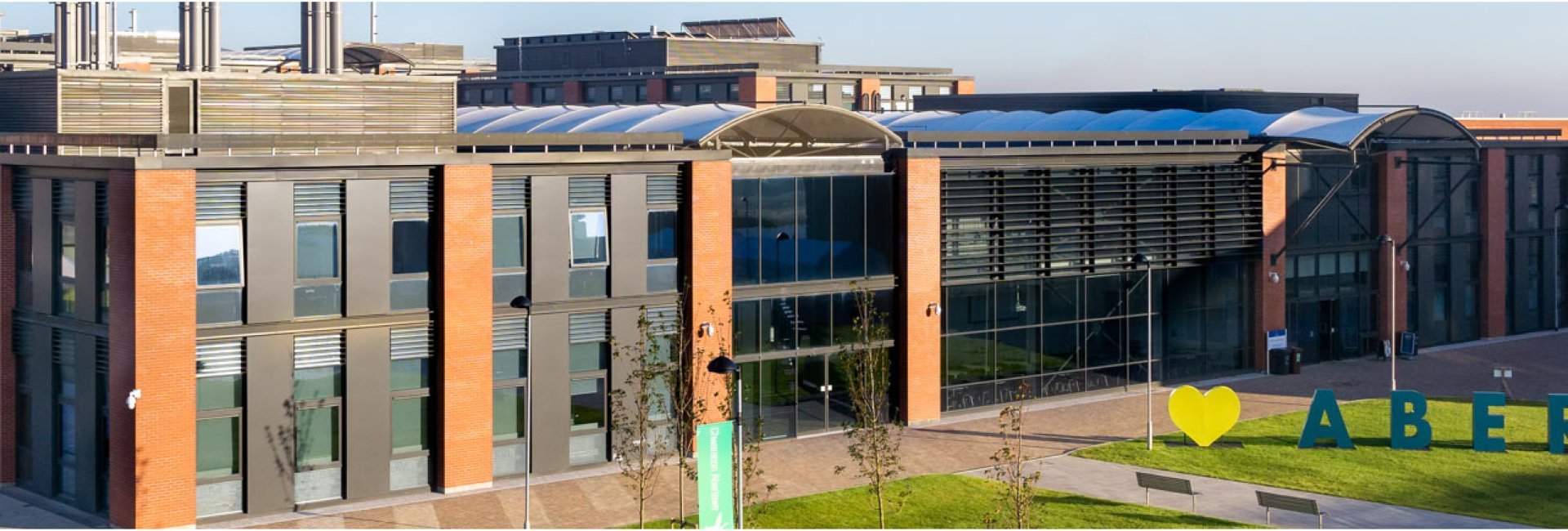
Undergraduate On-Campus Open Day at Swansea University - Singleton Park Campus and Bay Campus - 13 June 2026
13 Jun 2026, 07:30
Swansea

Mathematics underpins all contemporary science, business and technology, creatively applying the ideas of pure mathematics. Our three-year BSc degree in Pure Mathematics is a highly regarded programme that welcomes students from around the world.
Throughout your studies you will cover the fundamental mathematical concepts of real and complex analysis, geometry, and linear, abstract and categorical algebra, allowing you to focus on pure aspects of the subject.
Your learning will be shaped by inspirational and internationally-renowned academics who have expertise in a range of topics in pure and applied mathematics, and you will study in bespoke teaching spaces, designed by, and for, mathematicians.
You will master the ideas and logic of mathematics and their applications, with strong analytical skills, logical reasoning, data handling and quantitative thinking, building a highly desirable set of graduate attributes that will set you apart in the employment marketplace.
This programme includes opportunities to undertake a Year Abroad, enhancing your learning and offering invaluable life experience, and a Year in Industry, in the UK or overseas, enabling you to gain valuable workplace experience. The University advocates for paid-only placements, which on average have a salary of over £20,000. Unpaid placements are considered on a case-by-case basis.
In Year 1, you will typically study areas including: Mathematical and Computational Methods; Analytical Methods in Mathematics; Analysis; Foundations of Algebra; and Vector Spaces and Linear Algebra.
In Year 2, you will typically study areas including: Differential Equations; Probability Theory; Multi-variable analysis; Metric spaces; Vector Spaces; Groups and Rings; Mathematical Modelling: Theory and Practice; Credibility, Liability and Ruin; Game Theory and Optimization; and Statistical Data Analysis.
In Year 3, modules will depend on which partnership University you choose to study at.
In Year 4, you will typically study areas including: Topology; Higher Algebra; Lie Theory; Complex Analysis; Cashflows and Interest Rates; Financial Mathematics in Discrete Time; Markov Processes and Applications; Dynamical Systems; Numerics of ODEs and PDEs; Machine Learning; Assurance and annuity; Financial Mathematics in Continuous Time; Risk and Survival Models. You will also undertake a project.
We are proud to provide an outstanding educational experience, using the most effective learning and teaching approaches, carefully tailored to suit the specific needs of your course. Apart from a small number of online-only courses, most of our courses consist of in-person, on-campus teaching, enabling full engagement with your lecturers and fellow students. Practical skills sessions, lab work seminars, and workshops predominantly take place in person, allowing for group working and demonstrations. We also operate virtual labs and Simulated Learning Environments which will facilitate greater access to training opportunities in the future. However, our approach also includes the use of some online learning to support and enhance traditional face-to-face teaching. Online learning may take place ‘live’ using software such as Zoom, allowing you to interact with the lecturer and other students and to ask questions. Lecture recordings also allow for more flexibility to revisit material, to revise for assessments and to enhance learning outside of the classroom. Some modules have extra resources in Canvas, such as videos, slides and quizzes enabling further flexible study. This course may offer some modules taught through the medium of Welsh or bilingually for students who consider themselves to be fluent Welsh speakers. For more details on the provision available see the Welsh Provision expander below.
Professionally accredited courses provide industry-wide recognition of the quality of your qualification.
The following entry points are available for this course:
If you are an International Student, please visit our International pages for more information about entry requirements: http://www.swansea.ac.uk/international/students/requirements/
Discover what it's like to study Pure Mathematics with a Year Abroad at Swansea University: insights on the course, making friends, personal statement tips, uni prep, and recommended books, podcasts, and videos.

To include a B in Mathematics
BTEC: DDM any subject plus Grade B in A Level Mathematics.
Access to Science (Maths): 24 Distinctions and 15 Merits with Distinctions in all Maths modules.
Scottish Highers: ABBBC plus Grade B in Mathematics.
International Baccalaureate: 32 overall with 5 in Higher Level Mathematics.
Swansea University accepts the Advanced Skills Baccalaureate Wales as fully equivalent to x1 A-Level.
English Language Requirements at Swansea Universityhttps://www.swansea.ac.uk/admissions/english-language-requirements/
UK applicants who meet course requirements are guaranteed a conditional offer. We assess applications on individual merit. We consider making reduced offers, eg. to Care Leavers or students with extenuating circumstances. We encourage you to disclose any relevant circumstances.
The Advanced Skills Baccalaureate Wales is considered as equivalent to one full A-Level and students can take x2 A-levels alongside this. EPQ students predicted Grade B or above will receive a one-grade offer reduction.
This section shows the range of grades that students who received offers were previously accepted on to this course with (learn more).
It is designed to support your research but does not guarantee whether you will or won't get a place.
Admissions teams consider various factors, including interviews, subject requirements, and entrance tests. Check all course entry requirements for eligibility.
We are unable to show previous accepted grades for this course. This could be because the course is new, it's a postgraduate course, there isn't enough historical data, or the provider has opted out of sharing their entry grades data for this course - learn more.
No fee information has been provided for this course
Tuition fee status depends on a number of criteria and varies according to where in the UK you will study. For further guidance on the criteria for home or overseas tuition fees, please refer to the UKCISA website.
For the latest fee information, please check the individual course page on our website. Our full range of programmes are listed here: https://www.swansea.ac.uk/undergraduate/courses/
Further information on tuition fees can be found here: https://www.swansea.ac.uk/undergraduate/fees-and-funding/tuition-fees/
You may be eligible for funding to help support your study.
To find out about scholarships, bursaries and other funding opportunities that are available please visit the University's scholarships and bursaries page https://www.swansea.ac.uk/undergraduate/scholarships/
Academi Hywel Teifi at Swansea University and the Coleg Cymraeg Cenedlaethol offer a number of generous scholarships and bursaries for students who wish to study through the medium of Welsh or bilingually. For further information about the opportunities available to you, visit the Academi Hywel Teifi Scholarships and Bursaries page https://www.swansea.ac.uk/academi-hywel-teifi/learn/scholarships/
Email:maths-admissions@swansea.ac.uk
Phone:01792 295720
Singleton Park
Swansea
SA2 8PP
At Swansea University