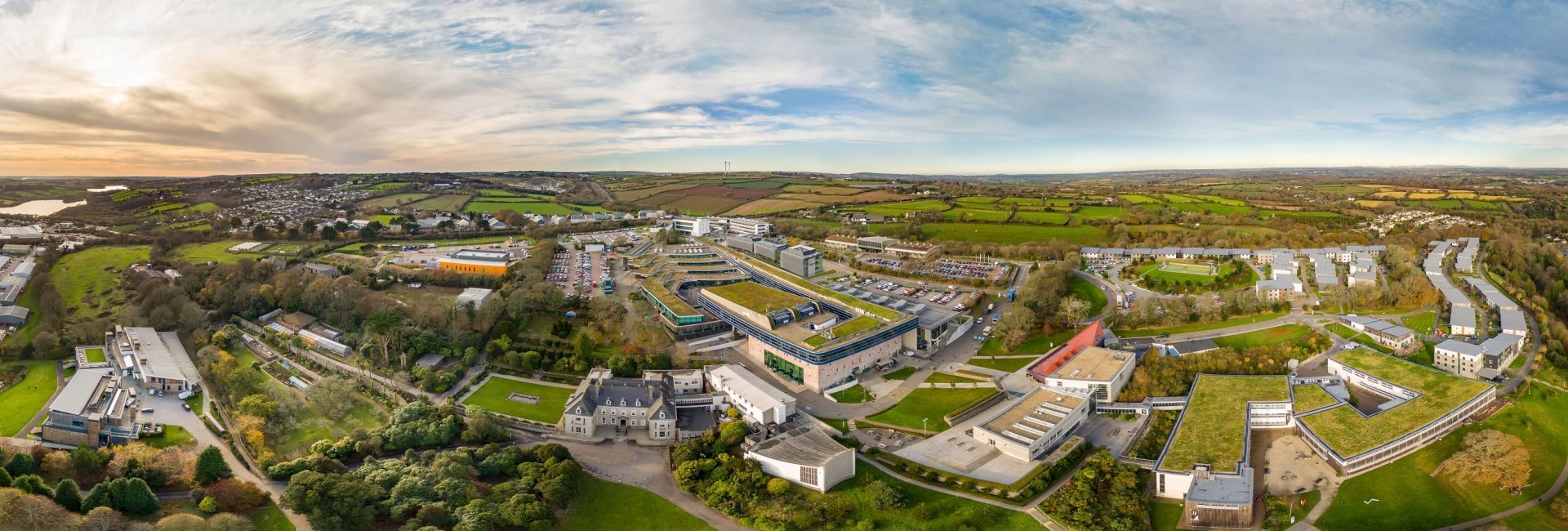
Open Day (in-person)
23 May 2026, 08:00
Falmouth


Fusing traditional and emerging forms of communication our courses prepare you for a career in the rapidly evolving digital media industries.
Our students are makers. They learn through doing and dissolve definitions such as online/offline to explore how physical computing meets behavioral design. Supported through workshops across a wide variety of media and programming skills, you'll be introduced to design fundamentals in sketching and notation, and the three sets of tools and techniques that focus Digital Media's output: interaction, image and audio design.
We are looking for fresh thinking contributors and we welcome applications from diverse educational backgrounds.
Students with a passion for creative technology, media production and computing, alongside film-makers, designers, artists, gamers, writers and image-makers are at home in our dynamic, multi-disciplined FdA in Digital Media.
We look for students who are excited by collaboration and experimentation, fusing traditional media and digital development to shape new forms of communication.
This course is taught by Bodmin College, and awarded by Falmouth University.
The FdA in Digital Media is designed to provide students with a comprehensive understanding of digital media and its application in various industries. The courses are composed of a range of modules below.
The courses are delivered by experienced staff, including our regular Visiting Lecturer Program (1 day per Week), who all have a background in digital media and related fields. Many of the staff members have worked or currently work in the industry and have a wealth of practical experience to share with students. This will provide students with insight into current trends and practices within the digital media sector.
Year One:
In your first year you'll learn the basics of designing and programming for online media and mobile apps, video production, sound recording and mixing, graphics and hardware interfaces.
Modules:
Foundations
Place
Collaboration
Grow
Year Two:
In year 2 we encourage you to focus on your areas of interest as well as studying the more advanced problem-solving and technical skills development.
Modules:
Formation
Realisation
Context
Professional Portfolio
As part of our process of continuous improvement, we routinely review course content to ensure that all our students benefit from a high-quality and rewarding academic experience. As such, there may be some changes made to your course which are not immediately reflected in the content displayed on our website. Any students affected will be informed of any changes made directly.
Students will be required to complete a range of coursework assignments, such as essays/reports, practical projects, and group work. They will also be expected to participate in class discussions, give presentations, and receive feedback on their work.
There are regular opportunities for students to receive feedback from staff and peers, which will help them further develop their skills and knowledge.
The courses will also involve from the outset, real client lead projects, which will enable students to gain valuable industry experience and apply their skills in a practical setting. The courses are designed to provide a balance between theoretical knowledge and practical skills, which will prepare students for a career in digital media.
This is the equal consideration deadline. You can still apply after this date, but your application may not receive guaranteed consideration.

Falmouth University has participated in the Teaching Excellence Framework. These ratings were awarded in 2023, for four years.
See why these ratings were awarded
What does this TEF outcome mean?
The following entry points are available for this course:
We regret that this course is not available to international applicants who would require a Student Visa.
If English is not your first language, you will need to demonstrate English language skills that are sufficiently developed for successful completion of your studies. We accept a range of recognised English language qualifications that are equivalent to the International English Language Testing System (IELTS) Academic minimum score of 6.0 overall, with a minimum of 5.5 in Reading, Writing, Speaking and Listening.
At Falmouth, we recognise excellence in many forms, and we see the whole you.
Our diverse community is creative, innovative and entrepreneurial.
We recognise that these qualities aren’t always shown in academic grades alone. That’s why, while many of our applicants achieve high academic grades, we also welcome those who can demonstrate their potential through an exceptional portfolio or performance.
At a minimum, we typically require the equivalent of 64 UCAS Tariff points for undergraduate courses where we can review a portfolio or audition, or a minimum of 96 UCAS points for those courses that do not require a portfolio or audition. For our Integrated Foundation Year courses, we typically require a minimum of 32 UCAS points for courses where we can review a portfolio or audition, or 64 UCAS points for those that do not require a portfolio or audition.
To support this approach, during a friendly conversation with our academic team, we’ll consider your ideas, your creative output and your ambition to ensure you’ll thrive at Falmouth.
If you are able to demonstrate relevant, current, equivalent experience instead of formal qualifications, we encourage you to apply. Please contact our Applicant Services team before applying, for advice regarding your individual experience and eligibility.
If you are an international applicant and require a Student visa to study in the UK, you must have a recognised English language test approved and vouched for by the University at the appropriate level. You can see what we accept on our website https://www.falmouth.ac.uk/study/international/english-language-requirements Our Applicant Services team can help you with any general questions you may have about study visas or suitable language tests. For more specific advice, we recommend you also consult UKCISA http://www.ukcisa.org.uk/
Find out more about qualification requirements for this course.
View our list of accepted English language tests and qualifications using the link below https://www.falmouth.ac.uk/study/international/english-language-requirements
At Falmouth University, we take a rounded approach to admissions. Instead of focusing on criteria like grades alone, we operate a contextual admissions policy, where we look at you as a person: your talents, your experiences and your potential. Every offer we make is shaped around you and your circumstances, and our conditional offers are always intended to be realistic and achievable.
This section shows the range of grades students (with UK A-Levels or Pearson BTEC Level 3 National Extended Diplomas) who received offers were previously accepted with (learn more). It is designed to support your research but does not guarantee whether you will or won't get a place. Admissions teams consider various factors, including interviews, subject requirements, and entrance tests. Check all course entry requirements for eligibility.
We are unable to show previous accepted grades for this course. This could be because the course is new, it's a postgraduate course, there isn't enough historical data, or the provider has opted out of sharing their entry grades data for this course - learn more.
No fee information has been provided for this course
Tuition fee status depends on a number of criteria and varies according to where in the UK you will study. For further guidance on the criteria for home or overseas tuition fees, please refer to the UKCISA website.
No additional fees or cost information has been supplied for this course, please contact the provider directly.
Digital Media Centre
Unit 16
Woods Browning Industrial Estate
Bodmin
PL31 1DQ
Visit our website Visit our course page
Email:applicantservices@falmouth.ac.uk
Phone:01326 213730