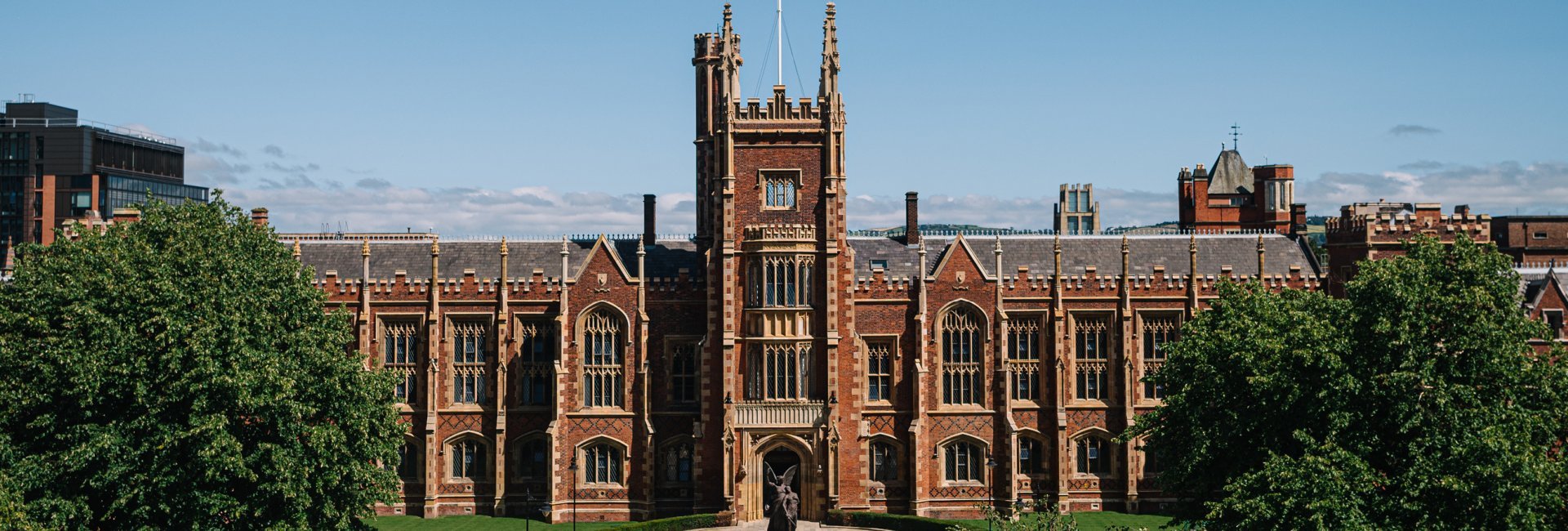
Queen's University Belfast
University Road
Belfast
BT7 1NN
Visit our website Visit our course page
Course contact details
Admissions and Access Service
Email:admissions@qub.ac.uk
Phone:028 9097 3838

This mutually enriching Joint Honours programme equips students in identifying historical and contemporary patterns of social organisation, human-environment relationships, ethnic and cultural divisions, varieties of inequality, and patterns of change over time across diverse societies.
Anthropology is the study of human diversity around the world, and studying Anthropology together with Archaeology allows you to develop an understanding of how this diversity has changed over long periods. In studying Anthropology and Archaeology, you will learn how different societies live and have lived together, and think about such topics as family, sex, religion, art, and economics, as well as gaining skills increasingly in demand in a globalised and automated world.
The BA in Anthropology and Archaeology at Queen’s will allow you to examine some of the deepest and most pressing questions about human beings. Issues addressed in our modules include:
What are the roots of social inequality?
Does globalisation mean the end of cultural difference?
Can a post-conflict society heal?
How do societies and their environment shape each other?
How do ritual traditions, musical performances, and art shape cultural identities?
How do some people become willing to die for a group?
Studying Anthropology and Archaeology at Queen’s progressively develops general and specific knowledge and skills, through fieldwork, classroom modules, optional placements, overseas fieldtrips, performance ensembles, laboratory and practical work. A wide range of career options are available to our graduates, drawing on the valuable skills they develop in this course, including critical thinking, cross-cultural understanding, researching, interviewing, writing, and presenting.
Anthropology modules offered on this course examine the nature of social groups, from families to nations, the social dynamics at work within those groups, important themes in religion and morality, as well as the production, appropriation and use of material artefacts and images in a world of interconnectedness through migration, trade, and digital communication technology. Some modules deal directly with large-scale Global Challenges such as conflict, security, and peacebuilding. Issues such as migration, ethnic conflict, and globalisation will be covered across all three years of the degree, with specialist modules looking at Ireland and at the role of anthropology in policy. The archaeology modules available on this course focus on different periods of World, European and Irish/British archaeology, from human origins to modern times and heritage, allowing students to develop both their theoretical background knowledge and their practical skills in equal measure, and adding depth of time to some of the themes explored in Anthropology modules.
The way in which students are assessed in this course is designed to support the learning outcomes of the programme and of each specific module. A broad range of formative and summative assessment methods is used. Some modules are assessed solely through project work or written assignments. Others are assessed through a combination of coursework, including essays, reports, portfolios, presentations, reflective journals, and exams. As students progress through their course, they receive general and specific feedback that will help them to improve the quality of their work.
The following entry points are available for this course:
This section shows the range of grades students (with UK A-Levels or Pearson BTEC Level 3 National Extended Diplomas) who received offers were previously accepted with (learn more). It is designed to support your research but does not guarantee whether you will or won't get a place. Admissions teams consider various factors, including interviews, subject requirements, and entrance tests. Check all course entry requirements for eligibility.
We are unable to show previous accepted grades for this course. This could be because the course is new, it's a postgraduate course, there isn't enough historical data, or the provider has opted out of sharing their entry grades data for this course - learn more.
| Location | Fee | Year |
|---|---|---|
| England | £9250* | Year 1 |
| Scotland | £9250* | Year 1 |
| Wales | £9250* | Year 1 |
| Channel Islands | £9250* | Year 1 |
| Northern Ireland | £4750 | Year 1 |
| Republic of Ireland | £4750 | Year 1 |
| EU | £20800 | Year 1 |
| International | £20800 | Year 1 |
* This is a provisional fee and subject to change.
Tuition fee status depends on a number of criteria and varies according to where in the UK you will study. For further guidance on the criteria for home or overseas tuition fees, please refer to the UKCISA website.
The tuition fees quoted above for NI and ROI are the 2024/25 fees and will be updated when the new fees are known. In addition, all tuition fees will be subject to an annual inflationary increase in each year of the course. Fees quoted relate to a single year of study unless explicitly stated otherwise.
Further information on Fees and Funding can be found at: https://www.qub.ac.uk/Study/Feesandfinance/.
University Road
Belfast
BT7 1NN
Visit our website Visit our course page
Email:admissions@qub.ac.uk
Phone:028 9097 3838
At Queen's University Belfast