dBs Institute Manchester Open Day
20 Jun 2026, 10:00
Manchester

The BA (Hons) Music Production & Sound Engineering degree is designed to equip you with the creative, technical, and professional skills to thrive in today’s music and audio industries. From your very first study block, you’ll be working in professional studio environments, developing a deep understanding of recording, mixing, and music production through hands-on experience and critical reflection.
This course offers the perfect balance of creativity and technical precision. You’ll explore studio techniques, composition and arrangement, production workflows, sound design, and engineering principles, all while developing your own sonic identity. Optional modules in years 2 and 3 allow you to tailor your experience to your interests, whether that’s immersive audio, hardware-based production, commercial music creation, or sound for live broadcast.
As part of a suite of interlinked music degrees, you’ll also have the opportunity to collaborate with musicians, songwriters, composers, and performers on real-world projects. This reflects how the industry works and helps you build the skills to navigate professional creative environments with confidence.
You’ll also have the opportunity to explore cutting-edge topics like multichannel audio, spatial sound, and innovation in music technology. This degree prepares you to thrive as a forward-thinking music producer, equipped to adapt, evolve, and lead in a fast-moving and constantly changing industry.
Year 1
In your first year, you’ll build a strong foundation in studio practice, music production, and sound engineering. Through a blend of hands-on sessions and guided exploration, you’ll learn how to operate studio equipment, shape sound creatively, and understand the core processes of recording and mixing.
You’ll also begin to analyse music production in context and explore the wider industry landscape, gaining insights into the roles, technologies, and workflows that define contemporary audio work. This year is about building confidence, experimenting with ideas, and learning how to bring your creative and technical skills together in the studio.
Year 2
In year 2, you’ll expand your skill set through more advanced modules in music production, mixing, and mastering, while starting to shape your own areas of interest. You’ll also choose from a range of optional modules in areas like acoustics, composition and arrangement, hardware production, live broadcast, and immersive audio.
This year places a greater emphasis on creative decision-making, critical listening, and responding to real-world briefs. You’ll begin to work more independently, collaborate with students from other courses, and conduct research that will inform your final year projects. Optional modules are subject to availability and are designed to support a broad range of specialist pathways. There is a strong focus on innovation, technical exploration, and growing your understanding of the wider sound and music industries.
Year 3
In your final year, you’ll bring everything together through two major projects: a creative innovation project and a professional portfolio. These projects allow you to define and realise a personal area of focus within music production and sound engineering - whether it’s a studio album, a sound installation, a spatial audio experience, or a unique production system you’ve developed.
You’ll also choose from a range of optional modules that support your interests in leadership, collaboration, education, or future-facing production methods. Optional modules are subject to availability and designed to reflect current trends in the industry. A research-led module in sound cultures encourages deeper reflection on the cultural, social, or political dimensions of sound, while supporting your ability to produce informed, original work. This is your opportunity to push creative boundaries, refine your professional voice, and build a body of work that sets the tone for your next step.
Year 1 - Core Modules
Industry Foundations
Music Production
Studio Practice
Mixing
Creative Recording Techniques
Production Analysis
Year 2 - Core modules
Industry Practice
Advanced Music Production
Creative Research Practice
Advanced Mixing & Mastering
Year 2 - Option Modules
Applied Acoustics
Composition & Arrangement
Hardware Production
Commercial Music Creation
Immersive Audio
Marketing & Promotion
Live Recording & Broadcast
Year 3 - Core Modules
Innovation: Exploration
Industry Portfolio Development
Innovation: Realisation
Industry Portfolio Delivery
Sound Cultures
Year 3 - Option Modules
Music Education & Wellbeing Practice
Signature System Design
Management & Leadership in the Music Industry
Collaborative Creative Practice
Please note. Option modules are subject to availability and may change, depending on factors such as demand, staffing and timetabling. As part of our process of continuous improvement, we routinely review course content to ensure that all our students benefit from a high-quality and rewarding academic experience. As such, there may be some changes made to your course which are not immediately reflected in the content displayed on our website. Any students affected will be informed of any changes made directly.
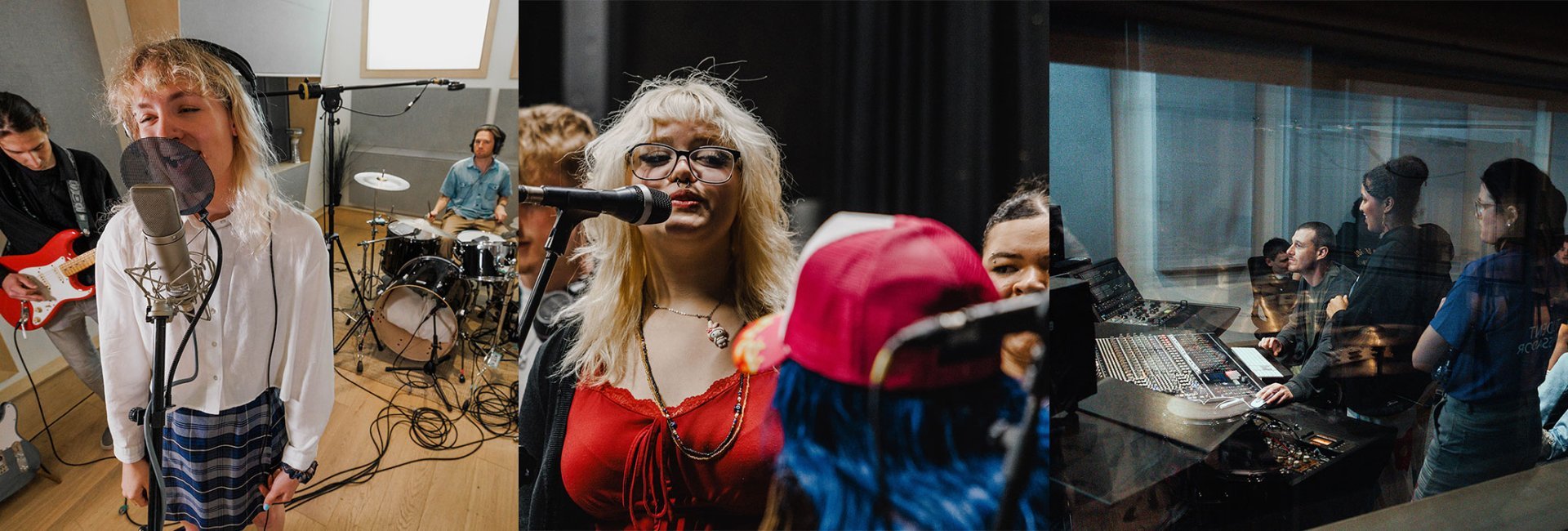
You’ll spend a significant amount of time in state-of-the-art recording studios, honing your skills as a music producer and sound engineer using professional equipment such as mixing consoles, digital audio workstations, high-quality microphones, and studio hardware. Learning is hands-on and practice-based, supported by workshops, seminars, lectures, and one-to-one tutorials that help you build both technical confidence and creative direction.
Assessment Methods:
The following entry points are available for this course:
We regret that this course is not available to international applicants who would require a Student Visa. At this time, we are currently unable to accept international students on our on-campus undergraduate degree programmes. Students who hold settled or pre-settled status may qualify, more detail can be found on our website.
As a guide our typical offer at undergraduate level is 96-112 UCAS Tariff points, primarily from Level 3 qualifications such as but not limited to A-levels, a BTEC/UAL Extended Diploma or a Foundation Diploma.
We consider all applications on their own individual merit and potential, you will be invited to an interview/audition, where you will have the opportunity to discuss your experience and suitability for the course.
We welcome applications from all subject backgrounds, whether you’ve specialised in STEM, the arts or humanities. If you do not hold the minimum entry requirements but can demonstrate aptitude, enthusiasm and motivation you will be considered on an individual basis.
For applicants whose first language is not English, we accept a variety of English language tests and they are listed on our validating partner's, Falmouth University, International Entry Requirements page.
Who's this course for?
This degree is designed for people that are fascinated by the process of recording, mixing and producing sound and music. You’ll have a keen interest in exploring the tools and techniques used in professional recording studios and may have already begun experimenting with recording yourself. You’re focused on deepening your understanding and approach to recording and producing music, as well as developing your own sonic signature with a view to working in an established studio or setting up your own.
Find out more about qualification requirements for this course.
You can find full information of accepted qualification on our validating partner's website.https://www.falmouth.ac.uk/study/international/english-language-requirements
We consider all applications on their own individual merit and potential, you will be invited to an interview/audition, where you will have the opportunity to discuss your experience and suitability for the course.
This section shows the range of grades that students who received offers were previously accepted on to this course with (learn more).
It is designed to support your research but does not guarantee whether you will or won't get a place.
Admissions teams consider various factors, including interviews, subject requirements, and entrance tests. Check all course entry requirements for eligibility.
We are unable to show previous accepted grades for this course. This could be because the course is new, it's a postgraduate course, there isn't enough historical data, or the provider has opted out of sharing their entry grades data for this course - learn more.
| Location | Fee | Year |
|---|
Tuition fee status depends on a number of criteria and varies according to where in the UK you will study. For further guidance on the criteria for home or overseas tuition fees, please refer to the UKCISA website.
No additional fees or cost information has been supplied for this course, please contact the provider directly.
Email:admissions@dbsinstitute.ac.uk
Phone:01615526467
2 Mitchell Lane
Bristol
BS1 6BU
At dBs Institute