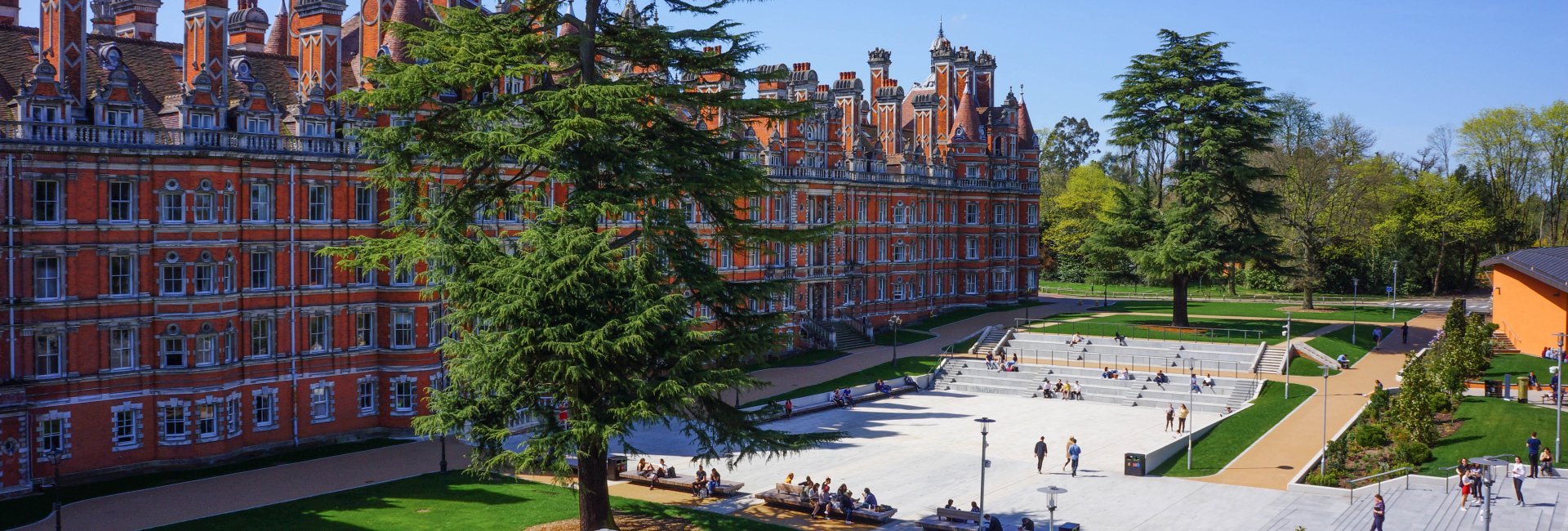
Royal Holloway, University of London - Postgraduate Open Morning (Egham campus)
13 Jun 2026, 08:00
Egham

Our Integrated Foundation Year for Arts and Humanities will take you through a carefully-designed programme to help you to progress confidently onto your undergraduate degree.
Arts and Humanities subjects, like Classical Studies, provide key ways of understanding our complex world, its histories, and current debates facing contemporary society. Identity, political and social conflict, our interaction with new digital and genetic technologies, our stewardship of the environment are all issues where the voice of creative and critical thinking are key. Literary texts, films, plays and digital games offer important ways in which societies have debated - and continue to represent - their values and their futures.
The Foundation Year provides progressive structures in which you are able to gain knowledge and understanding of approaches to humanities study and your chosen degree subject. All Foundation Year students take ‘Global Perspectives’, as well as four subject-based courses which provide approaches to the study of arts and humanities subjects, giving you critical skills to explore a range of literary, visual, and cultural forms, including plays, films, and digital media.
Once you have completed your Foundation year, you progress onto the full degree programme, BA Classical Studies.
If you are captivated by classical literature and philosophy and are keen to understand more about ancient history and classical archaeology, Classical Studies is an ideal degree course for you.
Classical Studies is a flexible degree that offers a great deal of choice in subjects related to the ancient world. It’s ideal for those who want to gain a deep understanding of lots of aspects of ancient Greece and Rome – its literature, history, philosophy and archaeology – even its languages; Greek and Latin can be studied at whatever level you’re at and for one, two or three years.
There is also the possibility of spending a year abroad, experiencing how classical society has had a lasting impact on history, culture and politics.
As a student of Classical Studies you will be part of our Classics Department, where the quality of research that informs our teaching and a friendly, individual approach which shapes the way we guide our students combine to create an unbeaten academic experience.
Cultures of Thinking
Culture and Memory
Society on Screen
Textual Cultures
Foundations of Classical Studies
Below is a taster of some of the exciting optional modules that students on the course could choose from during this academic year. Please be aware these do change over time, and optional modules may be withdrawn or new ones added.
Beginner’s Greek
Intermediate Greek
Beginner's Latin
Intermediate Latin
Introduction to Greek Literature
Roman Literature of the Empire
Introduction to Ancient Philosophy
Greek History and the City State
Key Themes in Roman History
Introduction to Greek Archaeology
Introduction to Roman Archaeology
Advanced Greek
Advanced Latin
Intensive Latin
Homer (In Translation)
Greek Drama (In Translation)
Ovid’s Metamorphoses: Art and Power in Augustan Rome
Virgil’s Aeneid: The Empire in the Literary Imagination
Greek History to 322 BC
Augustus: Propaganda and Power
Historiography of the Roman World
The Good Life in Ancient Philosophy
Spinning the Past: Greek Historiography from Herodotos to Diodoros
The Rise and Fall of the Roman Republic
Rome and its Empire from Augustus to Commodus
The Later Roman Empire
Byzantium and its Neighbours, 641-1081
From Dig to Digital: Archaeological Theory, Method and Practice
Life in the Big City
Advanced Greek
Intensive Greek
Athenian Law and Social History
Further Aspects of Modern Greek Language and Culture
Alexander the Great
Understanding Pompeii and Herculaneum
City of Athens
The Good Life in Ancient Philosophy
Advanced Greek
Advanced Latin
Art, Architecture and Identity in the Hellenistic World
Athenian Law and Social History
Augustus
Christians and Pagans from Constantine to Augustine (AD 306-430)
Contemporary Approaches to Latin Literature
Encounters with Latin Poetry (in Latin)
Extended Essay (Dissertation)
Food in the Ancient World
History and Fiction
Intensive Greek
Intensive Latin
Intermediate Greek
Intermediate Latin
Latin Epic (in Latin)
Latin Letters (in Latin)
Of Masks & Voices: Gender and Performance in Ancient Greece
Plato (in Greek)
Roman Protests and Riots
Tacitus and the Making of Empire
Thinking Myth: classical myth and its reception
Social and Economic History of the Roman Empire
In your Foundation Year, teaching methods include a mixture of lectures, seminars, workshops, individual tutorials, and supervisory sessions. Outside of the classroom you’ll undertake guided independent reading and study. You will also be assigned a Personal Tutor, who’ll be with you for the duration of your degree, and will have regular scheduled sessions to support learning and the development of study skills. Assessments are varied; quizzes, short written exercises, essays, examinations, poster preparation and presentation, blog/vlogs, short digital films, dissertations and personal development plans. In addition, the Foundation Year offers a full range of skills-based training and the opportunity to take a micro-placement to enhance your employability.
Once you progress onto your full degree course, you’ll follow a modular structure, whereby students take 12 course units at the rate of four whole units per year. The second year project unit and the third year dissertation are compulsory but all other course units are elective, thereby offering great flexibility and choice.
You’ll continue to be taught through a mixture of lectures, seminars and individual tutorials, depending on the subjects studied. Outside classes, you will undertake group projects and wide-ranging but guided independent study, including completing language exercises and reading prescribed and open material. Private study and preparation remain essential parts of every course, and you will have access to many online resources and the university’s comprehensive e-learning facility, Moodle.
In your final year the Classics department provides ongoing support for your dissertation work, which usually includes:
Lectures and practical sessions on Dissertation Research Methods e.g. planning your topics, carrying out research, using specialist resources, finding information in print and online, and managing your search results and references. These sessions are run in conjunction with the Library Service and are generally also open to second year students.
Short departmental writing ‘surgeries’, in which academic staff offer general writing support if you experiencing problems and/or those who have specific queries.
Assessment takes place by a combination of ongoing language tests, written assignments for non-linguistic course units and end of year exams. Your final year dissertation will also count towards your degree award.
This is the equal consideration deadline. You can still apply after this date, but your application may not receive guaranteed consideration.

Royal Holloway, University of London has participated in the Teaching Excellence Framework. These ratings were awarded in 2023, for four years.
See why these ratings were awarded
What does this TEF outcome mean?
The following entry points are available for this course:
We require English Language and Mathematics at grade 4/C
Plus 1 A-Level grade D
Plus A-Level grades CD
Requirements are as for A-levels where one non-subject-specified A-level can be replaced by the same grade in the Welsh Baccalaureate- Advanced Skills Challenge Certificate
This section shows the range of grades that students who received offers were previously accepted on to this course with (learn more).
It is designed to support your research but does not guarantee whether you will or won't get a place.
Admissions teams consider various factors, including interviews, subject requirements, and entrance tests. Check all course entry requirements for eligibility.
We are unable to show previous accepted grades for this course. This could be because the course is new, it's a postgraduate course, there isn't enough historical data, or the provider has opted out of sharing their entry grades data for this course - learn more.
| Location | Fee | Year |
|---|---|---|
| England, Scotland, Wales, Northern Ireland, Channel Islands & Republic of Ireland | £5760 | |
| EU & International | £26800 |
Tuition fee status depends on a number of criteria and varies according to where in the UK you will study. For further guidance on the criteria for home or overseas tuition fees, please refer to the UKCISA website.
*The tuition fee for Home (UK) students taking this Integrated Foundation Year course is controlled by Government regulations. The fee for the Foundation Year element of the degree in 2026/27 is £5,760 and is provided here as a guide.
Please note that once you move into Year 1 of your main degree, you will be charged the (higher) standard undergraduate fee for that year.
**This figure is the fee for EU and international students for the academic year 2026/27 and is included as a guide. The fee for the academic year 2027/28 has not yet been confirmed.
Royal Holloway reserves the right to increase tuition fees annually for all students.
***These estimated costs relate to studying this particular degree at Royal Holloway during the 2026/27 academic year and are included as a guide. Refers to specific individual items of £50 or more, and excludes accommodation, commuting, food, books/other learning materials and printing costs.
Email:Admissions.Enquiries@RoyalHolloway.ac.uk
Phone:01784 414944
Egham
TW20 0EX
At Royal Holloway, University of London