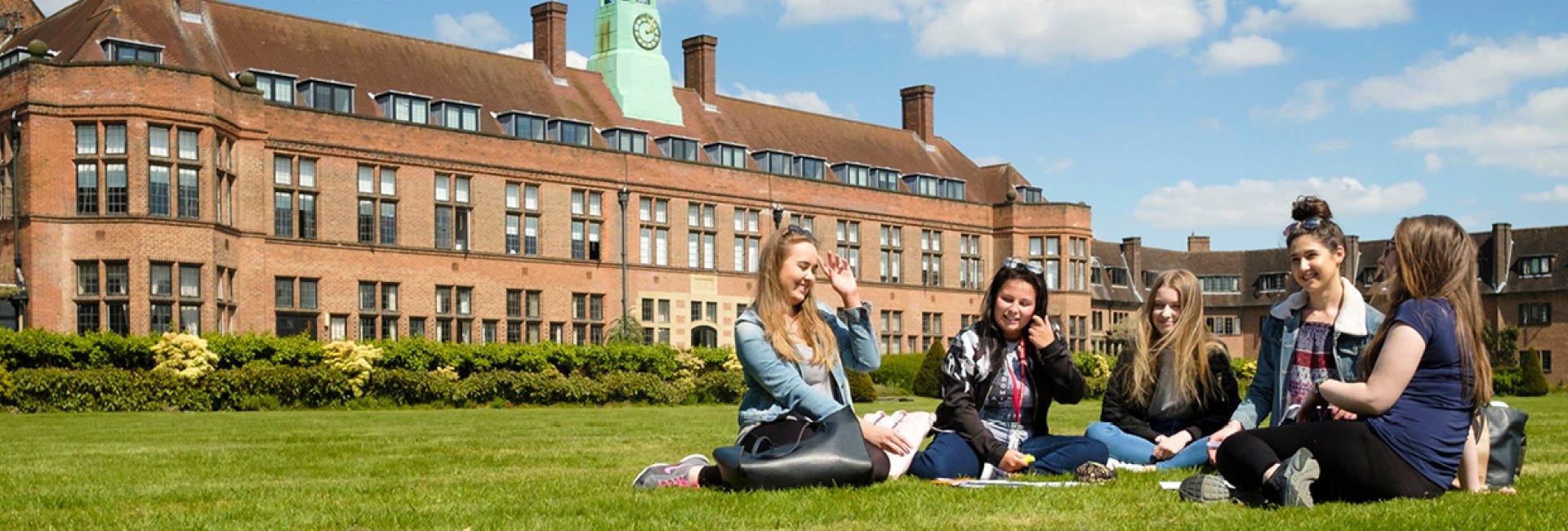
Open Day- Saturday 27th June 2026
27 Jun 2026, 08:00
Liverpool

Please note that Combined Honours degrees at Liverpool Hope University are split 50/50. This means both subjects will be studied equally.
Economics
This is an exciting time to study Economics: great ideological debates, policy decisions and technological changes are taking place that impact our lives, ranging from the direction of globalisation and international trade and trade restrictions, to trends in economic inequality, the environment and climate change, the gender pay-gap, migration flows, economic integration, and financial crises.
Our Economics programme will delve in to an in-depth study of real economic issues like the above, based on a solid foundation of an eclectic economic theory, and an understanding of how economic policy is formulated. This will enable students to gain the analytical and critical evaluation skills needed to recognise how national and global issues affect a society’s welfare.
The course is designed to provide students with the experience, knowledge and skills needed to succeed in the job market, by putting a strong emphasis on analytical, quantitative and research skills highly valued by employers. It will also develop a student’s ability to apply the concepts, theories and quantitative methods to business and public policy decisions, in a diverse range of settings.
In this course, students will study a range of areas, including Quantitative Methods, Econometrics, Intermediate Micro and Macroeconomics, History of Economic Thought, Banking & Finance, and International Economics and Finance.
Sport and Exercise Science
Our degree is founded on the core disciplines of sport and exercise science, namely psychology, physiology and biomechanics, and considers in detail three core questions from a multidisciplinary perspective. How does the human body respond to the different types of exercise, how
can we maximise the effects of training on sport and exercise performance, and how can physical activity reduce and prevent disease?
Study with us and you will have full access to the multi-million pound, state-of-the- art Health Science Building and Sports Complex, incorporating dedicated research space and new teaching laboratories. This facility houses ultra-modern equipment where you will learn to conduct complete physiological, psychological and biomechanical profiles of human sports performance using breath-by-breath expired gas analysis, blood analysis, vascular and cardiac screening, body composition analysis, eye-tracking, electromyography and motion capture to name but a few.
Please visit our website for information regarding the curriculum content.
Students are assessed via a number of methods. Please go to the course link provided for further information.
To work as a teacher at a state school in England or Wales, you will need to achieve qualified teacher status (QTS). This is offered on this course for the following level:
This is the equal consideration deadline. You can still apply after this date, but your application may not receive guaranteed consideration.

Liverpool Hope University has participated in the Teaching Excellence Framework. These ratings were awarded in 2023, for four years.
See why these ratings were awarded
What does this TEF outcome mean?
The following entry points are available for this course:
International applicants should refer to the International section of our website: http://www.hope.ac.uk/international
Qualifications must equate to 112 UCAS points.
Qualifications must equate to 112 UCAS points.
This qualification can only be accepted in conjunction with other relevant qualifications.
Qualifications must equate to 112 UCAS points.
UCAS Tariff points must come from a minimum of two A Levels (or equivalent). Additional points can be made up from a range of alternative qualifications.
Please contact our External Relations team directly for further information on how you can meet our entry requirements and what other qualifications may be accepted.
t: 0151 291 3111
e: enquiry@hope.ac.uk
| Test | Grade | Additional details |
|---|---|---|
| IELTS (Academic) | 6 | For International students, an overall score of 6.0 is required, with 6.0 in both reading and writing and no individual score lower than 5.5. |
This section shows the range of grades that students who received offers were previously accepted on to this course with (learn more).
It is designed to support your research but does not guarantee whether you will or won't get a place.
Admissions teams consider various factors, including interviews, subject requirements, and entrance tests. Check all course entry requirements for eligibility.
We are unable to show previous accepted grades for this course. This could be because the course is new, it's a postgraduate course, there isn't enough historical data, or the provider has opted out of sharing their entry grades data for this course - learn more.
Subject Spotlights give you the chance to try a higher education course before you apply. Delivered by the lecturers themselves you will gain insight into what it's like to study the course and give your personal statement a boost.

| Location | Fee | Year |
|---|
Tuition fee status depends on a number of criteria and varies according to where in the UK you will study. For further guidance on the criteria for home or overseas tuition fees, please refer to the UKCISA website.
Please note, some of our courses may have additional costs. Please visit the course webpage for further information.
Email:courses@hope.ac.uk
Phone:0151 291 3111
Email:businessschool@hope.ac.uk
Phone:0151 291 3087
Email:healthsciences@hope.ac.uk
Phone:0151 291 3441
Hope Park
Liverpool
L16 9JD
At Liverpool Hope University