Course contact details
Admissions (Undergraduate)
Email:admissions@stir.ac.uk
Phone:01786 467044
University of Stirling
Stirling
FK9 4LA

Want a career that changes the world? Environmental Science puts you on the front line of the planet’s biggest challenges, from climate change and pollution to biodiversity loss and the race for clean energy, food, and water.
The environmental consultancy market is booming. The UK environmental consulting market size is expected to reach £2.92 billion ($3.9 billion) by 2033 (IMARC Group).
Our environmental science degree equips you with analytical, field and laboratory skills needed to tackle environmental challenges.
Learn about the complex interactions between people and the environment.
Explore the science behind the global geological, physical, chemical and biological processes that shape our natural environment.
Learn computational skills such as programming in R, data management, Geographical Information Systems (GIS) and remote sensing.
Gain practical skills to prepare you for laboratory and field-based careers.
Get specialist training in environmental policy and management. Utilise the methods and applications in environmental science.
In years 3 and 4 you can opt to specialise in one of these areas:
Environmental Science with Ecology and Biodiversity
Environmental Science with Sustainable Environmental Management
Environmental Science with Climate Change and Environmental Monitoring
Our degree in environmental science gives you lots of opportunities to get practical experience.
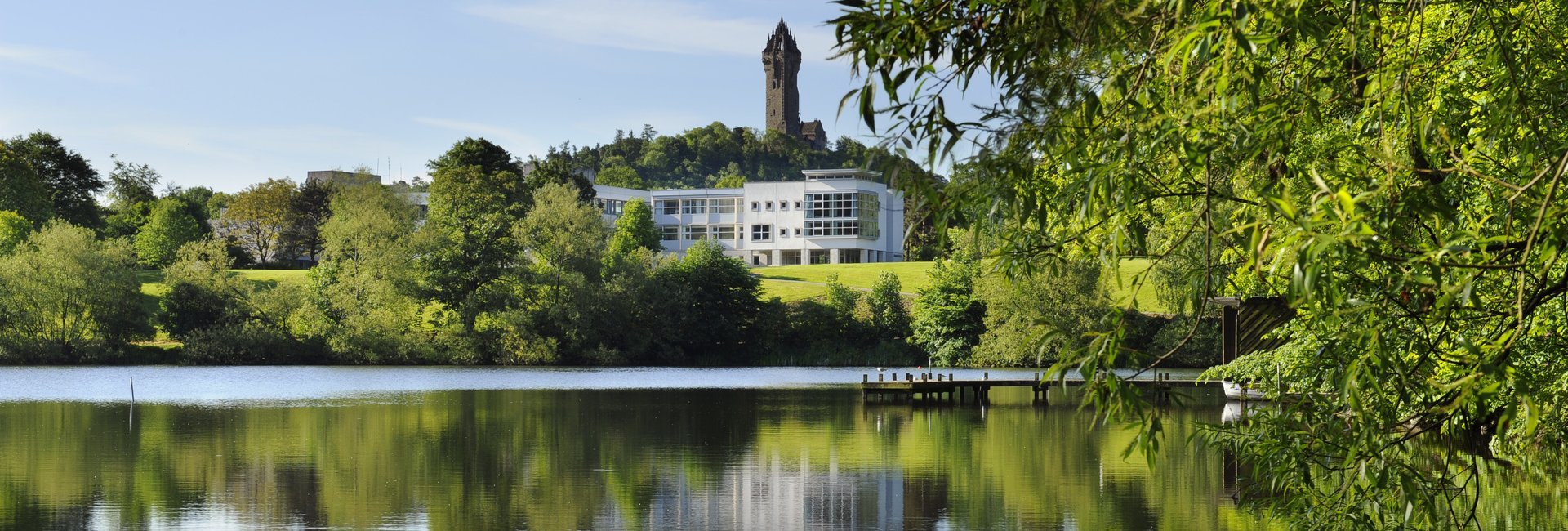
We regularly use the wide range of habitants on our biodiverse campus. We also go to locations close to campus to investigate various species. Skills you'll gain include:
environmental monitoring,
fauna and flora identification,
plant identification,
landscape history and management.
The course also offers the choice of two residential field trips:
A 10-day field course to South Africa to develop your field research skills. You'll explore different physical and environmental processes and ecosystem functioning. You’ll also learn about managing international landscapes.
A 7-day residential experience in the Scottish Highlands. It’s a unique opportunity to study geological, geomorphological and environmental processes at work.
Travel, accommodation, and subsistence on residential field courses are not included in the course fees.
We know that residential field courses can be difficult for some students to attend. They can also have an environmental impact. To widen participation and reduce this impact, we offer non-residential field-based modules. This focuses on day trips around the University.
You can take an optional conservation placement module. You’ll get practical experience with an organisation such as environmental charities, government agencies and industry partners. Previous students have completed placements with:
Royal Society for the Protection of Birds (RSPB)
Highland Wildlife Park
Butterfly Conservation
Bumblebee Conservation Trust
Scottish Water
Bat Conservation Trust
Royal Botanic Garden Edinburgh
Water of Leith Conservation Trust
The Conservation Volunteers
Forest Research
Our environmental science course is accredited by the Community for Environmental Disciplines in Higher Education (CEDHE). They are the education committee of the Institution of Environmental Sciences (IES). University of Stirling environmental science students can join the IES with a free student membership. This is a first step towards chartered status.
Professionally accredited courses provide industry-wide recognition of the quality of your qualification.
The following entry points are available for this course:
| Test | Grade | Additional details |
|---|---|---|
| IELTS (Academic) | 6 | Obtain IELTS 6.0 with 5.5 minimum in each skill or equivalent. |
If you don’t meet the entry requirements there are English language courses which can help you prepare for your degree: https://www.stir.ac.uk/international/international-students/pre-sessional-english-language-courses/https://www.stir.ac.uk/international/international-students/english-language-requirements/
The minimum grade requirements apply to specific categories of 'widening access' applicants domiciled in Scotland who may be eligible for a contextual offer.
This section shows the range of grades that students who received offers were previously accepted on to this course with (learn more).
It is designed to support your research but does not guarantee whether you will or won't get a place.
Admissions teams consider various factors, including interviews, subject requirements, and entrance tests. Check all course entry requirements for eligibility.
Historical entry grades data is not currently available for University of Stirling - we are working with them to try and make it available soon - learn more.
This report uses your grades to show how students with similar results have done when applying to this course in the past. Sometimes, there isn’t data for every possible set of grades. When that happens, universities and colleges occasionally fill in the gaps for sets of grades that are typically accepted.
| Location | Fee | Year |
|---|---|---|
| England, Wales, Northern Ireland, Channel Islands & Republic of Ireland | £10050 | |
| Scotland | £1820 |
Tuition fee status depends on a number of criteria and varies according to where in the UK you will study. For further guidance on the criteria for home or overseas tuition fees, please refer to the UKCISA website.
Scottish students can apply to the Student Award Agency for Scotland (SAAS) to have tuition fees paid by the Scottish government.
Students from the rest of the UK can apply for financial assistance, including a loan to cover the full cost of the tuition fees, from the Lifelong Learning Entitlement (LLE).
Fee information for International and EU students, can be found on the course webpage:
https://www.stir.ac.uk/courses/
The University of Stirling offers a range of scholarships, further information can be found on our website: https://www.stir.ac.uk/scholarships/
Email:admissions@stir.ac.uk
Phone:01786 467044
Stirling
FK9 4LA
At University of Stirling