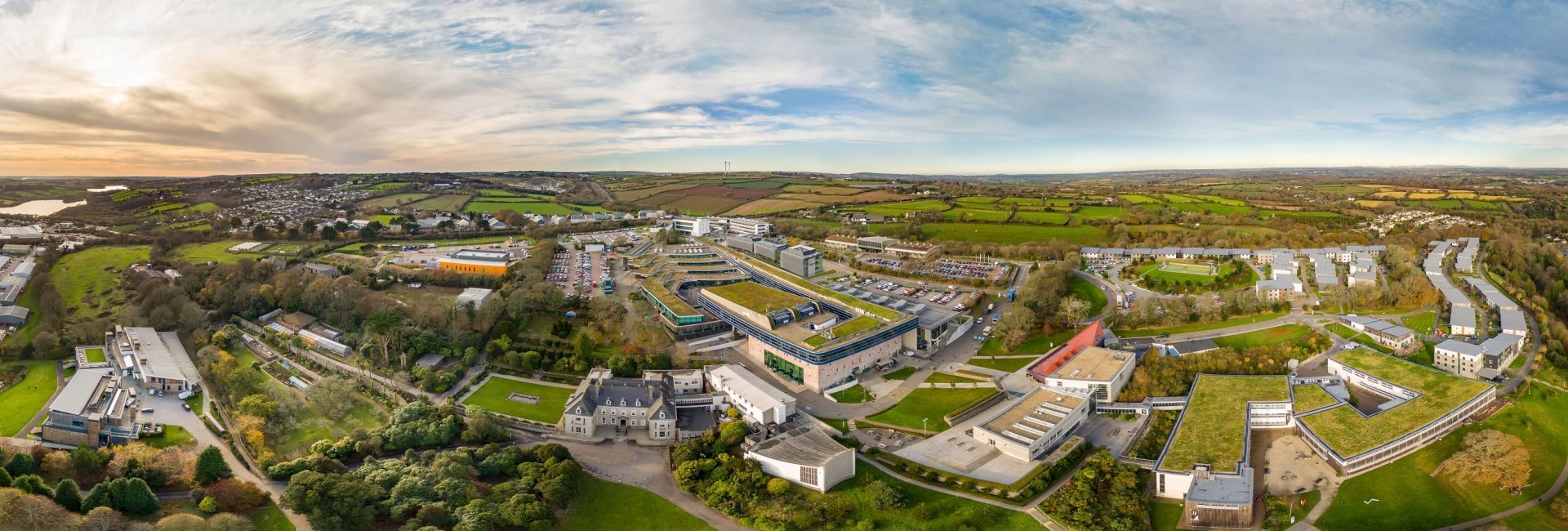
Open Day (in-person)
23 May 2026, 08:00
Falmouth

Bring your ideas to life through the world of animation.
Join this Animation degree and learn to craft believable worlds through animation, a dynamic medium for imaginative storytelling. This course blends traditional and life drawing techniques with 2D, 3D and stop-motion animation methods used in industry today. You’ll explore all aspects of animation before specialising and developing your personal style, preparing you for an exciting future in animation.
On this Animation degree, you’ll learn in an authentic studio set-up, using professional pipelines and working in the collaborative teams this industry thrives on. With the ability to pitch, present and produce, you’ll graduate as a capable, career-ready animator.
You will:
Study at a university which is a member of CILECT, the association of the world’s best film, TV and animation schools
Learn from staff with industry backgrounds and experience in film, children’s TV and advertising
Work in multi-skilled teams, reflecting industry practice
Develop technical and creative knowledge through character animation, storytelling, concept art and the use of software
Hone your skills in the production of 2D, 3D and stop-motion animation, working in professional-standard facilities
Underpin your creative work with theoretical and historical understanding
Gain a working knowledge of industry practice
Graduate with a varied and professional animation portfolio
Through this course, you'll develop your creative and technical skills, build professional practice approaches and hone your personal identity and autonomy within animation production. You'll master the art of your specialism in either 2D, 3D or stop motion animation and learn to present and pitch your ideas. Mirroring industry, you'll also work with multi-disciplinary teams to produce exciting, unique animation productions ready to make your mark in industry.
Year One:
In your first year, you'll explore 2D, 3D and stop-motion techniques to develop your understanding of the fundamental principles of animation. You'll build your knowledge of the animation pipeline and explore underpinning skills in drawing, design and techniques of film language, narrative structures and visual storytelling. You'll also learn to use industry-standard software to support all areas of your work.
Modules:
Animation Practice 1
Animation Practice 2
Underpinning 1
Production Design
Design & Motion
Underpinning 2
Year Two:
In your second year, the emphasis is on collaboration. Working on a live client brief as part of a team, you'll enhance your awareness of communication, time management, responsibility and job roles within the animation industry. You'll continue to develop your expertise in your chosen industry specialism, while refining your underpinning skills in drawing and techniques of film language, narrative structures and visual storytelling. You'll also develop critical research, identifying and exploring a topic that's related to your area of interest.
Modules:
Planning
Create
Underpinning 3
Pre-production Collaboration
Production
Critical Proposal
Year Three:
Your third year is focused around the final major project. You'll have the opportunity to present your film idea and take part in a pitching process, with industry professionals selecting films to go into full production.
You'll have complete creative control over the theme, concept and style of the project. Through the production process, you'll showcase your professional skills as you prepare to step into industry.
Modules:
Critical research
Ideas and Development
Major Pre-production
Production
Profile
As part of our process of continuous improvement, we routinely review course content to ensure that all our students benefit from a high-quality and rewarding academic experience. As such, there may be some changes made to your course which are not immediately reflected in the content displayed on our website. Any students affected will be informed of any changes made directly.
We employ a variety of assessment strategies over the course of this degree. These include the submission of portfolios of practical work, presentations, essays, written or verbal reports and a major research project. In your first year, you'll also have the chance to take part the process of peer group assessment.
Your summative (final) assessments occur at the end of each module, usually at the end of the study block. However, you may have interim formative assessments part way through a module as well. These assessments help ensure that you remain on track with your work.
You'll receive continuous feedback on all your work throughout the year. This will be delivered through tutorials and while you are working in the studio. At the end of a module, you'll receive detailed written feedback and will have the chance to discuss this with your assessor.
The following entry points are available for this course:
If English is not your first language, you will need to demonstrate English language skills that are sufficiently developed for successful completion of your studies. We accept a range of recognised English language qualifications that are equivalent to the International English Language Testing System (IELTS) Academic minimum score of 6.0 overall, with a minimum of 5.5 in Reading, Writing, Speaking and Listening.
Through the award of international scholarships, we aim to support academic enrichment by encouraging diversity and excellence at Falmouth. For details of our international scholarships, and how to apply for them, please visit our website at www.falmouth.ac.uk.
At Falmouth, we recognise excellence in many forms, and we see the whole you.
Our diverse community is creative, innovative and entrepreneurial.
We recognise that these qualities aren’t always shown in academic grades alone. That’s why, while many of our applicants achieve high academic grades, we also welcome those who can demonstrate their potential through an exceptional portfolio or performance.
At a minimum, we typically require the equivalent of 64 UCAS Tariff points for undergraduate courses where we can review a portfolio or audition, or a minimum of 96 UCAS points for those courses that do not require a portfolio or audition. For our Integrated Foundation Year courses, we typically require a minimum of 32 UCAS points for courses where we can review a portfolio or audition, or 64 UCAS points for those that do not require a portfolio or audition.
To support this approach, during a friendly conversation with our academic team, we’ll consider your ideas, your creative output and your ambition to ensure you’ll thrive at Falmouth.
If you are able to demonstrate relevant, current, equivalent experience instead of formal qualifications, we encourage you to apply. Please contact our Applicant Services team before applying, for advice regarding your individual experience and eligibility.
If you are an international applicant and require a Student visa to study in the UK, you must have a recognised English language test approved and vouched for by the University at the appropriate level. You can see what we accept on our website https://www.falmouth.ac.uk/study/international/english-language-requirements Our Applicant Services team can help you with any general questions you may have about study visas or suitable language tests. For more specific advice, we recommend you also consult UKCISA http://www.ukcisa.org.uk/
Find out more about qualification requirements for this course.
View our list of accepted English language tests and qualifications using the link below https://www.falmouth.ac.uk/study/international/english-language-requirements
At Falmouth University, we take a rounded approach to admissions. Instead of focusing on criteria like grades alone, we operate a contextual admissions policy, where we look at you as a person: your talents, your experiences and your potential. Every offer we make is shaped around you and your circumstances, and our conditional offers are always intended to be realistic and achievable.
This section shows the range of grades students (with UK A-Levels or Pearson BTEC Level 3 National Extended Diplomas) who received offers were previously accepted with (learn more). It is designed to support your research but does not guarantee whether you will or won't get a place. Admissions teams consider various factors, including interviews, subject requirements, and entrance tests. Check all course entry requirements for eligibility.
Students aged 17/18 who applied to this course were offered a place.
See how students with your grades have been accepted onto this course in the past.
Operated by the Office for Students
Employment after 15 months (Most common jobs)
Go onto work and study
The number of student respondents and response rates can be important in interpreting the data – it is important to note your experience may be different from theirs. This data will be based on the subject area rather than the specific course. Read more about this data on the Discover Uni website.
No fee information has been provided for this course
Tuition fee status depends on a number of criteria and varies according to where in the UK you will study. For further guidance on the criteria for home or overseas tuition fees, please refer to the UKCISA website.
No additional fees or cost information has been supplied for this course, please contact the provider directly.
Woodlane
Falmouth
TR11 4RH
Visit our website Visit our course page
Email:applicantservices@falmouth.ac.uk
Phone:01326 213730