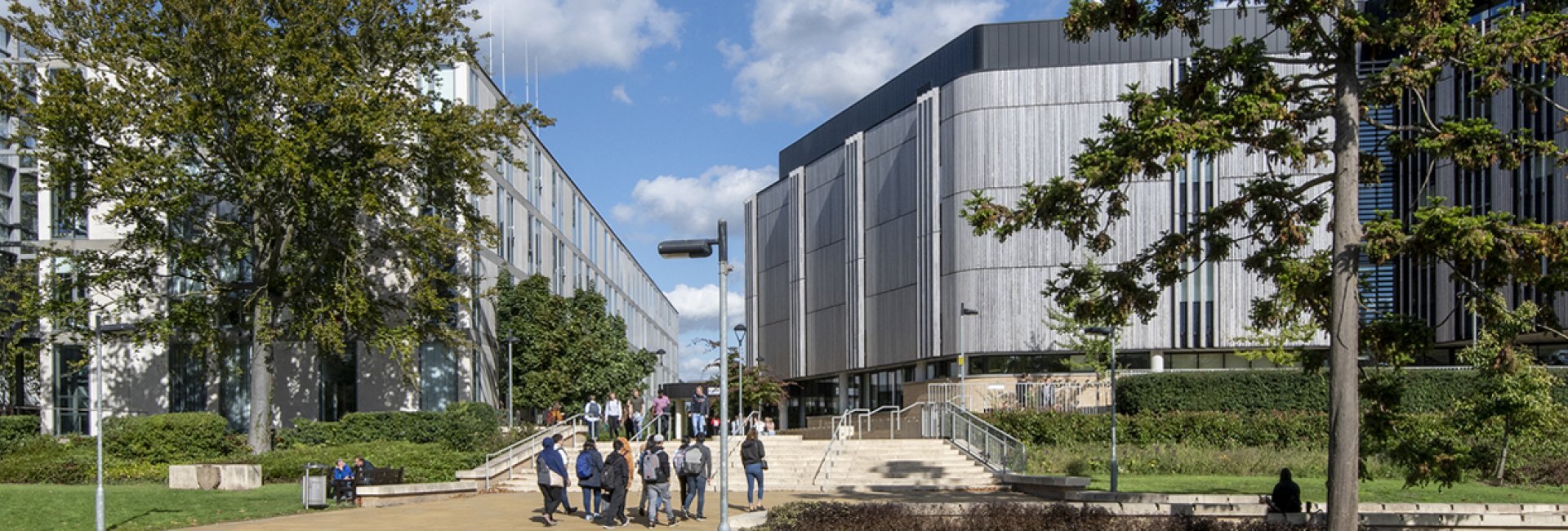
Winchester School of Art - Open Day
6 Jun 2026, 09:00
Winchester

Summary
Physics helps us understand everything from the vastness of galaxies to the smallest building blocks of matter. It is a way of seeing the universe with clarity and precision.
On this three-year BSc Physics degree, you will explore the core ideas that shape modern physics, including relativity, quantum mechanics and electromagnetism. These are the tools that explain how the universe works at every scale.
Here, you can shape your own path. Choose from a range of optional modules each year and follow the topics that spark your curiosity. You will also have the flexibility to switch between the BSc and MPhys degrees up until the end of your second year.
You will learn in an environment where research and teaching go hand in hand, gaining insight into the ideas that are shaping the future of physics.
Key features of the course
Access facilities that bring physics to life. From a rooftop observatory to specialist photonics laboratories, you will work with equipment used in real research.
It is your journey. Build your degree around your interests with optional modules throughout your studies.
Keep your options open. You can move between the BSc and MPhys pathways until the end of your second year.
This course is accredited by the Institute of Physics, giving you a strong foundation for your future career.
Student support
Your Personal Academic Tutor will support you throughout your time at Southampton. They will offer guidance on your studies, help you plan your next steps, and connect you with wider support if you need it.
You will be part of a collaborative community, learning alongside students and academics who share your curiosity about how the world works.
Further information
A physics degree opens doors across a wide range of careers. Our graduates go on to roles as physicists and engineers, as well as careers in data, finance and research. Others apply their skills in areas such as science communication and medicine.
Wherever you want to go, you will graduate with the analytical thinking, problem-solving ability and technical expertise that employers value.
Typical modules include:
Year one: Electricity and Magnetism; Energy and Matter; Mathematical Methods for Physical Scientists; Motion and Relativity; Physics Skills; Waves, Light and Quanta; plus additional module options.
Year two: Classical Mechanics; Electromagnetism; Physics from Evidence I; Quantum Physics; Statistical Mechanics; Wave Physics; plus additional module options.
Year three: Atomic Physics; BSc Final Year Synoptic Examination; Bachelor of Science Project; Crystalline Solids; Nuclei and Particles; plus additional module options.
Throughout your degree, you’ll also develop key transferable skills such as problem solving, data analysis and computing, which are sought after by a range employers. During year two, you’ll also have access to a programme of physics-focused career sessions, timetabled to fit in with your studies, which include application and interview workshops as well as talks from visiting professionals.
Assessment in the first and second year is a mixture of unseen written examinations, marked problem-based coursework and laboratory work. For the BSc programme, in the third year assessment is mainly by examination; laboratory work is replaced by a project which involves continuous assessment, written reports and an oral examination.
Professionally accredited courses provide industry-wide recognition of the quality of your qualification.
This is the equal consideration deadline. You can still apply after this date, but your application may not receive guaranteed consideration.

University of Southampton has participated in the Teaching Excellence Framework. These ratings were awarded in 2023, for four years.
See why these ratings were awarded
What does this TEF outcome mean?
The following entry points are available for this course:
AAA-AAB including physics (minimum grade A) and either mathematics or further mathematics (minimum grade A.
or
AABB-ABBC including physics (minimum grade A) and either mathematics or further mathematics (minimum grade A).
A pass in the Physics science practical is required.
Offers typically exclude General Studies and Critical Thinking. Successful applicants will be invited to visit the department and attend an optional interview. The optional interview may lead to the lower offer. Applicants who have not studied mathematics/further mathematics and/or physics at A-level can apply for the Engineering/Physics/Mathematics Foundation Year.
If you are taking an EPQ in addition to 3 A levels, you will receive the following offer in addition to the standard A level offer: AAB including physics (minimum grade A) and either mathematics or further mathematics (minimum grade A) plus grade A in the EPQ.
We are committed to ensuring that all students with the potential to succeed, regardless of their background, are encouraged to apply to study with us. The additional information gained through contextual data allows us to recognise a student’s potential to succeed in the context of their background and experience. Students who are highlighted in this way will be made an offer which is lower than the typical offer for that programme.
We normally consider applicants who offer at least 1 Advanced Higher. Applicants presenting with only Highers will be considered on a case by case basis. Where Highers are taken over two years it might be expected that higher grades are achieved, particularly in any specific subjects required. For example, S5 – S6 (2 years): AABBB (A in specific subject) or S6 (1 year): ABBBB (A in specific subject).
Unless a more advanced level (Higher or Advanced Higher) is specified in the stated entry requirements, all applicants will be required to have achieved a pass in Mathematics and English at Standard Grade, Grade 3 or National 5, Grade C, the equivalent of GCSE Grade C/ Grade 4
We are committed to ensuring that all learners with the potential to succeed, regardless of their background, are encouraged to apply to study with us. The additional information gained through contextual data allows us to recognise a learner's potential to succeed in the context of their background and experience. Applicants who are highlighted in this way will be made an offer which is lower than the typical offer for that programme.
Applicants must hold GCSE English language (or GCSE English) (minimum grade 4/C) and mathematics (minimum grade 4/C)
D in the BTEC Subsidiary Diploma plus grades AA from two A-levels including physics and either mathematics or further mathematics.
Successful applicants will be invited to visit the department and attend an optional interview. The optional interview may lead to the lower offer. Applicants who have not studied mathematics/further mathematics and/or physics at A-level can apply for the Engineering/Physics/Mathematics Foundation Year.
If you are taking an EPQ in addition to 3 A levels, you will receive the following offer in addition to the standard A level offer: AAB including physics (minimum grade A) and either mathematics or further mathematics (minimum grade A) plus grade A in the EPQ
A pass in the physics Practical exam is required where it is separately endorsed.
Pass, with 36-34 points overall with 18-17 points at Higher Level, including 6 at Higher Level in Mathematics (Analysis and Approaches or Applications and Interpretation) and 6 at Higher Level in Physics.
We are committed to ensuring that all learners with the potential to succeed, regardless of their background, are encouraged to apply to study with us. The additional information gained through contextual data allows us to recognise a learner’s potential to succeed in the context of their background and experience. Applicants who are highlighted in this way will be made an offer which is lower than the typical offer for that programme.
Successful applicants will be invited to visit the department and attend an optional interview. The optional interview may lead to the lower offer. Applicants who have not studied mathematics and/or physics at Higher Level can apply for the Engineering/Physics/Mathematics Foundation Year.
International Baccalaureate Career Programme (IBCP) offer
Offers will be made on the individual Diploma Course subject(s) and the career-related study qualification. The CP core will not form part of the offer. Where there is a subject pre-requisite(s), applicants will be required to study the subject(s) at Higher Level in the Diploma course subject and/or take a specified unit in the career-related study qualification. Applicants may also be asked to achieve a specific grade in those elements.
Please see the University of Southampton International Baccalaureate Career-Related Programme (IBCP) Statement for further information. Applicants are advised to contact their Faculty Admissions Office for more information.
AAA-AAB including physics (minimum grade A) and either mathematics or further mathematics (minimum grade A)
or
AA from two A-levels including physics and either mathematics or further mathematics and A-B from the Advanced Skills Baccalaureate Wales.
or
AABB-AABC including physics (minimum grade A) and either mathematics or further mathematics (minimum grade A)
or
AA from two A-levels including physics and either mathematics or further mathematics, plus grades BB-BC from a third A-level and the Advanced Skills Baccalaureate Wales.
Offers typically exclude General Studies and Critical Thinking. Successful applicants will be invited to visit the department and attend an optional interview. The optional interview may lead to the lower offer. Applicants who have not studied mathematics/further mathematics and/or physics at A-level can apply for the Engineering/Physics/Mathematics Foundation Year.
A pass in the physics Practical exam is required where it is separately endorsed.
H1,H2,H2,H2,H2,H2- H2,H2,H2,H2,H2,H2 including mathematics, applied mathematics and physics
We are committed to ensuring that all learners with the potential to succeed, regardless of their background, are encouraged to apply to study with us. The additional information gained through contextual data allows us to recognise a learner’s potential to succeed in the context of their background and experience. Applicants who are highlighted in this way will be made an offer which is lower than the typical offer for that programme.
Successful applicants will be invited to visit the department and attend an optional interview. The optional interview may lead the lower offer.
D in the BTEC Extended Certificate plus grades AA from two A-levels including physics and either mathematics or further mathematics.
Successful applicants will be invited to visit the department and attend an optional interview. The optional interview may lead to the lower offer. Applicants who have not studied mathematics/further mathematics and/or physics at A-level can apply for the Engineering/Physics/Mathematics Foundation Year.
D3 D3 D3 - D3 D3 M2 in three Principal subjects including physics (minimum grade D3) and either mathematics or further mathematics (minimum grade D3).
Successful applicants will be invited to visit the department and attend an optional interview. The optional interview may lead to the lower offer.
We are committed to ensuring that all learners with the potential to succeed, regardless of their background, are encouraged to apply to study with us. The additional information gained through contextual data allows us to recognise a learner’s potential to succeed in the context of their background and experience. Applicants who are highlighted in this way will be made an offer which is lower than the typical offer for that programme.
Cambridge Pre-U's can be used in combination with other qualifications such as A Levels to achieve the equivalent of the typical offer, where D3 can be used in lieu of A Level grade A or grade M2 can be used in lieu of A Level grade B.
If you are not sure that your qualifications meet the requirements of this course please contact our Admissions Teams. https://www.phys.soton.ac.uk/programmes/f300-bsc-physics-3-yrs
| Test | Grade | Additional details |
|---|---|---|
| IELTS (Academic) | 6.5 | with no component below 6.0 |
All programmes at the University of Southampton are taught and assessed in the medium of English (other than those in modern foreign languages). Therefore, all applicants must demonstrate they possess at least a minimum standard of English language proficiency.https://www.southampton.ac.uk/studentadmin/admissions/admissions-policies/language.page
Most of the students who enrolled on this course in previous years met their offer conditions at our published entry criteria, securing their place on their chosen course. We encourage all applicants with the potential to succeed, regardless of their background, to apply to study with us. Applicants who qualify for contextual admissions will be made an offer which is lower than the typical offer for that programme.
This section shows the range of grades that students who received offers were previously accepted on to this course with (learn more).
It is designed to support your research but does not guarantee whether you will or won't get a place.
Admissions teams consider various factors, including interviews, subject requirements, and entrance tests. Check all course entry requirements for eligibility.
We are unable to show previous accepted grades for this course. This could be because the course is new, it's a postgraduate course, there isn't enough historical data, or the provider has opted out of sharing their entry grades data for this course - learn more.
| Location | Fee | Year |
|---|---|---|
| England, Scotland, Wales, Northern Ireland, Channel Islands & Republic of Ireland | £10050 | |
| EU & International | TBC |
Tuition fee status depends on a number of criteria and varies according to where in the UK you will study. For further guidance on the criteria for home or overseas tuition fees, please refer to the UKCISA website.
Please see our website for further details and updates regarding tuition fees.
We anticipate that international tuition fee levels for 2027 entry will be confirmed in August 2026.
Email:ugadmissions@southampton.ac.uk
Phone:023 8059 4732
Highfield
Southampton
SO17 1BJ
At University of Southampton