Course contact details
UG Home and EU Admissions
Email:admissions@ucb.ac.uk
Phone:0121 604 1040
University College Birmingham
Summer Row
Birmingham
B3 1JB

OVERVIEW
Nutrition issues have become increasingly important in the commercial food sector, with food-related research and product developments now being regularly reported in the media. With growing demand for graduates with specialised nutrition backgrounds, our Food and Nutrition top-up degree course is a great option for anyone with existing knowledge of this field to help you get into the industry.
This Food and Nutrition top-up course is designed for anyone who has previously studied a relevant subject (up to Level 5) and has been developed in accordance with guidelines from the Association for Nutrition (AfN) with the aim of becoming an accredited course. Expanding upon your current knowledge and skills, your studies will cover core competencies for the sector, including nutritional science, current issues in food and nutrition, supply and sustainability.
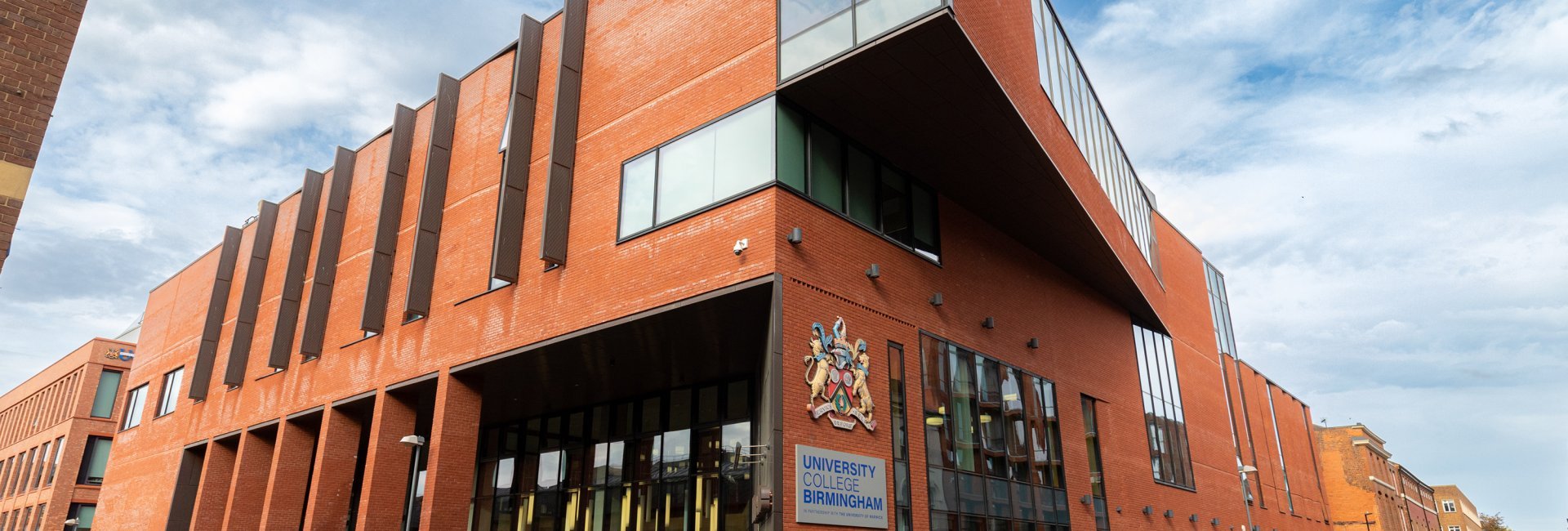
To help support your learning, you will have the chance to work in our cutting-edge Food Science and Innovation Suite as well as our industry standard kitchen facilities at University College Birmingham. Thanks to our celebrated links with the food industry, you will also benefit from a range of guest lectures and the latest industry research.
WHY CHOOSE THIS COURSE?
Specialise your studies – Develop a specialism relevant to your chosen career through optional modules, covering subjects including food technology and food education
Practical application – Get hands-on working in our state-of-the-art facilities featuring the latest food testing and diagnostic equipment
Enrichment – Our industry connections provide you with guest lectures from experts and additional work experience opportunities, as well as the latest research from the industry
FACILITIES
University College Birmingham is renowned for its outstanding food industry training facilities. As a student on our Food and Nutrition course, you will have access to our professional standard kitchens which are used regularly for prestigious competitions, as well as our Food Science and Innovation Suite. Designed with the help of the food industry, this multi-million pound suite features the latest food testing and diagnostic technology, state-of-the-art development kitchen facilities and a bespoke sensory evaluation room.
PLACEMENTS
We encourage students on our top-up course to gain work experience throughout your studies.
Employers we have worked with include Ritz Carlton Naples (Florida), NHS England, Holland & Barrett (Coventry), Food Cycle (Birmingham) and Sandwell Council (Birmingham).
CAREERS AND PROGRESSION
Examples of careers you could pursue following this course:
Nutritionist
Food technologist
Product/process development scientist
Health promotion specialist
Nutritional therapist
Secondary school teacher (food technology)
You could also progress onto one of our postgraduate courses at University College Birmingham.
Plus one option from:
Plus one option from:
Note: Indicative information only. Actual timetables and assessment regimes will be issued at your induction. Please be aware that methods of delivery for this course may be altered due to the ongoing Covid-19 pandemic – for the most up-to-date information, please refer to our website: www.ucb.ac.uk
ASSESSMENT
Estimated breakdown of assessment for this course (weighting may vary depending on optional modules):
Our teaching and assessment is underpinned by our Teaching, Learning and Assessment Strategy 2021-2024.

University College Birmingham has participated in the Teaching Excellence Framework. These ratings were awarded in 2023, for four years.
See why these ratings were awarded
What does this TEF outcome mean?
All non-EU international students can apply directly via our online application forms:
https://portal.ucb.ac.uk/#/admissions/direct-application/intro
Undergraduate applicants can also apply via UCAS, if they wish to apply to more than one university. The International Admissions team aim to respond to any new application made directly via the online application form within 5 working days of receipt. However, this can vary during peak application periods (particularly January-March) or if the team require additional information to process your application.
Applicants who apply to transfer to University College Birmingham on to a second year or final year of a course will have their previous course matched for entry.
Each application is considered individually and careful consideration is given to all information on your application form. We may also need to contact you regarding your immigration status or previous studies in the UK.
Discover what it's like to study Food and Nutrition Top-up at University College Birmingham: insights on the course, making friends, personal statement tips, uni prep, and recommended books, podcasts, and videos.

A relevant HND or a foundation degree in the areas of Food, Food and Nutrition or Food Technology, with 240 credits.
If you are unsure if your previous qualification is suitable please contact us before completing an application, you can call us on 0121 604 1040 or email: direct@ucb.ac.uk
EU/international students
Academic: European and International qualifications studied in a relevant subject matter will also be considered applicants will need to have achieved 120 ECTS or equivalent (European Credit Transfer)
If you are unsure if your previous qualification is suitable please contact us before completing an application, you can call us on 0121 604 1040 or email
EU: euadmissions@ucb.ac.uk
International: International@ucb.ac.uk
Find out more about qualification requirements for this course.
UCB English Language Requirementshttp://www.ucb.ac.uk/our-courses/international/english-language-requirements/english-language-requirements-table.aspx
This section shows the range of grades that students who received offers were previously accepted on to this course with (learn more).
It is designed to support your research but does not guarantee whether you will or won't get a place.
Admissions teams consider various factors, including interviews, subject requirements, and entrance tests. Check all course entry requirements for eligibility.
This course may have Historical entry grades data available, please select a course option to view.
Course optionsThis report uses your grades to show how students with similar results have done when applying to this course in the past. Sometimes, there isn’t data for every possible set of grades. When that happens, universities and colleges occasionally fill in the gaps for sets of grades that are typically accepted.
| Location | Fee | Year |
|---|
Tuition fee status depends on a number of criteria and varies according to where in the UK you will study. For further guidance on the criteria for home or overseas tuition fees, please refer to the UKCISA website.
UK:
If you are a UK student enrolling on a Foundation Degree or a BA/BSc at University College Birmingham in 2021/22, your fee for this academic year will be £9,250. A half year tuition fee is £4625.
This is a yearly fee, and will increase with inflation in subsequent years (in line with the government’s permitted rise).
If you are an English student studying your first higher education qualification, you can apply for a tuition fee loan from the Student Loans Company. You will not start repaying this loan until you leave the course and are earning over £25,000 a year.
If you live in Scotland, Wales or Northern Ireland, you should apply to Student Finance Wales, Student Finance Northern Ireland, or SAAS. The loans and grants available to you will differ from those available from Student Finance England.
UCB does not charge for 24 or 48 week placements.
More information about UK Fees please go to our website here -
https://www.ucb.ac.uk/study/fees-and-funding/undergraduate-fees/
EU and International:
More information about International Fees please go to our website here - https://www.ucb.ac.uk/our-courses/international/tuition-fees-and-scholarships.aspx
Email:admissions@ucb.ac.uk
Phone:0121 604 1040
Summer Row
Birmingham
B3 1JB
At University College Birmingham