ASU London - June Open Day
27 Jun 2026, 09:00
London

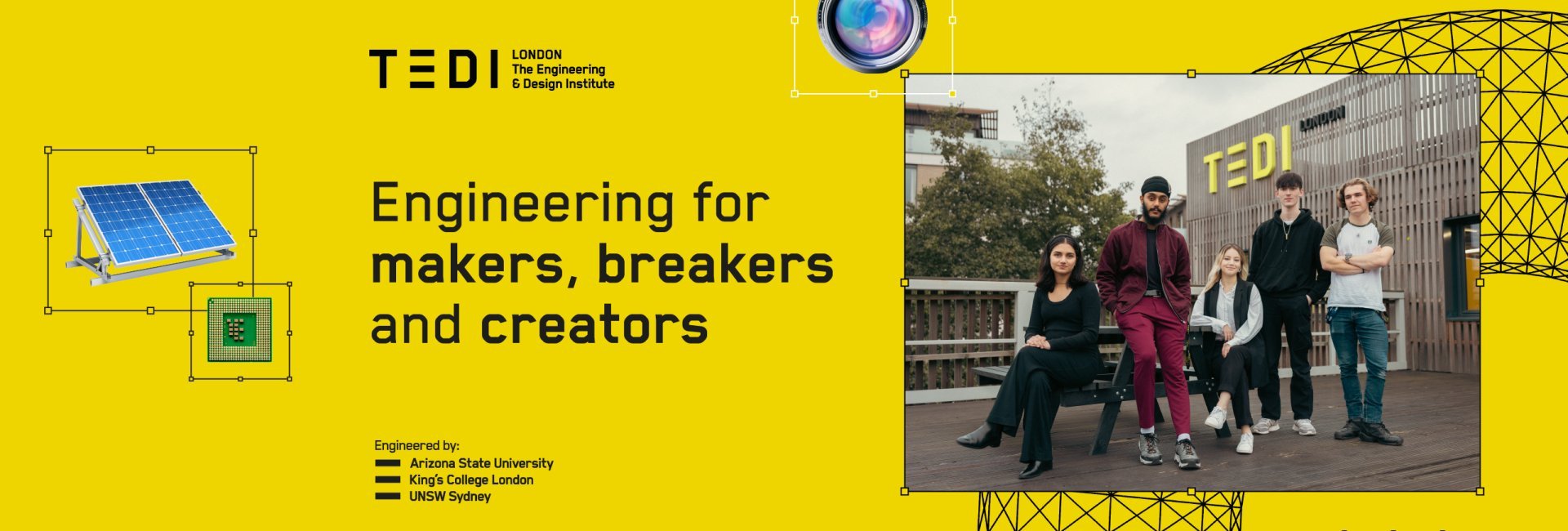
ASU London is now home to TEDI-London.
Innovate, build, and lead in Electronic and Electrical Engineering
Design, build, and innovate at ASU London - where UK and US engineering excellence meet. Earn a bachelor’s and master’s in just four years and launch your global electronic and electrical engineering career. More choices, bigger opportunities with post-study work options for you to begin your career, including up to three-year visa options in the US.
Electronic and Electrical Engineering (EEE) is key to our digital future, from smart grids and renewable energy to AI-enabled devices, communications networks and future data centres. This degree programme equips you with the knowledge, creativity and professional skills to design, build and manage the technologies that underpin a sustainable, intelligent future.
Complete your undergraduate at ASU London then head to Arizona State University to complete your master’s degree. Through ASU London’s partnership with Arizona State University you’ll gain access to a number of specialisations from the one of the best engineering schools in the world, allowing you to complete both qualifications in just four years.
How will you learn?
As soon as you start, you’ll be on a fast-track to complete your bachelor’s degree and master’s degree in Electronic and Electrical Engineering in four years.
You’ll learn through a mix of hands-on labs, makerspace projects, simulations, and problem-based learning.
Group projects let you tackle real-world engineering challenges, developing teamwork, problem-solving and communication skills while designing, testing, and analysing circuits, sensors, actuators, and systems.
Maths and digital skills are taught in context, helping you apply them confidently across all areas of electronic and electrical engineering. Assessments mirror industry practice, preparing you for the challenges of professional engineering.
From 2026, ASU London will be located in the heart of Islington, Central London at the City St George’s Clerkenwell campus. From trendy cafés and live music venues to leafy parks and independent shops, Islington offers the perfect mix of city buzz and community feel. It is one of London’s most vibrant student areas.
The new ASU London campus will combines sustainable design with flexible, modern learning spaces built to inspire innovation. You will have access to plenty of areas for all facets of student life, including places you can use to socialise, study, worship or reflect.
After you graduate
Graduates enter fields such renewable energy, smart grids, telecommunications, and digital infrastructure. You can choose between specialising in one of two pathways: Power systems (focusing on energy networks, power electronics, and smart grids) or communication systems (exploring fields, signals, antennas, and advanced networks).
Year 1
-Empowering Engineering
-Simulation
-Smart Systems
-Engineering Leadership and Impact
Year 2
Core Modules:
-Research and Innovation
-Ecological Structures
-Machine Learning
-Power Systems Recommended Modules
-Power Electronics
-Power Systems
Communications Systems Recommended Modules:
-Field and Waves
-Signal Processing
Year 3
Core Modules:
-Global Design Engineering Individual Project
-Applied Artificial Intelligence
Power Systems Recommended Modules:
-Advanced Power Electronics
-Energy Networks
-Power Plants
-Renewable Energy
Communications Systems Recommended Modules:
-Communication Systems and Networks
-Antennas
-Computer-Controlled Systems
-Optoelectronics
To support your development as an engineer, you’ll be assessed in a variety of ways that reflect both professional practice and technical understanding.
These include: Individual and group assessments such as reports, presentations, vivas, tests, log books, and portfolios.
This mix of methods gives you the chance to demonstrate your skills in different formats and ensures fair opportunities for all learning styles.
Group work is an important part of the programme, and a clear group working policy is in place to make sure contributions are consistent and fairly recognised.
The following entry points are available for this course:
If studying A Levels, T Levels, IB, BTEC (or any post 16 education) you’ll be on track for approximately 120 UCAS points or equivalent
A minimum of a grade C or 4 in Maths is required. Equivalents can be accepted, please contact admissions@asu-london.ac.uk
| Test | Grade | Additional details |
|---|---|---|
| IELTS (Academic) | 6 | We require 6.0 overall within a minimum score of 5.5 in each component. Must be IELTS Academic for UKVI |
This section shows the range of grades that students who received offers were previously accepted on to this course with (learn more).
It is designed to support your research but does not guarantee whether you will or won't get a place.
Admissions teams consider various factors, including interviews, subject requirements, and entrance tests. Check all course entry requirements for eligibility.
We are unable to show previous accepted grades for this course. This could be because the course is new, it's a postgraduate course, there isn't enough historical data, or the provider has opted out of sharing their entry grades data for this course - learn more.
| Location | Fee | Year |
|---|---|---|
| England, Scotland, Wales, Northern Ireland, Channel Islands & Republic of Ireland | £9780* | |
| EU & International | £23600* |
* This is a provisional fee and subject to change.
Tuition fee status depends on a number of criteria and varies according to where in the UK you will study. For further guidance on the criteria for home or overseas tuition fees, please refer to the UKCISA website.
No additional fees or cost information has been supplied for this course, please contact the provider directly.
Email:admissions@asu-london.ac.uk
TEDI-London Building
11 Quebec Way
London
SE16 7LG
At ASU London