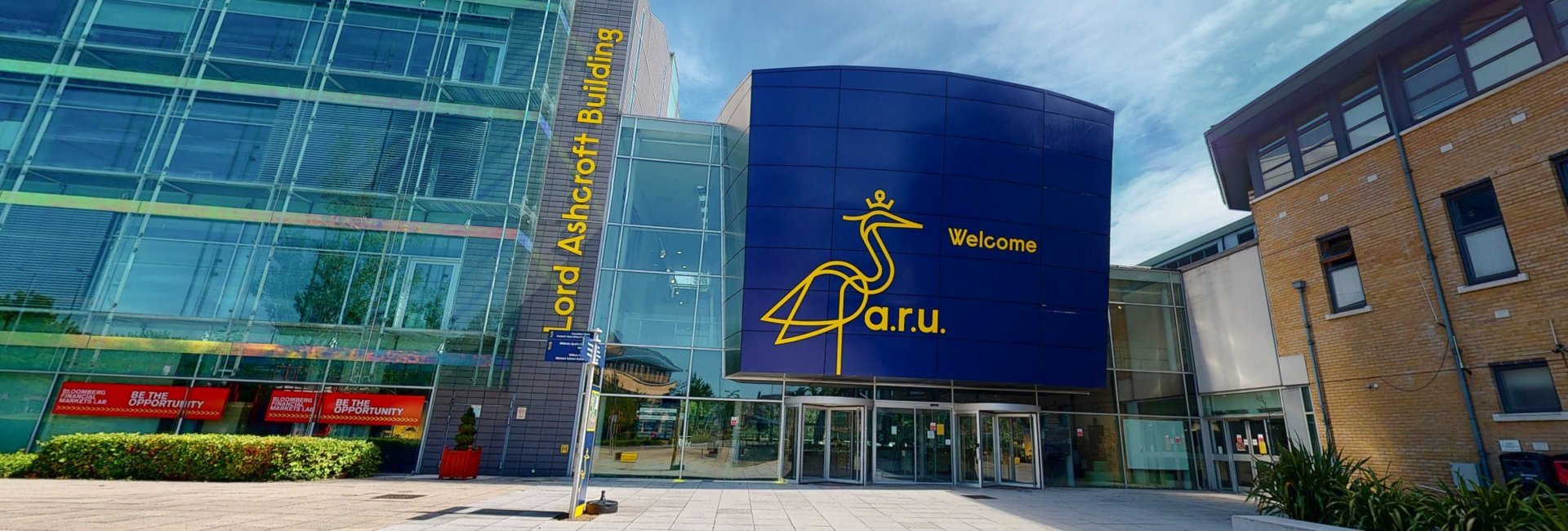
Anglia Ruskin University - Undergraduate Open Day - Cambridge
6 Jun 2026, 09:00
Cambridge

Graduate with a professionally recognised LLB while exploring how law interacts with society, culture, inequality, and social change.
The LLB (Hons) Law with Sociology gives a valuable insight into the sociological aspects in which society and legal professionals operate. Explore the invisible forces that shape our world - sociology uncovers how groups, cultures, and institutions influence human behaviour, making this degree ideal for those curious about people and power. Our degree gives you the option to pursue a career as a solicitor or barrister, whilst opening up options in teaching, community and social work, non-profit organisations or policy development.
Alongside the seven foundational subjects required for professional legal training, you’ll get applied sociological insight in areas like global social and political issues, power structures in society, and bridging cultures. With optional modules you’ll be able to tailor your degree to your interests as you broaden your knowledge and expertise. These could include delving into global feminism, woke wars or looking at social mobility and migration.
You’ll develop critical thinking, communication, and personal development skills whilst being taught by legal professionals and experienced academics. On graduating, you’ll hold a qualifying law degree and a dual understanding of legal reasoning and sociology.
Why ARU?
Qualifying law degree with a sociological lens - graduate with a professionally recognised LLB while exploring how law interacts with society, culture, inequality, and social change.
Understand the social impact of legal systems - study topics like identity, power, justice, and institutions alongside core legal subjects - ideal for careers in law, policy, advocacy, or social research.
Real-world experience through Live Briefs and Law Clinic - work on live courtroom scenarios and advise real clients in our award-winning Law Clinic, gaining practical legal and sociological insight.
Learn from experts in law and social sciences - be taught by experienced academics and legal professionals who bring current debates and real-world relevance into the classroom.
Tailor your studies and boost your employability - choose optional modules, complete an independent research project, and benefit from our nationally recognised ARU CPD programme.
Year 1:
Foundation in Law and Policing
Year 2:
Constitutional and Administrative Law
Global Affairs
Contract Law
Criminal Law
Into ARU
Year 3:
Tort Law
Ruskin Module (15 credits)
Critical Social Thought: Knowledge, Power and Division
Equity, Trusts and Succession
Mobilities and Migration
Violence, Gender and Victimisation
Woke Wars
Bridging Cultures
Year 4:
Property Law
EU Law
Undergraduate Major Project
Diversity, Equality and the Law
Issues in Immigration Law
Global Feminisms
Environment, Nature and Society
The Making of Modern Media
You'll complete preparatory tasks and contribute to online discussions. This will help your critical engagement with legal and sociological materials, foster your independent reasoning, and enable you to apply legal principles to real-world and hypothetical scenarios. Screencasts introduce essential legal content and theoretical frameworks, offering guided analysis of key issues. They provide discussion prompts, assignment guidance, and illustrative examples, encouraging you to develop a critical understanding of legal and sociological debates and to begin formulating your own structured arguments.
In interactive, discussion-rich sessions, your tutor will facilitate deeper exploration of complex legal and sociological topics. Through problem-based learning and guided analysis, you'll refine your ability to apply legal principles critically, articulate well-reasoned arguments, and engage in collaborative evaluation of case law and academic commentary.
You'll present your interpretations of legal and sociological materials in student-led workshops and then reflect on your progress, clarify outstanding questions, and plan for improvement.
Professionally accredited courses provide industry-wide recognition of the quality of your qualification.
This is the equal consideration deadline. You can still apply after this date, but your application may not receive guaranteed consideration.

Anglia Ruskin University has participated in the Teaching Excellence Framework. These ratings were awarded in 2023, for four years.
See why these ratings were awarded
What does this TEF outcome mean?
The following entry points are available for this course:
If you have achieved at least grade E in one A level, or equivalent, you are exempt from the two years post-GCSE study requirement, but you still must meet the GCSE requirements.
Applicants who do not meet the two years post GCSE study at level 3 may be considered based on their satisfactory employment history, which must be a minimum of two years full time employment supported by employer evidence and deemed appropriate by the University for meeting the course of study applied for.
If English is not your first language you will be expected to demonstrate a certificated level of proficiency of at least IELTS 5.5 (Academic level) or equivalent English Language qualification, as recognised by Anglia Ruskin University.
Find out more about qualification requirements for this course.
This section shows the range of grades students (with UK A-Levels or Pearson BTEC Level 3 National Extended Diplomas) who received offers were previously accepted with (learn more). It is designed to support your research but does not guarantee whether you will or won't get a place. Admissions teams consider various factors, including interviews, subject requirements, and entrance tests. Check all course entry requirements for eligibility.
We are unable to show previous accepted grades for this course. This could be because the course is new, it's a postgraduate course, there isn't enough historical data, or the provider has opted out of sharing their entry grades data for this course - learn more.
| Location | Fee | Year |
|---|---|---|
| England | £5760 | Year 1 |
| Northern Ireland | £5760 | Year 1 |
| Scotland | £5760 | Year 1 |
| Wales | £5760 | Year 1 |
| Channel Islands | £5760 | Year 1 |
| Republic of Ireland | £5760 | Year 1 |
Tuition fee status depends on a number of criteria and varies according to where in the UK you will study. For further guidance on the criteria for home or overseas tuition fees, please refer to the UKCISA website.
https://aru.ac.uk/student-life/preparing-for-university/help-with-finances/undergraduate
https://www.aru.ac.uk/study/tuition-fees
East Road
Cambridge
CB1 1PT
Visit our website Visit our course page
Email:answers@aru.ac.uk
Phone:01245 68 68 68