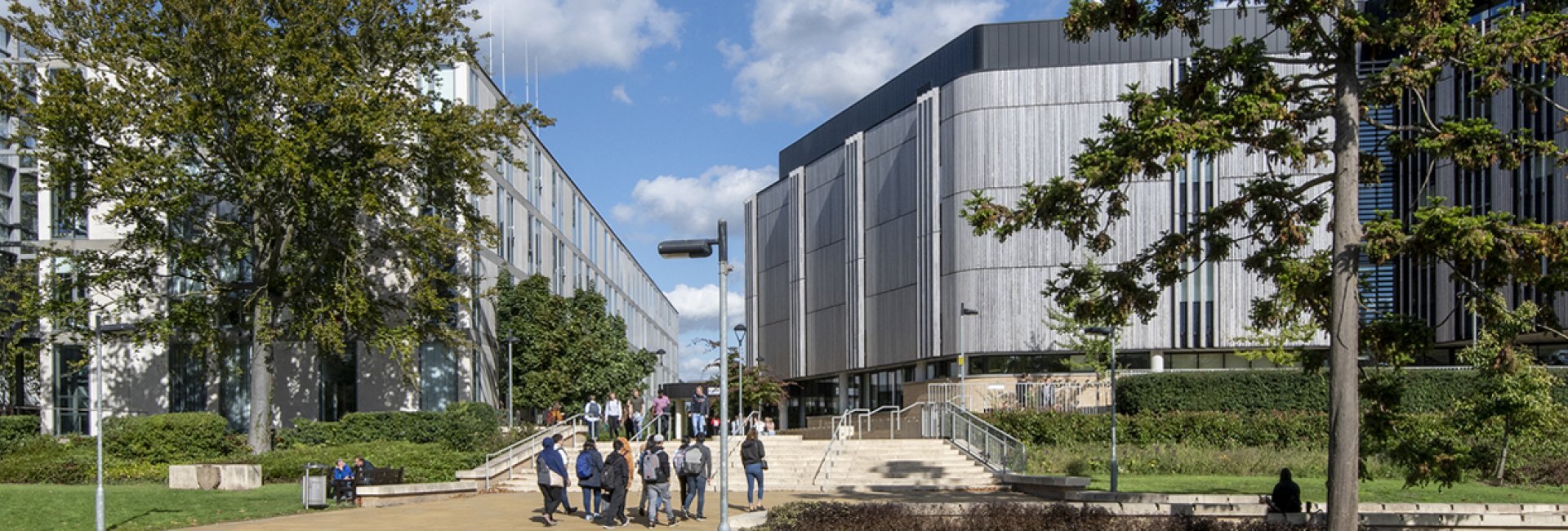
Winchester School of Art - Open Day
6 Jun 2026, 09:00
Winchester
Chemistry is at the heart of solutions to many of today’s biggest challenges, from climate change to the treatment of disease. On this degree you’ll study chemistry to an advanced level, equipping you to change the world for the better.
This is our most flexible chemistry degree, enabling you to tailor your degree to the areas that spark your curiosity. Options include medicinal chemistry, sustainable chemistry, chemical biology and the fast-growing field of computational chemistry.
Placement Opportunities
The final year of your degree could include an extended project that can be taken within our research facilities, as part of a year-long industrial placement or as an external placement at a university overseas. A university placement could take you to Australia, New Zealand, Canada, the USA, Singapore or almost anywhere in the world. Most placements within industry are in the UK and are paid, whichever type you choose you’ll gain specialist experience and transferable skills which will impress employers.
You’ll be prepared for a role as a professional chemist or may choose to use your skills in another field. Our graduates have achieved success in sectors including finance, banking, accountancy, sales and marketing, management, patent law and teaching.
Outstanding undergraduate laboratories and equipment
Take advantage of our refurbished labs, which opened recently as part of a £12m investment in Chemistry’s facilities. You’ll study in bright, spacious modern laboratories using new, high-tech equipment, which is the same as you’ll find if you go on to work in the chemical industry. Each student has a laptop to use in the laboratory, for analysing data and writing laboratory reports.
Gain hands-on practical experience with research-grade equipment such as NMR and IR spectrometers and X-ray diffractometers. You’ll make and analyse your own samples, with full support and training, rather than sending samples to be analysed or watching demonstrations. And your lab work will incorporate modern ‘green’ chemistry practices that are used in industry.
Learn about research as it happens
Part of a research-active Russell Group University, Chemistry at Southampton means you’ll learn from staff who are making trailblazing discoveries.
Our academics are advancing battery technology for cleaner energy, designing drugs for hard-to-treat cancers, and using digital modelling in the fight against contagious diseases, to name just a few examples. They will share their passion with you, bringing the most up-to-date knowledge to your seminars and lectures. The breadth of their research activities gives you a wide choice of project topics.
Supporting your studies
You’ll be part of a supportive Chemistry community, with a personal academic tutor to provide any extra help you need, both academically and personally.
Between classes, the Chemistry department will be your ‘home’ on campus, where you can grab a coffee in the common room, catch up with friends and talk to staff.
Core modules in the first and second year are shared across most of our chemistry degrees. This makes it easy to transfer if you decide you’d like to do our MChem with six-month or year-long placement. Depending on your optional module choices or level of maths study, there’s also the possibility of moving to one of our specialist MChem courses.
In years one and two, core modules provide a solid foundation for more in-depth study in your third and fourth year. You’ll learn the fundamentals of organic, inorganic and physical chemistry, as well as practical lab techniques. In year one you’ll also take a mathematics module tailored to your previous maths experience.
You’ll be able to select optional modules in years two, three and four. These cover a wide range of topics, such as:
• environmental chemistry;
• chemical biology;
• introduction to programming;
• medicinal chemistry;
• artificial intelligence and machine learning in chemistry;
• synthetic methods in organic chemistry;
• sustainable chemistry;
• quantum mechanics in chemistry and spectroscopy.
You can also choose modules from other disciplines such as oceanography, biology, physics or a language.
Year three includes advanced practical projects. In year four you’ll undertake an advanced research project in an area that interests you. The project could be working within one of our research groups in Southampton or could be taken as part of an industrial or overseas placement. You’ll contribute to chemistry research, develop your professional skills and generate new knowledge, and there’s a good chance of getting your research published.
There are written examinations at the end of each semester to test your knowledge and understanding of material presented in the lectures and workshops. Many modules also have coursework components that feed into final module marks as well. The coursework can take on a variety of forms from analysing data, to working through problem sets. The practical work is continuously assessed primarily through written reports.
Project work is assessed by dissertation and oral examination together with a report on your relevant skills from your supervisor. A written literature review related to the project is also assessed. Alongside these summative assessments are several formative pieces of work where feedback can be provided to allow for continuous improvement of your chemistry skills.
The research project will be assessed via a variety of means including review of your laboratory notebook, your assessments of the risks and hazards of your work, written reports, oral presentations, the production of a dissertation, and an oral examination.
Professionally accredited courses provide industry-wide recognition of the quality of your qualification.
The following entry points are available for this course:
Find out about equivalent entry requirements and qualifications for your country: https://www.southampton.ac.uk/uni-life/international/your-country.page
If you are not sure that your qualifications meet the requirements of this course please contact our Admissions Teams.
Find out more about qualification requirements for this course.
| Test | Grade | Additional details |
|---|---|---|
| IELTS (Academic) | 6.5 | with no component below 6.0 |
Find out more about the University’s English Language requirements https://www.southampton.ac.uk/studentadmin/admissions/admissions-policies/language.page
Most of the students who previously enrolled on this course joined us with grades lower than our published entry criteria. After receiving their grades, we carefully considered each students’ individual circumstances before confirming their place on their chosen course. We encourage everyone with the potential to succeed to apply, regardless of their background. Applicants who qualify for contextual admissions will be made an offer lower than the typical offer for that programme.
This section shows the range of grades students (with UK A-Levels or Pearson BTEC Level 3 National Extended Diplomas) who received offers were previously accepted with (learn more). It is designed to support your research but does not guarantee whether you will or won't get a place. Admissions teams consider various factors, including interviews, subject requirements, and entrance tests. Check all course entry requirements for eligibility.
Students aged 17/18 who applied to this course were offered a place.
See how students with your grades have been accepted onto this course in the past.
Operated by the Office for Students
Employment after 15 months (Most common jobs)
Go onto work and study
The number of student respondents and response rates can be important in interpreting the data – it is important to note your experience may be different from theirs. This data will be based on the subject area rather than the specific course. Read more about this data on the Discover Uni website.
| Location | Fee | Year |
|---|---|---|
| England | £9535* | Year 1 |
| Northern Ireland | £9535* | Year 1 |
| Scotland | £9535* | Year 1 |
| Wales | £9535* | Year 1 |
| Channel Islands | £9535* | Year 1 |
| Republic of Ireland | £9535* | Year 1 |
| EU | £31000 | Year 1 |
| International | £31000 | Year 1 |
* This is a provisional fee and subject to change.
Tuition fee status depends on a number of criteria and varies according to where in the UK you will study. For further guidance on the criteria for home or overseas tuition fees, please refer to the UKCISA website.
Please see our website for further details and updates: www.southampton.ac.uk/uni-life/fees-funding.page
Highfield
Southampton
SO17 1BJ
Visit our website Visit our course page
Email:AdmissionsUG.EPS@soton.ac.uk
Phone:023 8059 4732