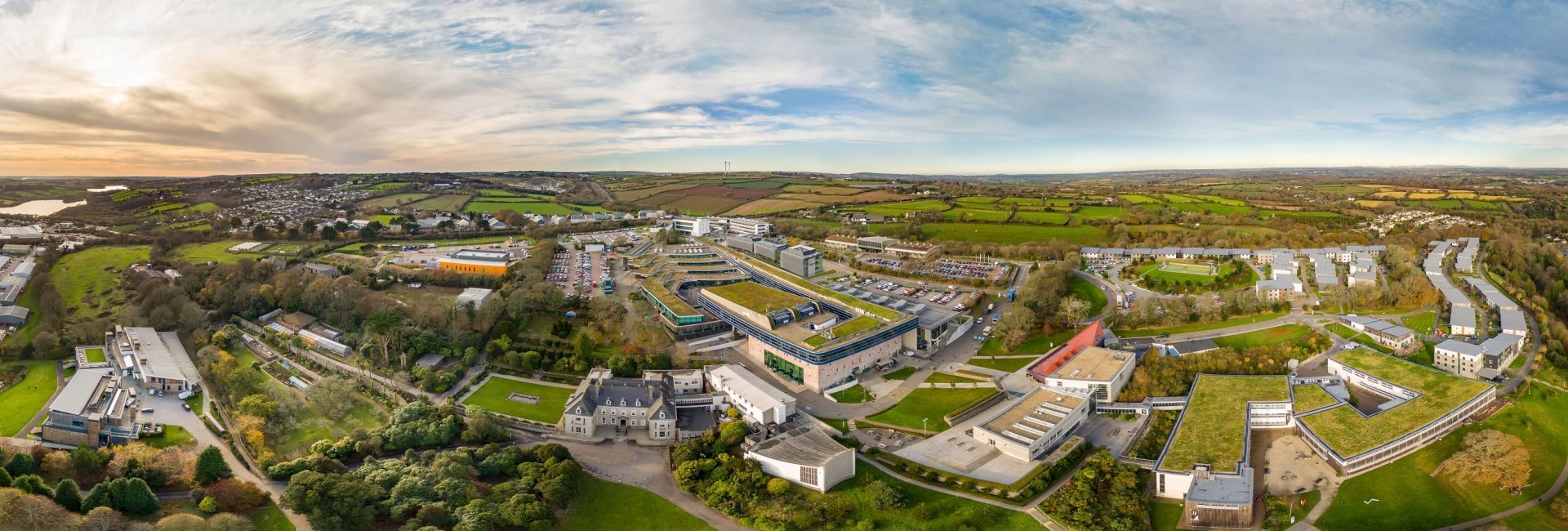
Open Day (in-person)
3 Oct 2026, 08:00
Falmouth

Become a skilled creative music artist with one of our three CertHE courses.
Whether you’re a vocalist, instrumentalist, songwriter, composer or producer, these programmes are aimed at those looking to eventually become entrepreneurial and creative music professionals with varied and enduring portfolio careers. You’ll be introduced to a range of music practices and contexts and provided with the experience, technical support and industry links to progress your creative ambitions.
Whichever CertHE course you choose, you’ll find a wealth of teaching experience, technical support and industry links that will provide you with the opportunity to progress your creative ambitions. As part of the Academy of Music & Theatre Arts, you'll learn from industry professionals and have access to our cutting-edge facilities and performance spaces.
Once you have successfully completed your CertHE you’ll have the option to apply for the second year of the equivalent honours degree: BA(Hons) Creative Music Technology.
You will:
Develop and nurture your specialist practice
Communicate via sound and music in collaboration with others
Gain key insights into the music industry and understand the requirements to succeed in a variety of roles
Explore sound and music practices as they evolve within ever-changing audio cultures
Examine the context and culture in which artists and musicians work, to better understand and critically question the relationship between music, sound, noise and culture
Engage with various theoretical concepts in order to form critical theories and to reflect on your own practice
Acquire the fundamental skills and knowledge needed to work in the sound and music industries
Study modules tailored to your chosen subject as you develop and nurture your specialist practice
Your assessments will be practical exams and coursework.
Depending on the course option you choose, your assessment methods may consist of the following:
Essays
Performance
Portfolios
Presentations
Individual reports
Practical work
This is the equal consideration deadline. You can still apply after this date, but your application may not receive guaranteed consideration.

Falmouth University has participated in the Teaching Excellence Framework. These ratings were awarded in 2023, for four years.
See why these ratings were awarded
What does this TEF outcome mean?
The following entry points are available for this course:
We welcome A Levels in a wide range of subjects, especially in those relevant to the course for which you apply.
60 credits (with a minimum of 45 credits achieved at level 3) in a relevant subject.
We accept BTEC Extended Diplomas in a wide range of subjects, especially those relevant to the course you are applying to.
Accepted with other qualifications
Acceptable when combined with other qualifications
Acceptable when combined with other qualifications
Acceptable when combined with other qualifications
Acceptable with UCAS tariff points from the Supporting Qualifications
We accept BTEC Extended Diplomas in a wide range of subjects, especially those relevant to the course you are applying to.
Acceptable when combined with other qualifications
Accepted
Acceptable with UCAS tariff points from the Supporting Qualifications
Accepted
At Falmouth, we recognise excellence in many forms, and we see the whole you.
Our diverse community is creative, innovative and entrepreneurial.
We recognise that these qualities aren’t always shown in academic grades alone. That’s why, while many of our applicants achieve high academic grades, we also welcome those who can demonstrate their potential through an exceptional portfolio or performance.
At a minimum, we typically require the equivalent of 64 UCAS Tariff points for undergraduate courses where we can review a portfolio or audition, or a minimum of 96 UCAS points for those courses that do not require a portfolio or audition. For our Integrated Foundation Year courses, we typically require a minimum of 32 UCAS points for courses where we can review a portfolio or audition, or 64 UCAS points for those that do not require a portfolio or audition.
To support this approach, during a friendly conversation with our academic team, we’ll consider your ideas, your creative output and your ambition to ensure you’ll thrive at Falmouth.
If you are able to demonstrate relevant, current, equivalent experience instead of formal qualifications, we encourage you to apply. Please contact our Applicant Services team before applying, for advice regarding your individual experience and eligibility.
If you are an international applicant and require a Student visa to study in the UK, you must have a recognised English language test approved and vouched for by the University at the appropriate level. You can see what we accept on our website https://www.falmouth.ac.uk/study/international/english-language-requirements Our Applicant Services team can help you with any general questions you may have about study visas or suitable language tests. For more specific advice, we recommend you also consult UKCISA http://www.ukcisa.org.uk/ https://www.falmouth.ac.uk/study/entry-requirements
If English is not your first language, you will need to demonstrate English language skills that are sufficiently developed for successful completion of your studies. We accept a range of recognised English language qualifications that are equivalent to the International English Language Testing System (IELTS) Academic minimum score of 6.0 overall, with a minimum of 5.5 in Reading, Writing, Speaking and Listeninghttps://www.falmouth.ac.uk/study/international/english-language-requirements
At Falmouth University, we take a rounded approach to admissions. Instead of focusing on criteria like grades alone, we operate a contextual admissions policy, where we look at you as a person: your talents, your experiences and your potential. Every offer we make is shaped around you and your circumstances, and our conditional offers are always intended to be realistic and achievable.
This section shows the range of grades that students who received offers were previously accepted on to this course with (learn more).
It is designed to support your research but does not guarantee whether you will or won't get a place.
Admissions teams consider various factors, including interviews, subject requirements, and entrance tests. Check all course entry requirements for eligibility.
We are unable to show previous accepted grades for this course. This could be because the course is new, it's a postgraduate course, there isn't enough historical data, or the provider has opted out of sharing their entry grades data for this course - learn more.
| Location | Fee | Year |
|---|---|---|
| England, Scotland, Wales, Northern Ireland, Channel Islands, Republic of Ireland, EU & International | TBC |
Tuition fee status depends on a number of criteria and varies according to where in the UK you will study. For further guidance on the criteria for home or overseas tuition fees, please refer to the UKCISA website.
No additional fees or cost information has been supplied for this course, please contact the provider directly.
We offer bursaries and awards to help support our undergraduate students.
The bursaries and awards you are eligible for will depend on your chosen course and pathway as well as your individual circumstances. These bursaries and awards are separate from any other Government loans or grants, helping you to fund your studies while at Falmouth.
Through the award of international scholarships, we aim to support academic enrichment by encouraging diversity and excellence at Falmouth.
For details of our scholarships and bursaries, and how to apply for them, please visit our website at www.falmouth.ac.uk/study/student-funding/undergraduate-bursaries-awards
https://www.falmouth.ac.uk/study/student-funding/undergraduate-bursaries-awards
Email:applicantservices@falmouth.ac.uk
Phone:01326 213730
Woodlane
Falmouth
TR11 4RH
At Falmouth University