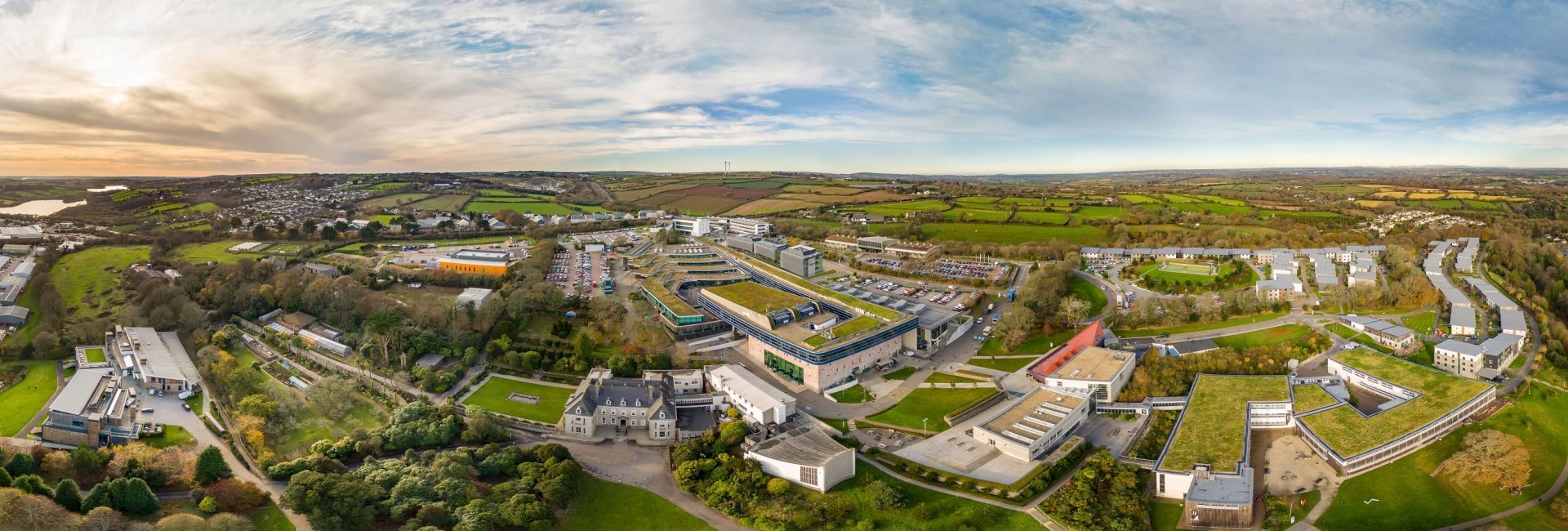
Open Day (in-person)
23 May 2026, 08:00
Falmouth
Turn heads and change minds as you steer the industry toward a more sustainable future.
With a pressing need to reduce its environmental impact, the fashion industry is calling for designers who place sustainability and circularity at the forefront. This is your chance to help shape fashion’s future. You’ll explore the environmental, ethical and moral contexts of fashion design as you tackle real- world challenges, learning how to embed responsible practice throughout the process of garment concept and creation – from pattern cutting and construction to curating fashionable, functional and highly original collections that don’t cost the earth.
You will:
Learn design skills needed to make positive change at the forefront of the creative industries
Explore the environmental, ethical and moral challenges of our time in relation to the fashion design sector
Have access to resources ranging from specialist industrial sewing and knit machines and ultrasonic welding equipment to screen printing and a natural dye garden
Discover the sustainable ways of working in both traditional and digital pattern cutting – including CLO3D
Collaborate with likeminded students, expert staff and industry specialists to unlock new ideas, opportunities and networks
Tackle live briefs from leading brands with a focus on global sustainability
Investigate brands and business models to develop professional practice skills
Have the opportunity to explore all realms of fashion design, including streetwear, sportswear and functional clothing concepts
Graduate as a confident, innovative and responsible fashion designer, with a career-launching portfolio, look book and final collection
Throughout this Fashion Design degree, you’ll learn to create original and inspiring fashion proposals underpinned by a specialist knowledge of sustainable fashion practices. While developing an understanding of your responsibility as a fashion designer, you’ll gain advanced skills in research, analysis, translation, drawing, pattern cutting and construction. Working with professional facilities, you’ll also be encouraged to take risks as you experiment with new and emerging technologies and processes.
Year one
Through design and practical projects, you’ll build an awareness of the fashion industry’s social and environmental impact and seek innovative and sustainable solutions. Through tutorials and workshops, you’ll develop core skills in research, design development, drawing, pattern cutting and construction – utilising professionally equipped studios to create original works.
Modules
Cut and Construct
Redesign
Belonging
Histories
Colour and shape
Year two
The second year focuses on industry knowledge, responding to global challenges and exploring how digital and traditional fashion practices can invoke positive change. By investigating brands and sustainable business models, you’ll continue to build on your creative design skills and start to align with sustainable practices.
Modules
Industry Practice
Core skills: Digital
Core skills: Stretch
Collaboration
Innovation
Theories
Year three
You’ll be responsible for finding your own placement, with support from the employability team. Choosing this option will enhance your industry experience and skills while studying.
How you’ll study during your professional placement
You’ll spend time working in a professional context, as part of a business or organisation. This can be in one role, or up to three, and must be for a minimum of 24 weeks.
You’ll develop in-demand workplace skills, deepen your insight into industry and grow your network of contacts, all of which could help you get ahead in your career after graduation.
Throughout this year, you’ll develop a portfolio of work that includes critical self-reflection on what has been learned from the experience. You’ll be required to evidence your experiences, the skills you’ve learned and your professional growth.
Year four
In the final year of your Fashion Design degree, you'll develop a graduate collection by intensively researching, developing and exploring 2D and 3D concepts. Your collection will be underpinned by a consideration of the UN Sustainable Development Goals and supported by a dissertation.
With sights set firmly on launching your career, you’ll also produce a professional portfolio and lookbook and have the opportunity to participate in live competition briefs set by professional fashion organisations, such as the British Fashion Council and the Graduate Fashion Foundation.
Modules
Pre-Collection
Investigations
Collection
Professional Strategies
As part of our process of continuous improvement, we routinely review course content to ensure that all our students benefit from a high-quality and rewarding academic experience. As such, there may be some changes made to your course which are not immediately reflected in the content displayed on our website. Any students affected will be informed of any changes made directly.
Studio-based projects, including portfolio and garments, and written assignments
Final year dissertation, collections & portfolio
The following entry points are available for this course:
If English is not your first language, you will need to demonstrate English language skills that are sufficiently developed for successful completion of your studies. We accept a range of recognised English language qualifications that are equivalent to the International English Language Testing System (IELTS) Academic minimum score of 6.0 overall, with a minimum of 5.5 in Reading, Writing, Speaking and Listening. Through the award of international scholarships, we aim to support academic enrichment by encouraging diversity and excellence at Falmouth. For details of our international scholarships, and how to apply for them, please visit our website at www.falmouth.ac.uk
At Falmouth, we recognise excellence in many forms, and we see the whole you.
Our diverse community is creative, innovative and entrepreneurial.
We recognise that these qualities aren’t always shown in academic grades alone. That’s why, while many of our applicants achieve high academic grades, we also welcome those who can demonstrate their potential through an exceptional portfolio or performance.
At a minimum, we typically require the equivalent of 64 UCAS Tariff points for undergraduate courses where we can review a portfolio or audition, or a minimum of 96 UCAS points for those courses that do not require a portfolio or audition. For our Integrated Foundation Year courses, we typically require a minimum of 32 UCAS points for courses where we can review a portfolio or audition, or 64 UCAS points for those that do not require a portfolio or audition.
To support this approach, during a friendly conversation with our academic team, we’ll consider your ideas, your creative output and your ambition to ensure you’ll thrive at Falmouth.
If you are able to demonstrate relevant, current, equivalent experience instead of formal qualifications, we encourage you to apply. Please contact our Applicant Services team before applying, for advice regarding your individual experience and eligibility.
If you are an international applicant and require a Student visa to study in the UK, you must have a recognised English language test approved and vouched for by the University at the appropriate level. You can see what we accept on our website https://www.falmouth.ac.uk/study/international/english-language-requirements Our Applicant Services team can help you with any general questions you may have about study visas or suitable language tests. For more specific advice, we recommend you also consult UKCISA http://www.ukcisa.org.uk/
Find out more about qualification requirements for this course.
View our list of accepted English language tests and qualifications using the link below https://www.falmouth.ac.uk/study/international/english-language-requirements
At Falmouth University, we take a rounded approach to admissions. Instead of focusing on criteria like grades alone, we operate a contextual admissions policy, where we look at you as a person: your talents, your experiences and your potential. Every offer we make is shaped around you and your circumstances, and our conditional offers are always intended to be realistic and achievable.
This section shows the range of grades students (with UK A-Levels or Pearson BTEC Level 3 National Extended Diplomas) who received offers were previously accepted with (learn more). It is designed to support your research but does not guarantee whether you will or won't get a place. Admissions teams consider various factors, including interviews, subject requirements, and entrance tests. Check all course entry requirements for eligibility.
We are unable to show previous accepted grades for this course. This could be because the course is new, it's a postgraduate course, there isn't enough historical data, or the provider has opted out of sharing their entry grades data for this course - learn more.
No fee information has been provided for this course
Tuition fee status depends on a number of criteria and varies according to where in the UK you will study. For further guidance on the criteria for home or overseas tuition fees, please refer to the UKCISA website.
No additional fees or cost information has been supplied for this course, please contact the provider directly.
Woodlane
Falmouth
TR11 4RH
Visit our website Visit our course page
Email:applicantservices@falmouth.ac.uk
Phone:01326 213730
At Falmouth University