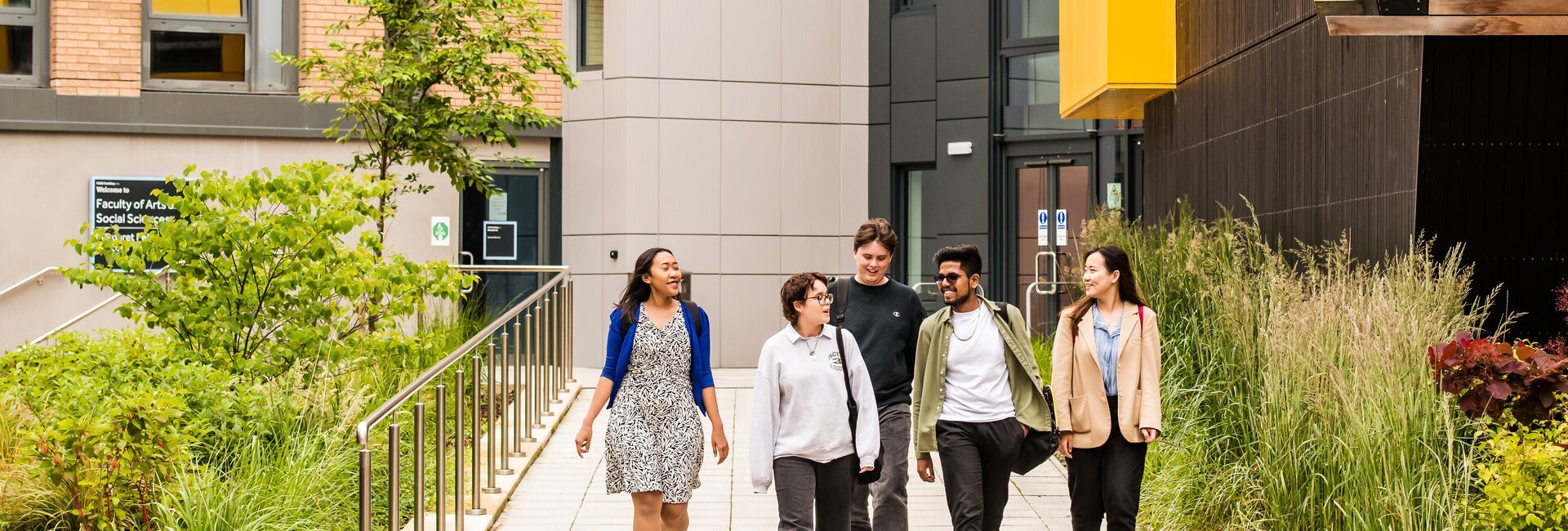
Lancaster University undergraduate open day
27 Jun 2026, 08:00
Lancaster

Mechanical engineers use their skills in almost every industry, and you’ll find their expertise in nearly everything you see and use in everyday life. They design and develop products, systems and machinery to tackle all sorts of challenges, from renewable energy to household appliances, from robotics to manufacturing equipment, from aerospace components to healthcare solutions. As a mechanical engineer you get to use your creativity to design and develop products and systems, build prototypes, analyse and test until you find your solution. Throughout your career you will frequently work across teams of engineers from other branches of the discipline, so it’s crucial to have a broad understanding of general engineering and its applications. At Lancaster, your first year is dedicated to exactly this, and you’ll share this experience with all our School of Engineering students, regardless of their specialisation. We think this makes you a well-rounded graduate, with excellent teamwork and communications skills, prepared for your future career.
What to expect
Our three-year BEng Hons Mechanical Engineering degree starts with your general engineering first year and includes core themes of design, materials, manufacturing, thermodynamics and heat transfer, along with mathematics.
In Year 2 is where you start to specialise in mechanical engineering and you will learn core themes such as the science of materials, mechanics, fluids and thermodynamics, and also machine design and control, which includes the opportunity to apply these principles to applications like mobile robotics. Working in our two new engineering buildings with state-of-the-art facilities, you’ll develop your creativity and technical skills as you design, build and test to solve real-world problems.
In the third year you will undertake an extended individual project which gives you the opportunity to conduct research and pursue your interests in an engineering application of your choosing. Students tell us this is one of the academic highlights of their time here. They’ve tackled things like wind turbines design and control, hydrogen production for zero carbon transport, novel inspection robots for monitoring nuclear sites, laser additive manufacturing of high-performance coatings, and much more. Alongside your project work you will study themes such as dynamic systems, computer aided engineering and product design.
Take further steps towards professional engineering with management skills, project management, and industry engagement. Sustainability, safety, ethics and quality management are kept in focus too.
Personal development
You will develop valuable transferable skills that make you highly desirable to future employers, such as working in collaboration, communication, and the ability to design, build, and implement a system or device. You will grow practical skills in diagnosis and testing, system maintenance, digital proficiencies, and the ability to consider and maintain work safety practices in a range of environments.
3 things our mechanical engineering students would like you to know:
The multi-disciplinary first year is brilliant for future careers when project work will include colleagues from other engineering specialisms
Each year of engineering has been better than the previous one, and you build up more independence as you go. From first year introductory labs, all the way to your very own project, research and supervisor
All of us engineers share the same newly built facilities. We have access to the labs and maker spaces a lot of the time for both personal and academic use
This is the equal consideration deadline. You can still apply after this date, but your application may not receive guaranteed consideration.

Lancaster University has participated in the Teaching Excellence Framework. These ratings were awarded in 2023, for four years.
See why these ratings were awarded
What does this TEF outcome mean?
The following entry points are available for this course:
Discover what it's like to study Mechanical Engineering at Lancaster University: insights on the course, making friends, personal statement tips, uni prep, and recommended books, podcasts, and videos.

This should include Mathematics and a physical science subject, for example, Physics, Chemistry, Electronics, Design & Technology or Further Mathematics.
Considered on a case-by-case basis. Our typical entry requirement would be 30 Level 3 credits at Distinction plus 15 Level 3 credits at Merit, but you would need to have covered appropriate subject content.
32 points overall with 16 points from the best 3 HL subjects including either:
Acceptable physical science subjects include Physics, Chemistry, Computer Science and Design Technology.
Pre-2016 specifications: DDM in an Engineering related subject to include Distinctions in Mathematics for Engineering Technicians and Further Mathematics for Engineering Technicians units.
2016 specifications: DDM in an Engineering related subject to include Distinctions in the following units - Unit 1 Engineering Principles, Unit 7 Calculus to Solve Engineering Problems. Unit 8 Further Engineering Mathematics is highly recommended.
GCSE Mathematics grade 6/B, GCSE English Language grade 4/C.
We will also look at your overall GCSE profile when considering your application as a whole.
We do have flexibility when considering GCSE requirements. Please visit our website for more details.
Only accepted alongside A level Mathematics grade B. The following subjects accepted at Distinction overall, alongside A level Mathematics grade B: Design and development for engineering manufacturing; Engineering, manufacturing, processing and control; Maintenance, installation and repair for engineering and manufacturing. The following subjects considered on a case by case basis, alongside A level Mathematics grade B: Design, surveying and planning for construction; Building services engineering for construction; Onsite construction.
We accept the Advanced Skills Baccalaureate Wales in place of one A level, or equivalent qualification, as long as any subject requirements are met.
We are happy to admit applicants on the basis of five Highers, but where we require a specific subject at A level, we will typically require an Advanced Higher in that subject. If you do not meet the grade requirement through Highers alone, we will consider a combination of Highers and Advanced Highers in separate subjects. Please contact our Admissions team for more information.
You can find full details of our entry requirements and the application process on our website. https://www.lancaster.ac.uk/study/undergraduate/how-to-apply/
| Test | Grade | Additional details |
|---|---|---|
| IELTS (Academic) | 6.5 | with at least 5.5 in each element |
| TOEFL (iBT) | 87 | with 18 in Reading, 17 in Listening, 17 in Speaking and 20 in Writing. For tests taken after 21 January 2026, we require 4.5 overall with at least 4 in each element. |
| PTE Academic | 58 | with at least 42 in each element |
| Cambridge English Advanced | Level B2 | 176 overall with at least 162 in each element |
| Cambridge English Proficiency | Level C1 | 176 overall with at least 162 in each element |
| Trinity ISE | Distinction | ISE II with a minimum of Distinction in each element |
At Lancaster, we are committed to widening access to higher education for all. As part of this we take a holistic approach to reviewing applications, taking into account exceptional circumstances and potential as much as we can. We run a Contextual Offer Scheme which incorporates a reduced grade offer for applicants that meet our eligibility criteria. For more information on the scheme, and other widening participation activity such as the Lancaster Access Programme, please visit our website.
We accept a wide range of international qualifications. If your qualification is not listed here, please see our website for more information, or contact our Admissions team for advice. https://www.lancaster.ac.uk/study/entry-requirements/undergraduate-qualifications/
This section shows the range of grades that students who received offers were previously accepted on to this course with (learn more).
It is designed to support your research but does not guarantee whether you will or won't get a place.
Admissions teams consider various factors, including interviews, subject requirements, and entrance tests. Check all course entry requirements for eligibility.
We are unable to show previous accepted grades for this course. This could be because the course is new, it's a postgraduate course, there isn't enough historical data, or the provider has opted out of sharing their entry grades data for this course - learn more.
No fee information has been provided for this course
Tuition fee status depends on a number of criteria and varies according to where in the UK you will study. For further guidance on the criteria for home or overseas tuition fees, please refer to the UKCISA website.
For information about fees and funding please visit www.lancaster.ac.uk/fees.
Email:ugadmissions@lancaster.ac.uk
Phone:01524 592028
Bailrigg
Lancaster
LA1 4YW
At Lancaster University