Course contact details
Admissions
Email:admissions@gsa.ac.uk
Phone:0141 353 4512
Glasgow School of Art
167 Renfrew Street
Glasgow
G3 6RQ

The Bachelor of Architecture (Hons) Programme is Part 1 ARB/RIBA accredited providing Exemption from the Part 1 ARB/ RIBA Examination in Architecture. As such the Programme establishes the foundational knowledge and skills to develop the required professional competencies in relation to ethical practices in the design of safe, healthy and sustainable buildings. The social purpose of architecture is at the core of the curriculum, informed by professional values including userfocussed design, climate literacy, and the responsible use of materials and resources.
The Programme duration is four years full time study or five years part-time mode of study.
Uniquely positioned within a wider community of artists and designers at the Glasgow School of Art the Programme offers students the opportunity to develop their creative practice while building their academic and social networks. In Stage 1 students collaborate with students from other creative disciplines within GSA, exploring common themes and outputs. In Stage 2 students undertake interdisciplinary collaboration with students from a selected design discipline within GSA. In Stage 3 students collaborate with students from the allied construction disciplines of engineering and quantity surveying.
The Programme ethos is delivered through a curriculum founded on tackling social challenges and the Climate Emergency, in the belief that architecture is a means to create positive change for people, places and our planet. Graduates will be both climate literate and climate numerate, able to make informed design decisions, supported by research and data, which address both the qualitative and quantitative aspects of climate change. Over the course of the Programme students are introduced to and develop a range of regenerative design strategies, including adaptive re-use, material provenance, circular economies, bioregionalism, climate adaptation and biophilic design. This is pursued through students' critical engagement with the environmental, social, cultural, political, economic and ethical issues shaping the built environment both presently and in the future.
The Programme is studio based, with studio activities informed by taught courses in Architectural Technology, History of Architecture and Urban Studies and Professional Studio, delivered holistically through a framework of six learning domains: Professionalism, Design/Create, Research, Communication, Skills, and Knowledge.
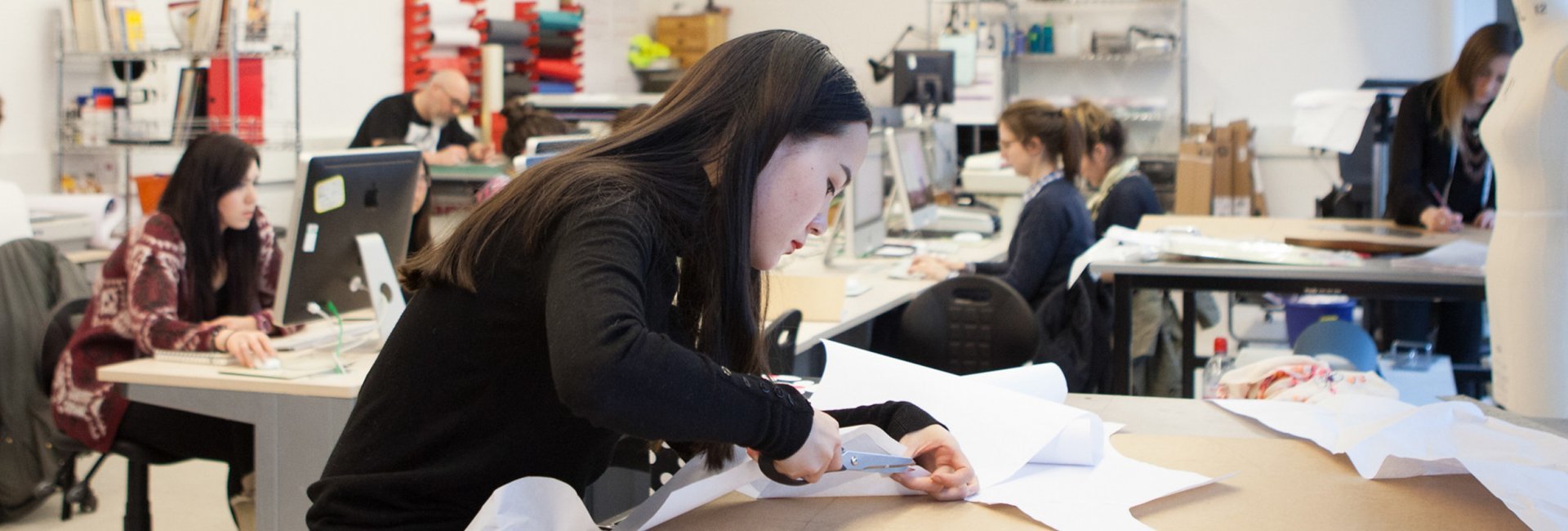
The curriculum is delivered primarily through studio-based design projects, enabling students to develop the core skills of architectural production through iterative design processes deploying the associated visual and verbal skills. The studio environment provides a forum for critical discussion, peer learning and support, where inclusivity is fostered through a mutually respectful, supportive and collaborative studio culture. Diverse teaching and learning methods encourage students to be curious, confident and above all independent in developing their personal responses to architecture and the environment.
The first three years of the Programme utilises Scotland’s landscapes, villages and towns as a design laboratory, focussing on the interplay of resourceful landscapes and human settlements, ranging in scale from island communities to town-scale urban environments with rural backdrops. Through study and design interventions in response to Scotland’s villages and towns, students learn how to analyse, evaluate and respond to a range of architectural contexts, in preparation for engagement with the city-scale urbanism of Glasgow in Stage 4.
On completion of the Programme, the primary aim is that graduates, as emergent designers, are highly competent and creative practitioners, and as graduates of the Glasgow School of Art, are engaged citizens, critical thinkers, skilled communicators, ethical practitioners and life-long learners.
The following entry points are available for this course:
A Levels: ABB to include Maths
Final award with B or above in graded unit
Final award with B or above in graded unit
Scottish Highers: ABBB and above to include Maths and/or Physics
International Baccalaureate Diploma award with a minimum of 30 points (18 points at Higher Level with a mininum of 4 points in English & Maths)
Completion of Irish Leaving Certificate with Four Highers at H2 or above to include Maths and/or Physics
Entry requirements for students joining after Year 1: We accept a range of qualifications and many of our entrants come with advanced entry – meaning they begin their studies in second or third year. For more information please visit https://www.gsa.ac.uk/study-at-the-gsa/advanced-entry
Scottish Highers: ABBB and above to include Maths and/or Physics
| Test | Grade | Additional details |
|---|---|---|
| IELTS (Academic) | 6.5 | IELTS for UKVI (Academic) or IELTS (Academic) test taken at a UKVI approved test centre. Applicants must achieve 6.5 overall, with a minimum of 5.5 in each component. |
| PTE Academic | 59 | Pearson PTE Academic UKVI or Pearson Test of English (PTE) Academic. Applicants must achieve 59 overall, with a minimum of 59 in each subtest. |
| TOEFL (iBT) | 80 | TOEFL (IBT) or TOEFL IBT at home. Applicants must achieve 80+ overall, with the following minimum scores in each component: Listening-17; Reading-18; Speaking-20; Writing-18. |
| Institution's Own Test | GSA Pre-Sessional English for Creative Disciplines | Applicants who complete GSA’s Pre-Sessional English for Creative Disciplines course will satisfy language conditions - https://www.gsa.ac.uk/undergraduate-degrees/english-for-creative-disciplines |
Applicants who require a Student Visa, and who are not a national of, nor have obtained a degree in one of the countries on the approved UKVI exemption list, will need to provide evidence of their English language ability through the use of a standardised test. All test results must be dated within 2 years of your programme start date.
This section shows the range of grades that students who received offers were previously accepted on to this course with (learn more).
It is designed to support your research but does not guarantee whether you will or won't get a place.
Admissions teams consider various factors, including interviews, subject requirements, and entrance tests. Check all course entry requirements for eligibility.
We are unable to show previous accepted grades for this course. This could be because the course is new, it's a postgraduate course, there isn't enough historical data, or the provider has opted out of sharing their entry grades data for this course - learn more.
| Location | Fee | Year |
|---|---|---|
| England, Wales, Northern Ireland, Channel Islands & Republic of Ireland | £9790* | |
| EU & International | £24800* | |
| Scotland | £1820 |
* This is a provisional fee and subject to change.
Tuition fee status depends on a number of criteria and varies according to where in the UK you will study. For further guidance on the criteria for home or overseas tuition fees, please refer to the UKCISA website.
No additional fees or cost information has been supplied for this course, please contact the provider directly.
Email:admissions@gsa.ac.uk
Phone:0141 353 4512
167 Renfrew Street
Glasgow
G3 6RQ
At Glasgow School of Art