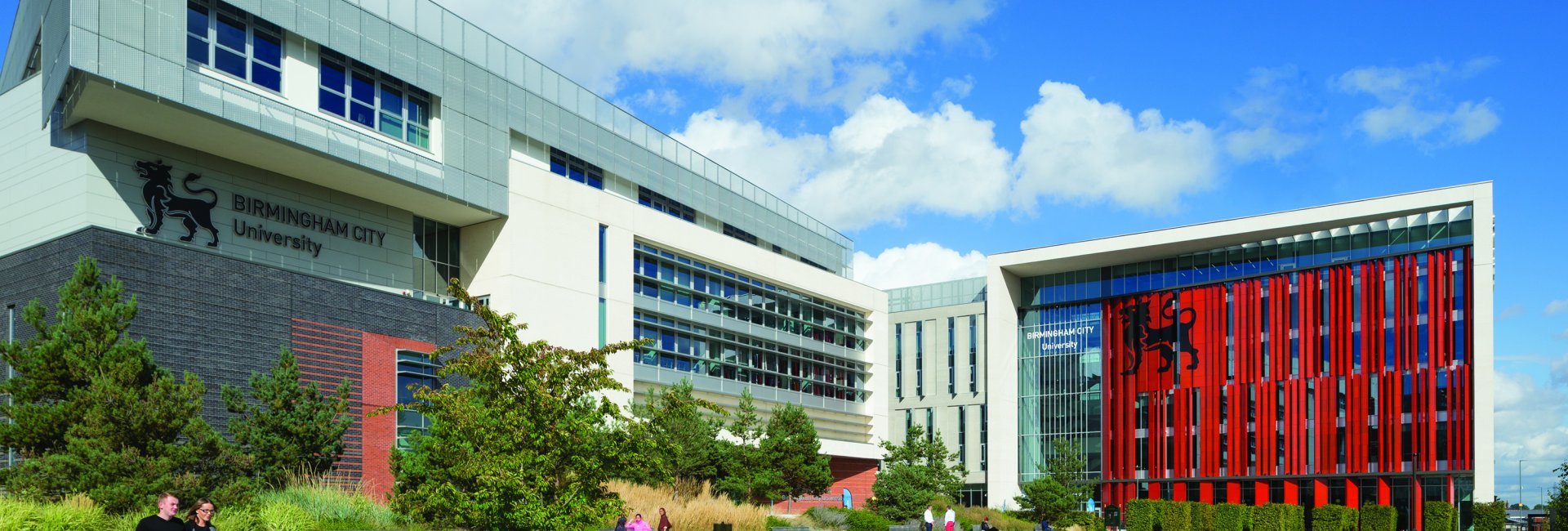
Birmingham City University Undergraduate Open Day, Friday 26 June 2026
26 Jun 2026, 08:00
Birmingham

Do you want to design and develop cutting-edge electrical and electronic systems that drive innovation and transform the way we live, work, and connect? Turn your passion into a future-proof engineering career with our reimagined and industry-focused BEng (Hons) Electrical and Electronic Engineering with a Foundation Year degree.
Our approach to Engineering is unique. You will not have traditional lectures or be assessed by exams, instead you will learn through practical-based tasks that respond to real-life engineering problems across industries including telecommunications, renewable energy, electrical power, robotics and advanced manufacturing.
This course has been carefully designed in collaboration with industry to ensure that you graduate ready for employment, with core technical skills and knowledge as well as employability skills such as communication, collaboration, problem-solving and leadership. You could have a career working with electric vehicles, robotics, smartphones and medical devices – the opportunities are endless!
The foundation year
This foundation year is a preparatory year designed for students who are passionate about engineering but may not yet meet the entry requirements for our degree programmes. Over the course of a year, you’ll build a solid grounding in key subjects such as mathematics, engineering principles, and problem-solving, while developing practical skills through hands-on projects and lab work. The foundation year will provide you with a smooth transition to progress on to one of our engineering degrees and set you up for a successful educational journey.
What's covered in this course?
On this course you will:
Learn through block delivery. This means you will study one module at a time across a 6-week period, allowing you to fully immerse yourself and get a deeper understanding of each subject. This style reflects how engineers work and shifts away from traditional models of teaching where you are expected to study multiple modules at one time.
Gain skills that industry needs. You will tackle real-world challenges that are co-designed with industry partners, developing skills that the workforce needs. You will also receive feedback and mentorship from industry professionals on your work throughout the course.
Get experience in the workplace. Work experience modules are factored into the course, as well as the opportunity to study abroad so that everyone leaves with practical work experience to take forward into a career. In addition to this, you will have the opportunity to do a professional placement year after year two, to spend a year in industry before returning to complete your final year.
Immerse yourself in practical learning. Each module includes hands-on, project-based tasks that enable you to conceive, design, implement and operate solutions based on the CDIO (Conceive Design Implement Operate) framework. This framework will transform you to think and act like an engineer and integrates professional skills into every aspect of work to ensure you graduate for industry.
Be assessed through competency and not traditional exams or lectures. You will be assessed through your practical outputs that reflect real-world engineering and industry expectations to ensure that your learning transitions seamlessly into a future career.
Develop sustainability and digital knowledge. You will create solutions aligned with the United Nations Sustainable Development Goals (SDG) and use cutting-edge technology in modules looking at Smart Grids, Sustainable Energy, IoT, Cyber-Physical Systems, and Artificial Intelligence (AI) to stay ahead of engineering innovation.
This is the equal consideration deadline. You can still apply after this date, but your application may not receive guaranteed consideration.

Birmingham City University has participated in the Teaching Excellence Framework. These ratings were awarded in 2023, for four years.
See why these ratings were awarded
What does this TEF outcome mean?
The following entry points are available for this course:
A Level: 80 UCAS tariff points / CDD (or equivalent). AS Level: Must be in a different subject to A Levels. A maximum of four subjects will be considered
Pass overall (C or above on the core). All subjects considered
80 UCAS tariff points from three Advanced Highers (DDD) or two Advanced Highers (DD) plus two Highers (DD)
Pass with 60 credits, 45 credits at level 3
This course does not require evidence of GCSE qualifications. Please see A Level, BTEC and other Level 3 requirements.
80 UCAS tariff points from three Advanced Highers (DDD) or two Advanced Highers (DD) plus two Highers (DD)
80 UCAS tariff points. Diploma accepted with one A Level or equivalent level 3 qualifications. Extended Certificate accepted with two A Levels or equivalent level 3 qualifications
Obtain a minimum of 24 points overall. For students who do not already hold a GCSE in Mathematics at Grade C/4 or above, Grade 5 in Maths (Standard level) from the IB Diploma will be accepted
80 UCAS tariff points. Diploma accepted with one A Level or equivalent level 3 qualifications. Extended Certificate accepted with two A Levels or equivalent level 3 qualifications
Minimum of 80 UCAS tariff points, achieved in five Higher level subjects
80 UCAS tariff points. Diploma accepted with one A Level or equivalent level 3 qualifications. Extended Certificate accepted with two A Levels or equivalent level 3 qualifications
Welsh Baccalaureate: 80 UCAS tariff points. Considered with two A Levels or equivalent level 3 qualifications
OCR Cambridge Technical qualifications: 80 UCAS tariff points
NCFE CACHE Level 3 qualifications: 80 UCAS tariff points
WJEC Level 3 qualifications: 80 UCAS tariff points. Considered with two A Levels or equivalent level 3 qualification(s)
| Test | Grade | Additional details |
|---|---|---|
| IELTS (Academic) | 6 | overall with no less than 5.5 in any level |
If you do not meet the required IELTS score, you may be eligible for one of our pre-sessional English courses. Please note that you must have a Secure English Language Test (SELT) to study on the pre-sessional English course.
This section shows the range of grades that students who received offers were previously accepted on to this course with (learn more).
It is designed to support your research but does not guarantee whether you will or won't get a place.
Admissions teams consider various factors, including interviews, subject requirements, and entrance tests. Check all course entry requirements for eligibility.
We are unable to show previous accepted grades for this course. This could be because the course is new, it's a postgraduate course, there isn't enough historical data, or the provider has opted out of sharing their entry grades data for this course - learn more.
| Location | Fee | Year |
|---|---|---|
| England, Scotland, Wales & Northern Ireland | £10050 | |
| EU & International | £19220 |
Tuition fee status depends on a number of criteria and varies according to where in the UK you will study. For further guidance on the criteria for home or overseas tuition fees, please refer to the UKCISA website.
No additional fees or cost information has been supplied for this course, please contact the provider directly.
Email:courseenquiries@bcu.ac.uk
Phone:0121 331 6295
Curzon Building
4 Cardigan Street
Birmingham
B4 7BD
At Birmingham City University