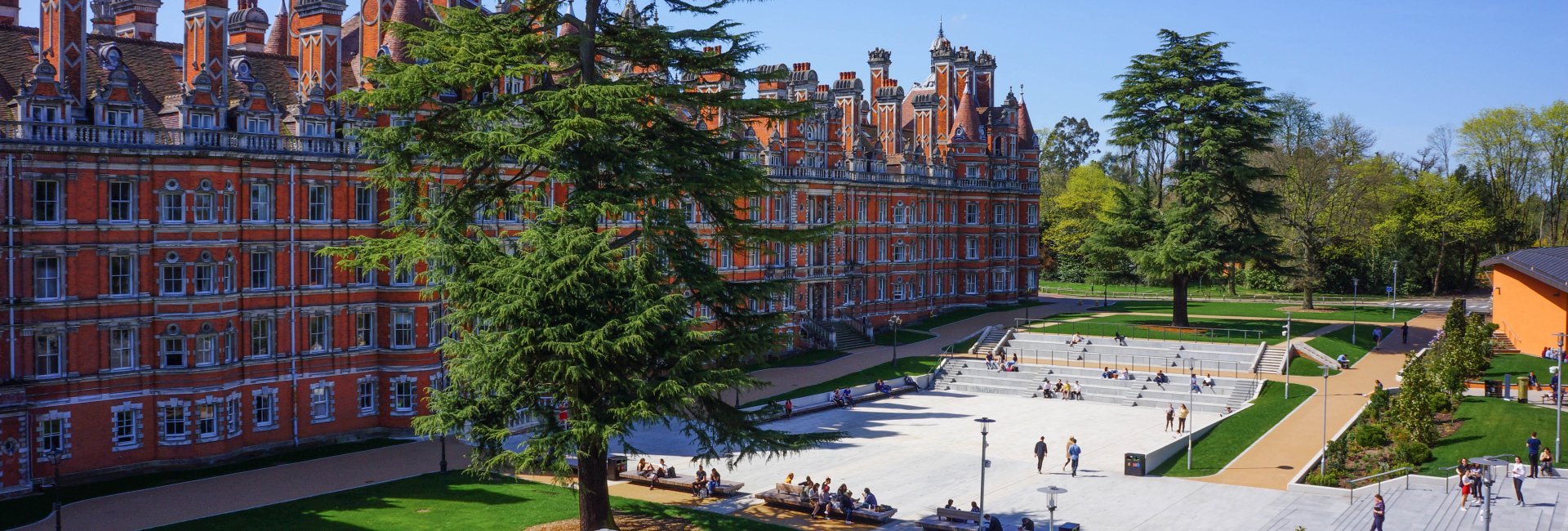
Royal Holloway, University of London - Postgraduate Open Morning (Egham campus)
13 Jun 2026, 08:00
Egham

“It has been said that figures rule the world; maybe. I am quite sure that it is figures which show us whether it is being ruled well or badly.” - Johann Wolfgang von Goethe
Fascinated by the power of statistics? The world increasingly needs graduates with an understanding of statistical methods, data analysis and the mathematics that underpins it all. The collection, analysis, application and representation of data are central to our globalised society. Statistics lie at the heart of our economics, accounting, banking, management and administration, communications, astronomy and the physical and social sciences.
This programme is led by renowned experts in the field and will give you a solid grounding in all the key methods and concepts of mathematics, whilst allowing you to explore the fascinating and rapidly evolving field of statistics. It helps you to link fundamental concepts of probability theory and pure mathematics to the application of a diverse array of statistical techniques. The modular structure also gives you the flexibility to tailor your studies to your own interests.
Our curriculum is broad and informed by our world-class research activities, including pioneering work in the field of statistics. We also offer an extensive array of postgraduate opportunities, and provided you make good progress in year 1 you will have the option of transferring onto our four-year Mathematics MSci programme if you decide to focus on taking your mathematics to a higher level. It might also be possible to transfer sideways into the second year of one of our other undergraduate mathematics programmes.
Join our friendly and inspiring department and you will benefit from a thoroughly supportive learning environment. We offer small group tutorials, problem-solving sessions, practical workshops and IT classes, as well as generous staff office hours and a dedicated personal adviser to guide you through your studies. We also offer CV writing workshops and a competitive work placement scheme. Graduates from our department are in great demand for their numeracy, analytical skills, data handling powers, logical thinking and creative problem-solving abilities.
Learn from renowned mathematicians and statisticians who are experts in their fields.
Feel at home in a lively, friendly department with a strong focus on small group teaching, where you will be known as an individual.
Enjoy a varied and flexible curriculum, and tailor your degree to your own interests.
From Euclid to Mandelbrot, Introduction to Applied Mathematics, Principles of Statistics, Calculus, Functions of Several Variables, Number Systems, Matrix Algebra, Numbers And Functions, Statistical Methods, Probability, Linear Algebra and a Group Project, Complex Variable, Inference, Time Series Analysis, Applied Probability
In addition to these mandatory course units there are a number of optional course units available during your degree studies
The programme has a flexible, modular structure and you will take a total of 12 course units at a rate of four, 30-credit modules per year. In addition to our compulsory core modules you will be free to choose between a number of optional courses. Some contribute 15 credits to your overall award while others contribute the full 30.
We use a variety of teaching methods and there is a strong focus on small group teaching in the department. You will attend 12 to 15 hours of formal teaching in a typical week, including lectures, tutorials, problem solving workshops and practical sessions in statistics and computational mathematics. You will also be expected to work on worksheets, revision and project work outside of these times. In year 2, teaching will mainly be delivered through lectures and workshops and in year 3, mostly through relatively small group lectures.
Our courses are mostly examined by end-of-year examinations but some of our statistics and computational courses also have project components and between 10% and 30% of your final mark for each core module in year 1 will come from coursework. Some of the first year modules also include tests that contribute 10% of the final mark. In the first term of year 2 you will work in small groups to prepare a report and an oral presentation on a mathematical topic of your choice, which will contribute to one of your core module grades. CV writing skills are also embedded into that course. In year 3 there are two optional courses which are examined solely by a project and presentation.
This is the equal consideration deadline. You can still apply after this date, but your application may not receive guaranteed consideration.

Royal Holloway, University of London has participated in the Teaching Excellence Framework. These ratings were awarded in 2023, for four years.
See why these ratings were awarded
What does this TEF outcome mean?
The following entry points are available for this course:
With almost a third of our students joining us from outside the UK, Royal Holloway is a diverse community with a strong international spirit.
Ranked highly in the UK and the world for international outlook in the Times Higher Education World University Rankings, Royal Holloway’s position recognises our global research impact and partnerships as well as student and staff diversity.
Our alumni are found in 160 countries, working in industry, the arts, public sector and other areas, Royal Holloway is truly international both in ethos and impact.
Within the 9,850 students enrolled at Royal Holloway, over 130 nationalities are represented, making our campus truly cosmopolitan. In addition, of the 104 societies and associations which enrich the post-study social life of our students, a quarter have an international flavour. We know a diverse community makes for a more creative and harder-working environment which benefits all our students, wherever they are from.
Students from overseas can apply for all of our undergraduate degrees. We offer a range of additional support specifically for international students, including through our Centre for the Development of Academic Skills. For example, ‘Academic English’ for international students is provided for non-native speakers of English. The courses are designed to help you meet the challenges of academic work, including writing essays, following lectures, taking part in academic discussion and giving presentations. We also offer additional degree preparation courses for international students. See our website for full details.
We have a number of scholarships that are dedicated to international students to help with tuition fees for undergraduate degrees. You can find a list of our current scholarship opportunities on our website.
Where an applicant is taking the EPQ alongside A-levels, the EPQ will be taken into consideration and result in lower A-level grades being required.
Socio-economics factors which may have impacted an applicant's education will be taken into consideration and alternative offers may be made to these applicants.
Required subject: A-level grade A in Mathematics
Pass with at least 24 Level 3 credits at Distinction, 15 of which must be in Maths units and the remaining level 3 credits at Merit PLUS A Level Maths grade A
Including A in Maths
Plus A-level Maths grade A.
Distinction plus A-levels grades AC including Maths grade A.
Plus A-level Maths grade A.
Including A in Maths
6,5,4 at Higher Level OR 30 overall including 6 in Maths at Higher Level
Requirements are as for A-levels where one non-subject-specified A-level can be replaced by the same grade in the Welsh Baccalaureate - Advanced Skills Challenge Certificate.
H2,H3,H3,H4,H4 at Higher Level including H2 in Mathematics at Higher Level
Applicants with the Cambridge Pre-U are strongly encouraged to apply to Royal Holloway. Offers will be made on the basis of equivalent A-Level grades as can be found on the Royal Holloway website.
At least five GCSEs at grade A*-C or 9-4 including English and Mathematics are also required.
Combinations of qualifications will be considered on an individual basis, please contact us on admissions.enquiries@rhul.ac.uk to discuss your situation
At Royal Holloway, we know every student approaches university with different experiences and backgrounds. We look at each application individually, and different factors can affect the exact offer a student receives. For instance, our contextual offer scheme means students from disadvantaged socio-economic background can receive a different offer. For full details please see our website.
Learn more on the Royal Holloway, University of London website
This section shows the range of grades that students who received offers were previously accepted on to this course with (learn more).
It is designed to support your research but does not guarantee whether you will or won't get a place.
Admissions teams consider various factors, including interviews, subject requirements, and entrance tests. Check all course entry requirements for eligibility.
We are unable to show previous accepted grades for this course. This could be because the course is new, it's a postgraduate course, there isn't enough historical data, or the provider has opted out of sharing their entry grades data for this course - learn more.
| Location | Fee | Year |
|---|
Tuition fee status depends on a number of criteria and varies according to where in the UK you will study. For further guidance on the criteria for home or overseas tuition fees, please refer to the UKCISA website.
*The tuition fee for Home (UK) undergraduates is controlled by Government regulations. This figure is the fee for the academic year 2026/27 and is shown as a guide.
**This figure is the fee for EU and international students starting a degree in the academic year 2026/27 and is shown as a guide.
Royal Holloway reserves the right to increase tuition fees annually for all students. For further information see fees and funding (https://www.royalholloway.ac.uk/studying-here/fees-and-funding).
*** These estimated costs relate to studying this particular degree at Royal Holloway during the 2026/27 academic year and are included as a guide. Refers to specific individual items of £50 or more, and excludes accommodation, commuting, food, books/other learning materials and printing costs.
Email:Admissions.Enquiries@RoyalHolloway.ac.uk
Phone:01784 414944
Egham
TW20 0EX
At Royal Holloway, University of London