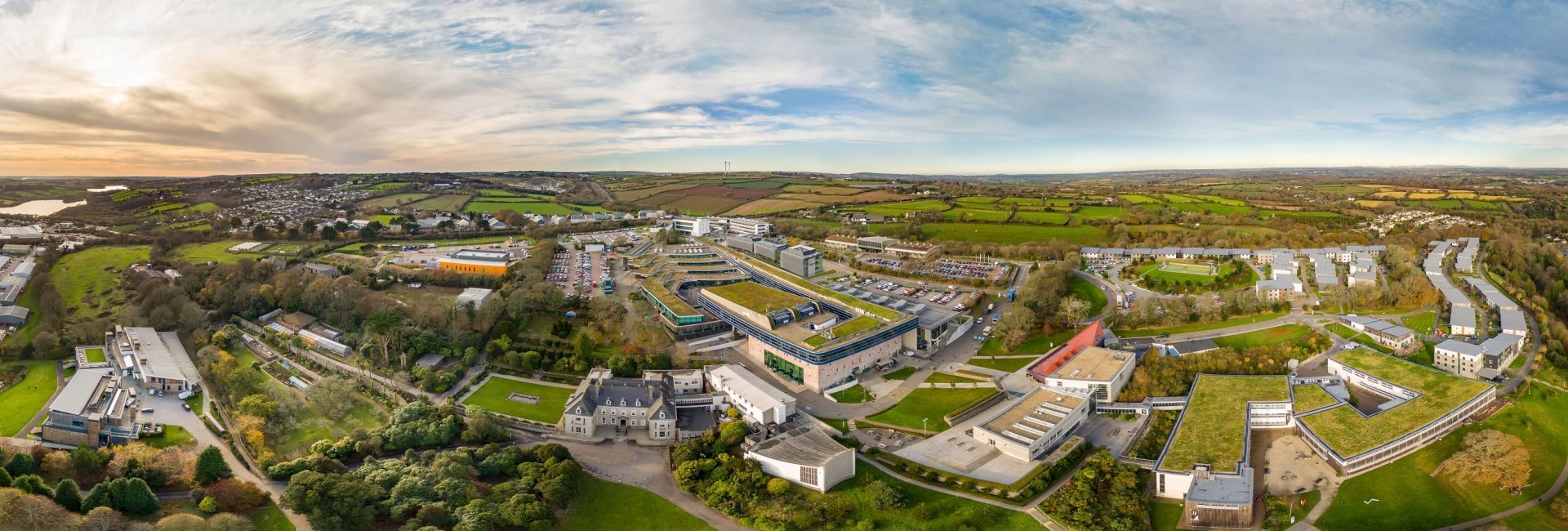
Open Day (in-person)
3 Oct 2026, 08:00
Falmouth

Where wires cross, ideas spark.
Creative Computing is for curious minds who view technology as a limitless canvas. At Falmouth University, you’ll experiment with technology to build digital experiences that excite audiences in new ways. Discover how computation can reimagine art, design and storytelling, whilst asking the big questions about how technology is shaping our culture and society.
Collaboration is at the heart of the course. You will work across creative disciplines to explore creative coding, interactive systems, digital storytelling and immersive media, gaining hands-on experience with web technologies, artificial intelligence, machine learning, virtual reality and augmented reality environments alongside physical computing.
Creative Computing graduates step into the world as innovators: experimental, ethically aware, and confident at crossing disciplinary boundaries. As a creative technologist, you'll be able to pursue digital storytelling, virtual production, immersive experiences, or interactive art. You’ll also be able to explore opportunities in games, apps, shows, media, festivals, exhibitions, visual effects and the wider creative technology sector.
Why study this course at Falmouth?
Creative: Turn ideas into real, interactive experiences that connect with audiences
Future-facing: Learn to think critically and work creatively with emerging technologies such as AI and XR
Flexible: Choose between a technically-focused BSc or an artistically-led BA, specialising through pathways in theatre, screen, or heritage to apply your skills to live performance, film and television, or cultural experiences
Ethically-aware: Explore how technology shapes culture, identity and the environment to design, make and critique digital work to be imaginative, inclusive and sustainable
Disruptive: Explore, experiment, prototype and play in a thriving creative environment where code, design and imagination collide to create the unexpected
Beginner-friendly: Gain confidence with coding, experiment with new ideas and grow your creative voice along the way
Connected: Collaborate with students from courses such as games, theatre, film, music, and performance to discover how creative ideas grow stronger through shared perspectives
Pioneering: Graduate as a confident maker, designer, and thinker, ready to shape creative projects in digital storytelling, virtual production, immersive experiences and beyond
At Falmouth, Creative Computing is about curiosity, craft and care. It’s the art of experimentation: shaping technology with imagination and social responsibility. You’ll explore how digital systems, materials and the physical world can interact in ways that are expressive, thoughtful and sustainable. Through prototyping, questioning and refinement, you’ll approach digital making as a craft that balances creativity with care for people and the planet.
Both the BSc and BA share a common first year, giving you a solid underpinning in computing and development, while giving you room to respond creatively to industry-style briefs. From your second year onwards, you will start to broaden your expertise across multiple disciplines, with modules that most suit your personal talent and ambitions.
On BSc(Hons) Creative Computing, you will study additional modules that enhance your mathematics and data analysis skills, while remaining rooted in creative applications.
Year One:
In your first year, everyone studies the same set of modules, learning together through shared projects and collaborative making. Designed for beginners, this stage builds your foundation in coding, data, digital creativity and physical computing through hands-on experimentation and teamwork.
You will learn by making, exploring how technology can be expressive, sustainable and responsible, while developing the confidence and curiosity to continue your creative computing journey.
Modules:
Principles of Computing
Development Foundations
Digital Creativity
Individual Programming Project
Data Fundamentals
Multidisciplinary Digital Performance
Year Two:
Year two is where you start to really specialise as a creative developer and solution designer. You’ll deepen your creative and technical practice through hands-on experimentation and interdisciplinary projects. You’ll explore ways to bring digital systems, interactive experiences and physical computing to life, combining making, coding and design to create engaging and responsive work.
You’ll also develop critical understanding of how technology shapes society and culture, considering ethical, inclusive and sustainable approaches to design. Across the stage, you’ll strengthen your analytical and research skills, integrate theory with practice and collaborate with others, preparing you for substantial projects in your final year. You’ll additionally sharpen your knowledge of computational mathematics and cybersecurity.
Modules:
Computational Mathematics
Digital Prototyping
Immersive & Participatory Performance
Immersive and Interactive Audio
Artificial Intelligence & Machine Learning
Animatronics
Year Three:
You’ll be responsible for finding your own placement, with support from the Employability team.
You’ll spend time working in a professional context, as part of a business or organisation. This can be in one role, or up to three, and must be for a minimum of 24 weeks.
You’ll develop a portfolio of work that includes critical self-reflection on what has been learned from the experience. You’ll be required to evidence your experiences, the skills you’ve learned and your professional growth.
Year Four:
In your final year, you’ll experiment with storytelling, interactivity and digital systems to craft engaging experiences. You’ll then take your ideas into Digital Innovation and the Major Collaboration modules. Working in multi-skilled teams, you’ll plan, design and develop a substantial project with real-world impact, exploring opportunities for employment, freelancing, or entrepreneurial ventures. You’ll focus on technical research, quantitative analysis, and creating a novel computing artefact, culminating in a dissertation.
Modules
Research & Development: Proposal
Digital Innovation
Interactive Experience Design
Major Collaboration
Research & Development: Dissertation
As part of our process of continuous improvement, we routinely review course content to ensure that all our students benefit from a high-quality and rewarding academic experience. As such, there may be some changes made to your course which are not immediately reflected in the content displayed on our website. During your course, module content may be updated or optional modules withdrawn in order to maintain the best academic experience. Any students affected will be informed of any changes directly.
https://www.falmouth.ac.uk/study/undergraduate/creative-computing
100% of your assessment will be coursework, computing projects or dissertations. There are no exams on this course.
A portfolio of personal and group project work is developed over the course of the degree to boost your employability, and this is also assessed during through your Major Collaboration project in your final year.
This is the equal consideration deadline. You can still apply after this date, but your application may not receive guaranteed consideration.

Falmouth University has participated in the Teaching Excellence Framework. These ratings were awarded in 2023, for four years.
See why these ratings were awarded
What does this TEF outcome mean?
The following entry points are available for this course:
We welcome A Levels in a wide range of subjects, especially in those relevant to the course for which you apply.
P (Pass) grade must be C or above, not D or E
A typical offer is 96 UCAS points
We may consider a standalone AS in a relevant subject, if it is taken along with other A Levels and if an A Level has not been taken in the same subject. However, you will not be disadvantaged if you do not have a standalone AS subject as we will not ordinarily use them in our offers.
60 credits (with a minimum of 45 credits achieved at level 3) in a relevant subject.
A typical offer is 96 UCAS points
Acceptable when combined with other qualifications
Acceptable when combined with other qualifications
Acceptable when combined with other qualifications
a minimum of 40 UCAS tariff points, when combined with a minimum of 64 UCAS tariff points from the Supporting Qualifications
A typical offer is 96 UCAS points
A typical offer is 96 UCAS points
Acceptable when combined with other qualifications
A typical offer is 96 UCAS points
Acceptable when combined with other qualifications
a minimum of 40 UCAS tariff points, when combined with a minimum of 64 UCAS tariff points from the Supporting Qualifications
A typical offer is 96 UCAS points
If you are able to demonstrate relevant, current, equivalent experience instead of formal qualifications, we encourage you to apply. Please contact our Applicant Services team before applying, for advice regarding your individual experience and eligibility.
If you are an international applicant and require a Student visa to study in the UK, you must have a recognised English language test approved and vouched for by the University at the appropriate level. Our Applicant Services team can help you with any general questions you may have about study visas or suitable language tests. For more specific advice, we recommend you also consult UKCISA http://www.ukcisa.org.uk/
If English is not your first language, you will need to demonstrate English language skills that are sufficiently developed for successful completion of your studies. We accept a range of recognised English language qualifications that are equivalent to the International English Language Testing System (IELTS) Academic minimum score of 6.0 overall, with a minimum of 5.5 in Reading, Writing, Speaking and Listeninghttps://www.falmouth.ac.uk/study/international/english-language-requirements
This section shows the range of grades that students who received offers were previously accepted on to this course with (learn more).
It is designed to support your research but does not guarantee whether you will or won't get a place.
Admissions teams consider various factors, including interviews, subject requirements, and entrance tests. Check all course entry requirements for eligibility.
We are unable to show previous accepted grades for this course. This could be because the course is new, it's a postgraduate course, there isn't enough historical data, or the provider has opted out of sharing their entry grades data for this course - learn more.
| Location | Fee | Year |
|---|---|---|
| England, Scotland, Wales, Northern Ireland, Channel Islands, Republic of Ireland, EU & International | TBC |
Tuition fee status depends on a number of criteria and varies according to where in the UK you will study. For further guidance on the criteria for home or overseas tuition fees, please refer to the UKCISA website.
No additional fees or cost information has been supplied for this course, please contact the provider directly.
We offer bursaries and awards to help support our undergraduate students.
The bursaries and awards you are eligible for will depend on your chosen course and pathway as well as your individual circumstances. These bursaries and awards are separate from any other Government loans or grants, helping you to fund your studies while at Falmouth.
Through the award of international scholarships, we aim to support academic enrichment by encouraging diversity and excellence at Falmouth.
For details of our scholarships and bursaries, and how to apply for them, please visit our website at www.falmouth.ac.uk/study/student-funding/undergraduate-bursaries-awards
https://www.falmouth.ac.uk/study/student-funding/undergraduate-bursaries-awards
Email:applicantservices@falmouth.ac.uk
Phone:01326 213730
Woodlane
Falmouth
TR11 4RH
At Falmouth University