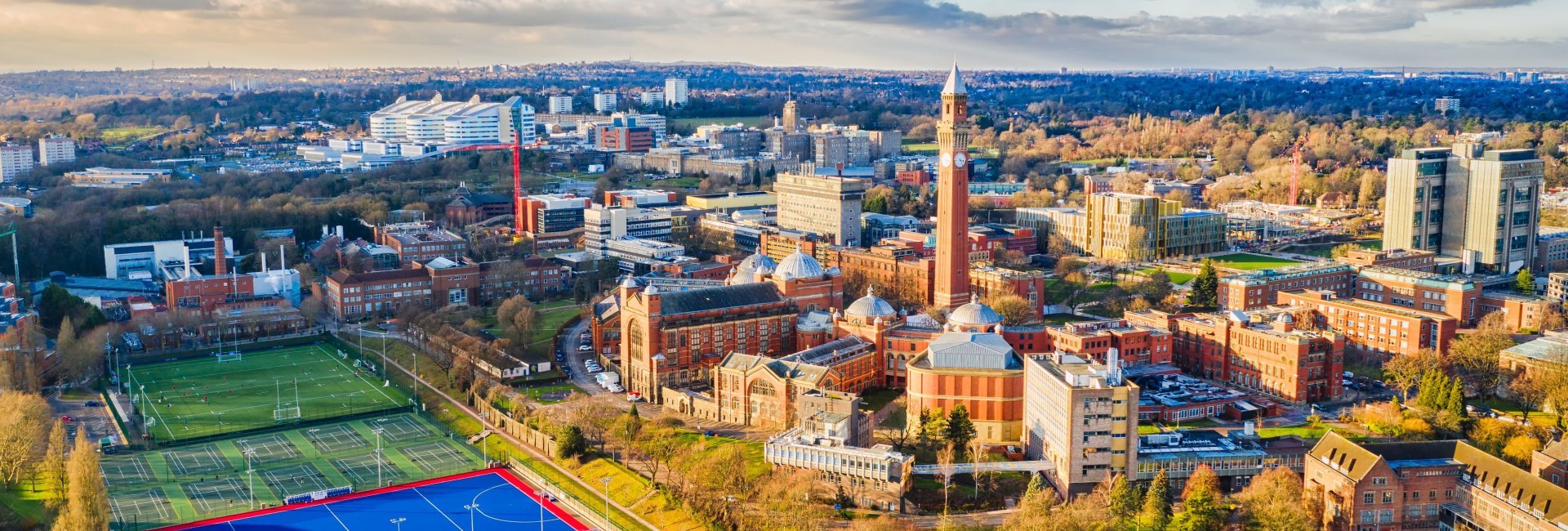
University of Birmingham - Undergraduate Open Day
26 Jun 2026, 08:00
Birmingham

Harness the ability to communicate across borders and industries through the study of language and culture.
Embrace flexibility - choose to combine study of two or three languages from Catalan, Chinese, French, German, Italian, Japanese, Portuguese, Russian, and Spanish.
Why study this course?
Experience a new approach to language learning with our CLIL (Content Language Integrated Learning) teaching method - study topics of cultural significance, designed and delivered by expert researchers.
Tailor your degree to your interests - choose to continue with languages you studied at A level, begin a new language, or mix the two!
Live and study in one of the most culturally mixed cities in the UK. Make global connections on your course and through our student societies, including our culture and language magazine - The UoB Linguist.
Top 30 for Modern Languages and Linguistics in the Guardian University Guide 2024
Top 100 for Modern Languages in the QS World Subject Rankings 2025
First-year modules cover a broad base of the subject and are designed to introduce you to ways of studying at university. By the final year the modules you take will become more specialised and reflect the research expertise of the academic staff. More detailed module information can be found on the course page.
This is the equal consideration deadline. You can still apply after this date, but your application may not receive guaranteed consideration.

University of Birmingham has participated in the Teaching Excellence Framework. These ratings were awarded in 2023, for four years.
See why these ratings were awarded
What does this TEF outcome mean?
The following entry points are available for this course:
You also require an A level or equivalent in each modern language that you plan to study at Advanced level. If you do not have the relevant language A Level, please feel free to contact us to discuss your options.
BTEC Extended Diploma: DDM, plus a B at A-level in the required subject/s mentioned above.
BTEC Diploma: DD, plus a B at A-level in the required subject/s mentioned above.
BTEC Subsidiary Diploma: D, plus AB at A-level, including the required subject/s mentioned above.
6,5,5 in Higher Level subjects. You also require a Higher Level or equivalent in each modern language that you plan to study at Advanced level. If you do not have the relevant language at Higher Level, please feel free to contact us to discuss your options.
Accepted in place of a non-required A level with the equivalent grade.
Accepted in place of A levels with the following grade equivalencies: D2 = A*; D3 = A; M2 = B. Combinations of A levels and Principle subjects are accepted. NB required subjects must be offered (see A level Section)
The historic entry grades range shown below includes students admitted with alternative offers through our contextual admissions schemes. These are typically 1 or 2 grades below the standard offer. You can find information on these schemes using the link below.
You can check your eligibility to receive an offer for this course using our Offer Calculator using the same link.
This section shows the range of grades that students who received offers were previously accepted on to this course with (learn more).
It is designed to support your research but does not guarantee whether you will or won't get a place.
Admissions teams consider various factors, including interviews, subject requirements, and entrance tests. Check all course entry requirements for eligibility.
We are unable to show previous accepted grades for this course. This could be because the course is new, it's a postgraduate course, there isn't enough historical data, or the provider has opted out of sharing their entry grades data for this course - learn more.
| Location | Fee | Year |
|---|
Tuition fee status depends on a number of criteria and varies according to where in the UK you will study. For further guidance on the criteria for home or overseas tuition fees, please refer to the UKCISA website.
For details of the annual tuition fee for International Students please see the course web page listed in the 'course details' section above.
If you are made an offer to study by the University, the yearly tuition fee will be stated in your offer letter.
At University of Birmingham