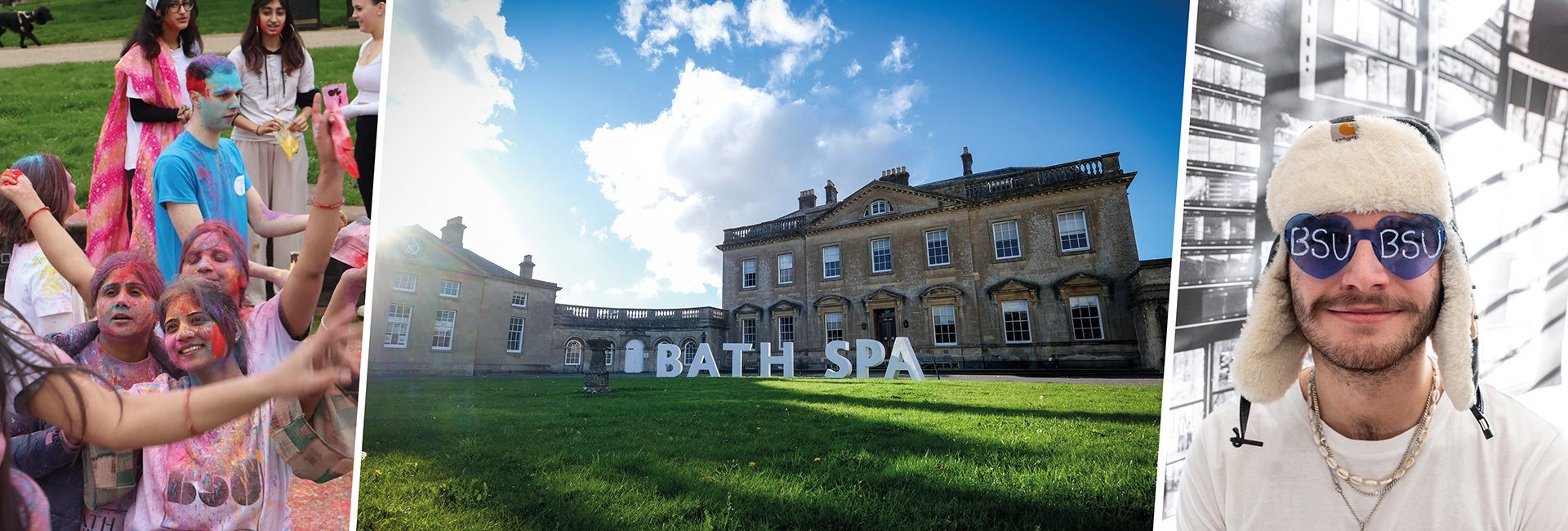
Bath Spa University
Newton Park
Newton St Loe
Bath
BA2 9BN
Visit our website Visit our course page
Course contact details
Bath Spa Admissions Team
Email:admissions@bathspa.ac.uk
Phone:01225 875875

Our Law degree develops your practical and vocational skills alongside your knowledge of legal theory.
Put your legal knowledge into practice while you develop career-enhancing skills.
Designed to prepare you for a wide range of careers, both within and beyond the legal sector.
Designed to help you attain many of the skills required to complete the practice elements of the Solicitors Qualifying Exam (SQE), Law at Bath Spa develops your legal knowledge, research and professional skills.
This innovative Law degree is informed by the new regulatory framework for the training of solicitors and barristers, and meets the requirements of the Bar Standards Board. Gain a broad understanding of legal systems and criminal law. You'll expand your knowledge to topics such as international law, media and entertainment law, and cybercrime. In your final year, you’ll hone your practice skills in our law clinic, or undertake a law research project.
Learn how to be a lawyer in practice and understand the business of law, so that you can hit the ground running when you graduate. We recognise that many Law students don’t pursue a career in law and have built career planning into each strand of the course, with a focus on the growing number of roles that require related skill sets. These include roles in governance, risk management, advocacy, public policy, HR and finance.
Our innovative Politics degree has been designed to enable you to acquire specialised subject knowledge while developing practical and professional skills that you can apply to contemporary challenges, issues and debates.
What do people really mean when they say they’re not 'interested in politics'?
Political action or inaction shapes our lives every day, in ways which are often invisible, or which seem remote or impenetrable. We know that it matters, but we can also feel removed from it: the vast sums of money spent on elections and then nothing seems to change, the narrowness of so much debate and the pointlessness of point scoring, getting power in order to keep it.
We want to try to get under the surface of all these assumptions and ask if it really has to be this way. We want to try to understand the politics of everyday life, as well as the major challenges of climate change, poverty and inequality, the imbalances of wealth and power nationally and internationally, and between elected governments and unelected corporations. Who decides: the local councillor, the member of parliament, or the chairman of the board?
More about the Professional Placement Year
A Professional Placement Year (PPY), traditionally known as a sandwich year, is where you undertake a period of work with an external organisation for between 9-13 months. The placement occurs between your second and final years of undergraduate study. You can engage in multiple placements to make up the total time and are required to source the placement(s) yourself, with support from the Careers team.
The LLB Law degree covers the ‘foundation law subjects’ required by the Bar Standards Board, including tort, contract, criminal, and property law. It also introduces practical skills such as case analysis, negotiation and alternative dispute resolution, drafting, interviewing and mooting.
You'll develop the ability to understand connections between legal topics; this replicates legal and paralegal practice, where problems are rarely neatly packaged. You'll also be supported to develop your professional practice and employability skills throughout the degree.
You'll select from a range of interdisciplinary options including business, criminology and sociology, as well as law options such as corporate law, employment law or entertainment, media and intellectual property law. This will enable you not only to be a better lawyer – due to your experiences outside of a legal education framework – but will also provide you with better employment prospects if you choose not to follow a career in law.
We'll encourage you to undertake a work placement, and the law clinic in the third year is an experiential learning option that will give you the opportunity to provide legal advice to clients.
Politics
Year one - Introductions and foundations: develop your skills in political thinking, and follow a broad curriculum which allows you to ask questions, challenge your own assumptions, interrogate evidence, data and opinions.
Year two - Practical, applied, relevant: this year combines the academic study of Politics with the acquisition of professional skills and the application of your knowledge and understanding to a defined problem or idea.
Year three - Professional Placement Year.
Final Year - Achievement, consolidation, creativity: your final project in the third year brings all this together. You’ll identify your own area of study, develop your proposal and put it into practice. This might be an extended piece of academic writing, but it might also be a pitch to a local employer, a community project or the creation of digital resources.
We use a mix of traditional and contemporary assessments, including essays, group and individual presentations, online reports, surveys, projects, practical tasks and exams. You’ll also learn to communicate key messages visually, as well as in words.
The Law section of the course will include a range of practice based assessments such as drafting, negotiating and mooting. It will also include a limited number of exams to prepare you for the SQE (Solicitors Qualifying Exam).
This is the equal consideration deadline. You can still apply after this date, but your application may not receive guaranteed consideration.

Bath Spa University has participated in the Teaching Excellence Framework. These ratings were awarded in 2023, for four years.
See why these ratings were awarded
What does this TEF outcome mean?
The following entry points are available for this course:
We welcome students from all backgrounds into Bath Spa University, and we look at more than just grades when we consider your application. This is known as ‘contextual admissions’ – where we use the information from your application to make sure your background and potential are fully considered alongside your academic achievements. Eligible applicants can and will receive an offer lower than our standard published entry tariff.
This section shows the range of grades students (with UK A-Levels or Pearson BTEC Level 3 National Extended Diplomas) who received offers were previously accepted with (learn more). It is designed to support your research but does not guarantee whether you will or won't get a place. Admissions teams consider various factors, including interviews, subject requirements, and entrance tests. Check all course entry requirements for eligibility.
Students aged 17/18 who applied to this course were offered a place.
See how students with your grades have been accepted onto this course in the past.
Operated by the Office for Students
Employment after 15 months (Most common jobs)
Go onto work and study
The number of student respondents and response rates can be important in interpreting the data – it is important to note your experience may be different from theirs. This data will be based on the subject area rather than the specific course. Read more about this data on the Discover Uni website.
| Location | Fee | Year |
|---|---|---|
| England | £9790 | Year 1 |
| Northern Ireland | £9790 | Year 1 |
| Scotland | £9790 | Year 1 |
| Wales | £9790 | Year 1 |
| Channel Islands | £9790 | Year 1 |
| Republic of Ireland | £9790 | Year 1 |
| EU | £17310 | Year 1 |
| International | £17310 | Year 1 |
Tuition fee status depends on a number of criteria and varies according to where in the UK you will study. For further guidance on the criteria for home or overseas tuition fees, please refer to the UKCISA website.
No additional fees or cost information has been supplied for this course, please contact the provider directly.
Newton Park
Newton St Loe
Bath
BA2 9BN
Visit our website Visit our course page
Email:admissions@bathspa.ac.uk
Phone:01225 875875