Course contact details
Main Contact
Email:Admissions.Enquiries@RoyalHolloway.ac.uk
Phone:01784 414944
Royal Holloway, University of London
Egham
TW20 0EX

This course is available to Home (UK) students and International students who meet the English Language requirements.
Our Integrated Foundation Year for science is a thorough, skills-building course that will give you everything you need to start your study of BEng Electronic Engineering with confidence.
Engineering, Physical, Computational and Mathematical sciences underpin modern technological society and can help us provide answers to fundamental questions. Our Foundation Year sets you up so that you’re ready to take on those questions - providing you with opportunities to gain knowledge and understanding of how to get started in studying the sciences at university, including your chosen degree subject.
Learning from friendly, expert tutors, you’ll explore modules designed to provide familiarity with Mathematics and computation – the language of modern science and technology, and key for success in science, technology and engineering.
Once you have completed your Foundation year, you will normally progress onto the full degree course, BEng Electronic Engineering. There may also be flexibility to move onto a degree in another department (see end of section, below).
All of our lives are touched by the products of Electronic Engineering. The breakthroughs made by today's electronic engineers help to create the mobile devices, personal media, computers, smart transportation and domestic appliances we use every day, but also have a more profound impact on issues such as environmental sustainability, healthcare and information security.
We're in the midst of a major technological revolution, and as such there has never been a more exciting time to study Electronic Engineering. Study at Royal Holloway's Department of Electronic Engineering and you'll have access to a purpose-designed building, with £20 million invested in state-of-the-art equipment and facilities including labs, collaboration and research spaces.
You'll benefit from research-led teaching from expert academics building international reputations in diverse fields including renewable energy and music technology. Electronic Engineering students will enjoy a rewarding blend of practical and theoretical study, working in pairs, groups and individually with one-on-one support from your own Personal Advisor.
Opportunities for student placements, internships and industry relevant projects will be available, and our connection with industry advisors ensures that students are taught the most relevant knowledge and skills and market awareness.
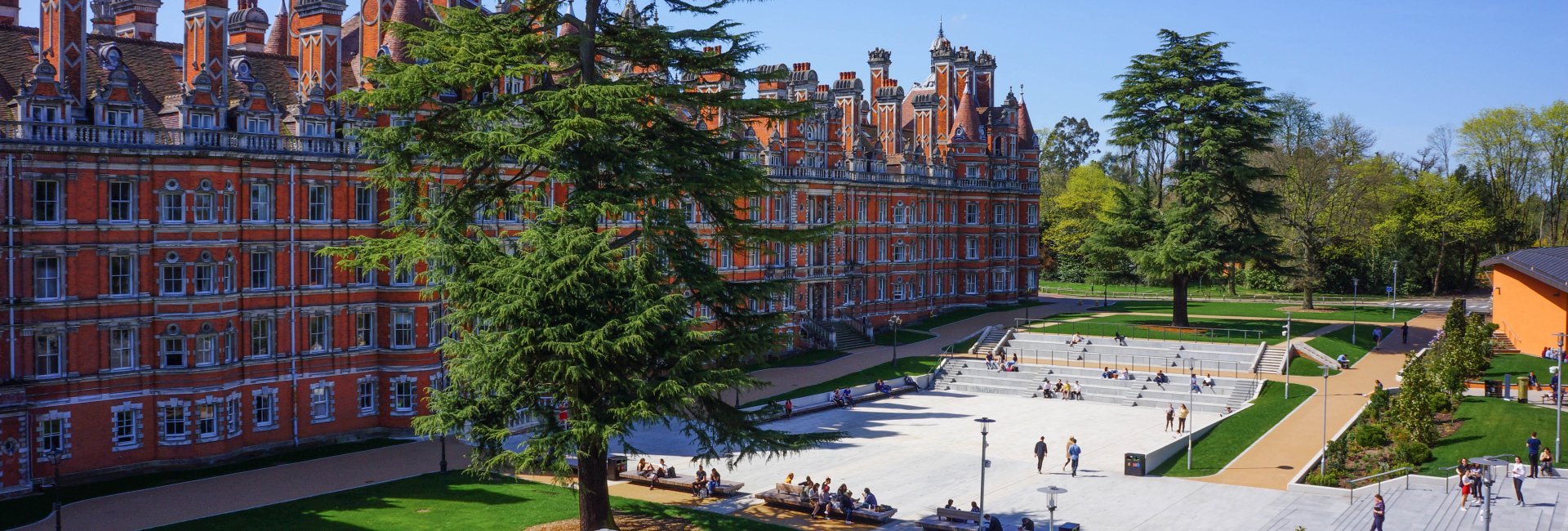
Join us at our beautiful, well-established Surrey campus within easy reach of London. You'll become a part of a vibrant, international student community as you prepare for a rewarding career in your chosen field. Follow your passion for the creative, innovative world of Electronic Engineering and develop the ingenuity, invention and product development skills you need to thrive in this rapidly expanding industry.
On successful completion of your Foundation Year, you may be able to choose an alternative pathway which could include a degree from one of the other departments offering a Foundation Year within the School of Engineering, Physical and Mathematical Sciences. If you'd like to do this, you may take your Foundation Year Individual Project in one of these other departments. The degree course you choose to take after progression is likely to depend on the individual project you select during the foundation year. Please note however that you must take 'Foundation Skills (Mathematics)' and your individual project in the Department of Mathematics if you wish to join a full degree course in Mathematics.
We sometimes make changes to our courses to improve your experience. If this happens, we’ll let you know as soon as possible.
Foundation Programming
Foundation Physical Sciences I
Foundation Mathematics I
Foundation Programming Group Project
Engineering Society
Foundation Mathematics II
Embedded Systems Creative Team Project 1
Programming in C++
Electronic Circuits and Components
Communications Engineering 1
Mathematics for Engineers 1
Mathematics for Engineers 2
Internet Services
Academic Integrity
Embedded Systems Creative Team Project 2
Signals, Systems and Communications
Control Engineering
Digital Coding and Data Networking
Electronic Materials and Devices
Professional and Sustainable Engineering
Analogue Electronic Systems
Individual Project
Digital Signal Processing Design
Principles of Engineering Management
Digital Systems Design
Advanced Communications Systems
Below is a taster of some of the exciting optional modules that students on the course could choose from during this academic year. Please be aware these do change over time, and optional modules may be withdrawn or new ones added.
Power Systems
Smart Transportation
Voice Technologies
Fundamentals of Biomedical Engineering
Applications of Cryptography
In your Foundation Year, teaching methods include a mixture of lectures, practical classes and workshops, laboratory classes, individual tutorials, and supervisory sessions. Outside of the classroom you’ll undertake guided and independent practice. You will be assigned a Personal Tutor in the Department of Electronic Engineering and will have regular scheduled sessions. In the Foundation Year, you’ll also be assigned a Personal Tutor in the Centre for the Development of Academic Skills (CeDAS). Assessments are varied; practical exercises, weekly problem sheets, set exercises, written examinations, laboratory reports, scientific poster preparation and presentation. In addition the Foundation Year offers a full range of skills-based training and also the opportunity to take a micro-placement to enhance your employability.
Once you progress onto your full degree course, in many modules you will carry out practical project work, involving problem-solving using theory developed within the module and electronic circuit building and/or software skills as appropriate. Teaching activities will include lectures, workshops and seminars, and practical project work will be carried out in groups and individually in purpose-built thinking and fabrication laboratories.
Various assessment methods will be used including examinations for theoretical subjects, formal presentations, reports and practical demonstrations for project work with an additional oral presentation examination for final year individual projects. You will be expected to review material after lectures to support your learning and to preview scripts before coming to laboratory sessions.
Excellent written and verbal communication skills are highly valued and sought after in the industrial workplace and are essential for effective group working. You will develop these as part of project-based work and will be assessed formally on them.
You’ll continue to work with your Personal Tutor, with whom any issues can be discussed to enable appropriate advice and help to be given as appropriate.
This is the equal consideration deadline. You can still apply after this date, but your application may not receive guaranteed consideration.

Royal Holloway, University of London has participated in the Teaching Excellence Framework. These ratings were awarded in 2023, for four years.
See why these ratings were awarded
What does this TEF outcome mean?
The following entry points are available for this course:
We require English and Mathematics at grade 4/C.
Requirements are as for A-levels where one non-subject-specified A-level can be replaced by the same grade in the Welsh Baccalaureate- Advanced Skills Challenge Certificate
At Royal Holloway, we know every student approaches university with different experiences and backgrounds. We look at each application individually, and different factors can affect the exact offer a student receives. For instance, our contextual offer scheme means students from disadvantaged socio-economic background can receive a different offer. For full details please see our website.
Learn more on the Royal Holloway, University of London website
This section shows the range of grades that students who received offers were previously accepted on to this course with (learn more).
It is designed to support your research but does not guarantee whether you will or won't get a place.
Admissions teams consider various factors, including interviews, subject requirements, and entrance tests. Check all course entry requirements for eligibility.
We are unable to show previous accepted grades for this course. This could be because the course is new, it's a postgraduate course, there isn't enough historical data, or the provider has opted out of sharing their entry grades data for this course - learn more.
| Location | Fee | Year |
|---|---|---|
| EU & International | £29900* | |
| England, Scotland, Wales, Northern Ireland & Channel Islands | £9790* |
* This is a provisional fee and subject to change.
Tuition fee status depends on a number of criteria and varies according to where in the UK you will study. For further guidance on the criteria for home or overseas tuition fees, please refer to the UKCISA website.
Other essential costs: Students are recommended to purchase a laptop before starting their course, to assist with their studies. The optional residential field courses incur an extra fee.
*The tuition fee for Home (UK) undergraduates is controlled by Government regulations. This figure is the fee for the academic year 2026/27 and is shown as a guide. The fee for the academic year 2027/28 has not yet been confirmed.
*This figure is the fee for EU and international students starting a degree in the academic year 2026/27 and is shown as a guide. The fee for the academic year 2027/28 has not yet been confirmed.
Royal Holloway reserves the right to increase tuition fees annually for all students. For further information see fees and funding: https://www.royalholloway.ac.uk/studying-here/fees-and-funding/
Email:Admissions.Enquiries@RoyalHolloway.ac.uk
Phone:01784 414944
Egham
TW20 0EX
At Royal Holloway, University of London