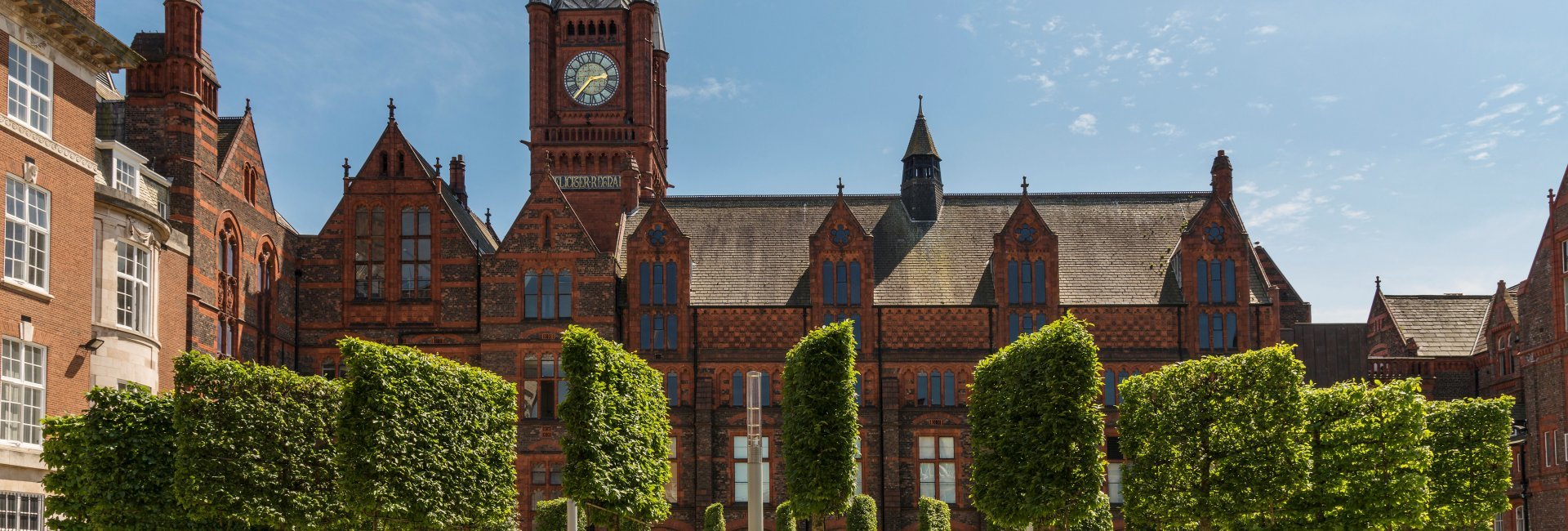
University of Liverpool
The Foundation Building
765 Brownlow Hill
Liverpool
L69 7ZX
Visit our website Visit our course page
Course contact details
External Relations
Email:ugrecruitment@liverpool.ac.uk
Phone:0151 794 5927

Our curriculum is built around five key suprathemes:
Science and Scholarship: includes Science of Medicine, Research & Scholarship, Design and Technology, Personalised Medicine and Genetics.
Core Skills: includes Clinical Examination and procedural skills; Communication for Clinical Practice (CCP); Therapeutics and Prescribing.
The Good Doctor: includes Psychology and Sociology as Applied to Medicine; The Clinical Team; Professionalism, ethics and legal context; Public, Preventative and Global Health.
Patient in the Community Setting: includes Patient Care Pathways; Disability and Community Care; General Practice.
Patient in Secondary Care: includes Acutely Ill Patient; Preparation for Practice.
The curriculum follows a spiral model, where concepts are introduced and revisited at increasing levels of complexity across the five-year programme:
Year 1: Core clinical science—structure and function of the body in ‘normal’ conditions.
Year 2: Pathology and disease—‘abnormality and illness’ and environmental interactions.
Year 3: Core clinical practice.
Year 4: Specialist and challenging clinical practice.
Year 5: Emergency and acute medicine.
In Years 1 and 2, students follow a structured lecture schedule with hands-on workshops, seminars, and practical skills training on campus. All teaching in Year 1 takes place on the University of Liverpool campus. From Years 2 to 5, students rotate through clinical placements in NHS Trusts, GP practices, hospices, and specialist services, gaining real-world experience. Secondary care providers include: Alder Hey Children’s Hospital, Aintree Hospital, Arrowe Park Hospital, Blackpool Hospital, Countess of Chester Hospital, Liverpool Heart and Chest Hospital, Liverpool Women’s Hospital, Royal Liverpool Hospital, Southport & Ormskirk Hospital, Warrington Hospital, Whiston Hospital, The Walton Centre.
At the University of Liverpool, we not only prepare you to be a doctor—we prepare you to lead in healthcare. Our curriculum integrates the latest research, technology, and ethical considerations to ensure you're ready for modern medical challenges.
Key Programme Highlights:
5-Year Comprehensive Curriculum: From foundational clinical science to advanced medical practice.
Spiral Learning Approach: Building expertise through progressive learning.
Hands-on Clinical Placements: Diverse healthcare settings from Year 2 onward.
GMC Accreditation: Meeting the highest professional standards.
Global Opportunities: Year in China option – for details, please see further information under qualifications.
This course is not accepting applications at this time. Please contact the provider to find out more.
This is the equal consideration deadline. You can still apply after this date, but your application may not receive guaranteed consideration.

University of Liverpool has participated in the Teaching Excellence Framework. These ratings were awarded in 2023, for four years.
See why these ratings were awarded
What does this TEF outcome mean?
This course is not accepting applications at this time. Please contact the provider to find out more.
The following entry points are available for this course:
Work Experience Requirements
If applying to our medical school you are advised, as a minimum, to read the following documents produced by the Medical Schools Council:
Statement on the core values and attributes needed to study medicine: https://www.medschools.ac.uk/media/2542/statement-on-core-values-to-study-medicine.pdf
Work experience guidelines for applicants to medicine: https://www.medschools.ac.uk/media/2331/relevant-experience-for-applying-to-medical-school.pdf
Duty Of Care Requirements
Applicants to programmes in the School of Medicine should be aware that the professional body governing the practice of medicine (The General Medical Council) has specific requirements relating to the protection of both staff and patients. Students will be required to undertake an enhanced Disclosure and Barring Service (DBS) check, undergo an occupational health check and be tested for and/or immunised against a range of infectious diseases prior to patient contact. See the General Medical Council website and the archived Department of Health & Social care guidance document.
Mature Students
Studying for a degree later in life can be highly rewarding and our mature students are among some of our most successful. At Liverpool, we are committed to extending opportunities to all adults with the desire and ability to succeed at university.
Please view our Mature Students and Access courses pages for more information.
Additional entry requirements
Admission tests
Non-graduates to the A100 programme will be expected to sit the UCAT admissions test. Applicants should also consult our website for details on how the UCAT test will be used. Graduates applying for the A100 programme must meet specific minimum criteria as defined in our guidelines and are required to sit the Graduate Medical School Admissions Test (GAMSAT).
The University of Liverpool is committed to supporting talented applicants from all backgrounds to succeed. One of the ways we support students and fair access to higher education is through making reduced offers as part of our contextual admissions strategy, the Liverpool Scholars programme, Realising Opportunities national collaboration of universities and Sutton Trust Pathways. Additional consideration may be given to applicants with disrupted education or extenuating circumstances.
This section shows the range of grades students (with UK A-Levels or Pearson BTEC Level 3 National Extended Diplomas) who received offers were previously accepted with (learn more). It is designed to support your research but does not guarantee whether you will or won't get a place. Admissions teams consider various factors, including interviews, subject requirements, and entrance tests. Check all course entry requirements for eligibility.
Students aged 17/18 who applied to this course were offered a place.
See how students with your grades have been accepted onto this course in the past.
Operated by the Office for Students
Employment after 15 months (Most common jobs)
Go onto work and study
The number of student respondents and response rates can be important in interpreting the data – it is important to note your experience may be different from theirs. This data will be based on the subject area rather than the specific course. Read more about this data on the Discover Uni website.
No fee information has been provided for this course
Tuition fee status depends on a number of criteria and varies according to where in the UK you will study. For further guidance on the criteria for home or overseas tuition fees, please refer to the UKCISA website.
If this is your first degree and you are a Home student applying for entry in 2026, you do not have to pay your fees upfront. Instead, you can take out a tuition fee loan which is paid straight to the University. This is available to most students, no matter what their household income.
Please note, for Home undergraduate students, 2026/27 fees have yet to be confirmed. Tuition fees are subject to increase each year, subject to the government’s regulated fee limits. For information, for UK students applying for 2025 entry the Tuition Fee was £9,535.
You will find full information about tuition fees in the “Fees and funding” section of all course pages on our website. Or see the “Paying for your studies” section of our website for more information.
Some of our programmes charge less than the full £9,535 fee:
• Psychology BSc (Hons) (2+2 programme with Foundation element), run in collaboration with Wirral Metropolitan College.
• Programmes with a year in industry or a year abroad
Some programmes which include compulsory fieldwork or additional elements such as the Pilots Licence in Aerospace Engineering may incur additional costs. Where this is the case, those costs will be outlined at on-campus events such as the University Open Days or Applicant Discovery Days.
For further information please see: https://www.liverpool.ac.uk/study/fees-and-funding/
The Foundation Building
765 Brownlow Hill
Liverpool
L69 7ZX
Visit our website Visit our course page
Email:ugrecruitment@liverpool.ac.uk
Phone:0151 794 5927