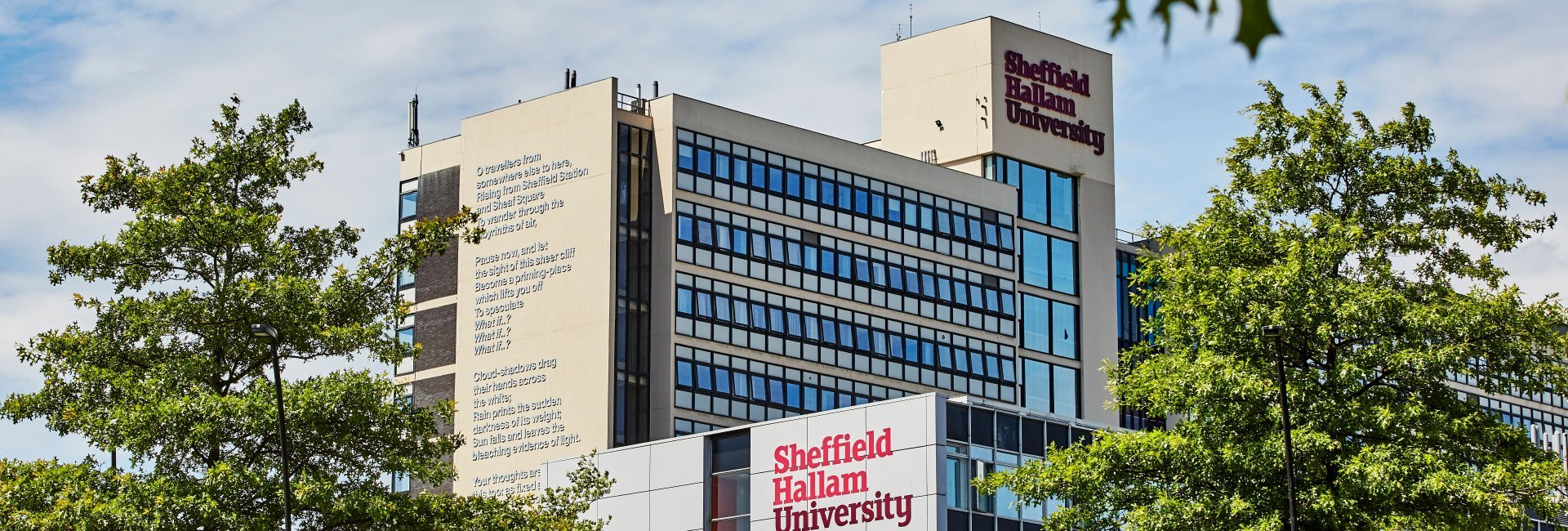
Sheffield Hallam University - applicant open day event
21 Mar 2026, 09:30
Sheffield

Please check the Sheffield Hallam University website for the latest information.
Course summary
Study modern AI practices, theories, techniques and ethical considerations.
Develop your problem-solving skills by applying AI methods.
Gain in-depth understanding by exploring rigorous development processes.
Cultivate a substantial portfolio of commercial-quality work.
On this course you’ll learn techniques relevant to the field of AI, from machine learning and to natural language processing. You’ll consider real-world challenges while developing your problem-solving and professional skills – plus a portfolio that enhances your employability in the dynamic field of AI, as well as other related industries.
How you learn
At Sheffield Hallam, all our courses are designed to engage you with the world and challenge you to think in new ways. You’ll get to collaborate with others, and you’ll be taught in a supportive environment where you can thrive.
This course emphasises hands-on learning in AI and machine learning, covering key areas like neural networks, robotics, natural language processing and computer vision.
You’ll prepare for real-world challenges through practical projects and collaborations with industry partners. The course also focuses on ethical considerations, security, privacy, and AI bias, encouraging a responsible approach to AI. Our expert staff help you gain both theoretical knowledge and practical skills, enhancing your employability.
You learn through:
Lectures
Tutorials and seminars
Regular feedback
Laboratory sessions
Real-world problems
Practical activity-based sessions
Group and individual project work
Supervisor support and guidance
Acting as mentors for new students
Self-directed study
Key themes
You’ll explore technical concepts across key areas of AI, including machine learning foundations, neural networks, cognitive systems for robotic logic and computer vision techniques. When combined, these lead into early course projects such as simulating a self-driving robot and evaluating its success.
You’ll then progress onto larger projects with industry clients that solve real-world problems. During those projects, you’ll have regular scrum meetings with academics and clients that identify narratives, learning needs and action plans to progress. You could find yourself working on a recommendation system for a retail company, or training robot football players to win the robot football world cup.
Ultimately you’ll engage in and with AI research, enhancing your learning and leading into your individual dissertation project. This is your opportunity to tailor your own piece of work in the discipline – as wide ranging as a computer-game-playing robot to screening skin conditions – with regular support from your supervisor.
Applied learning
Work placements
This course has a work experience route that offers a placement in industry of up to 12 months. For further information, please see MSc Artificial Intelligence (Work Experience).
Important notice: The structure of this course is periodically reviewed and enhanced to provide the best possible learning experience for our students and ensure ongoing compliance with any professional, statutory and regulatory body standards. Module structure, content, delivery and assessment may change, but we expect the focus of the course and the learning outcomes to remain as described above. Following any changes, updated module information will be published on this page.
Modules studied may differ depending on when you start your course.
Final year
Compulsory modules
Advanced Robotics And Artificial Intelligence
Ai Development Project
Artificial Intelligence Seminar Series
Computing Research Project
Deep Neural Networks And Learning Systems
Research Skills For Computing
Coursework.
First degree in a relevant subject area, including (but not limited to): Computer Science, Software Engineering, Games Programming.
Applicants with a first degree in another technical computing field will also be considered. First degree classification of 2:2 or above.
We would also consider applicants with relevant and substantial industry experience in software engineering or software development in leu of a relevant first degree.
#If English is not your first language, you will need an IELTS score of 6.0 with a minimum of 5.5 in all skills, or equivalent.
| Test | Grade | Additional details |
|---|---|---|
| IELTS (Academic) | 6 | If English is not your first language, you will need an IELTS score of 6.0 with a minimum of 5.5 in all skills, or equivalent. |
Please click the following link to find out more about English language requirements for this course https://www.shu.ac.uk/courses/Computing/MSc-Artificial-Intelligence/Full-time
No fee information has been provided for this course
Tuition fee status depends on a number of criteria and varies according to where in the UK you will study. For further guidance on the criteria for home or overseas tuition fees, please refer to the UKCISA website.
Our postgraduate fees vary depending on course, level and mode of study. Each postgraduate course page tells you how much the tuition fees are, and what additional costs you might have to budget for during your studies. Please refer to our website for up-to-date information on costs and fees for both full-time and part-time postgraduate study options.
Scholarships, discounts and bursaries may be available to students who study this course.
City Campus
Howard Street
Sheffield
S1 1WB
Visit our website Visit our course page
Phone:(+44) 0114 225 5533