Course contact details
Main Contact
Email:admissions@rcs.ac.uk
Phone:0141 332 4101
Fax: 0141 332 8901
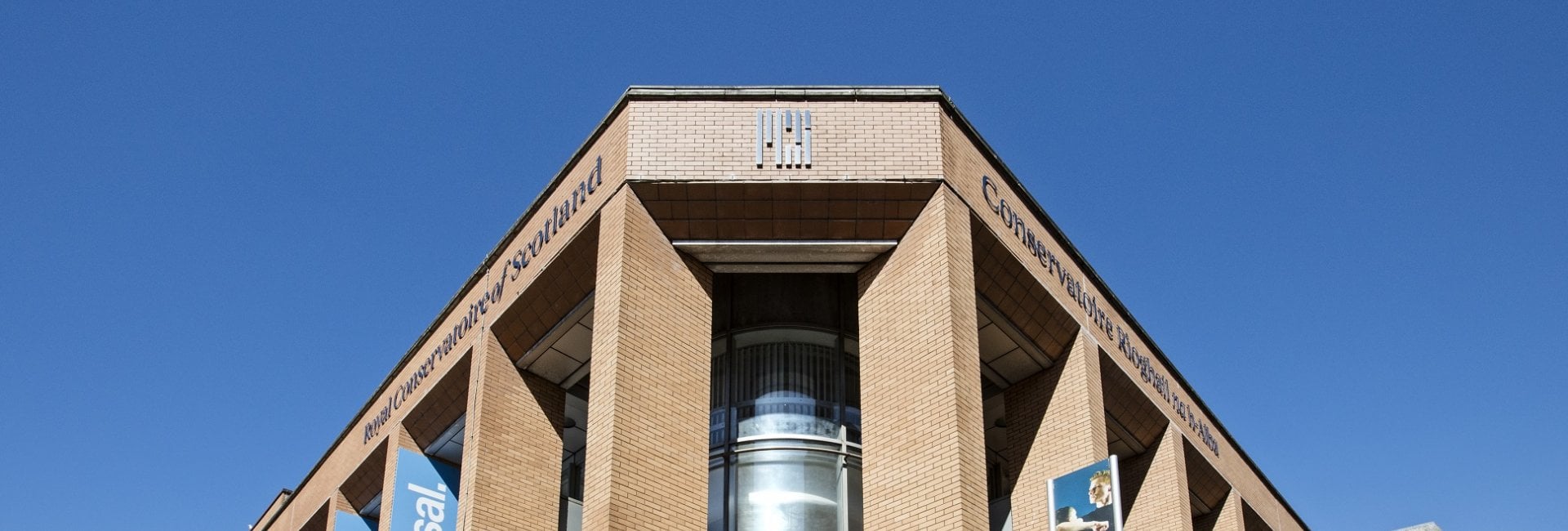
Royal Conservatoire of Scotland
100 Renfrew Street
Glasgow
G2 3DB

This one-year programme is designed to enable singers and instrumentalists to make a significant and original contribution to their chosen artistic sphere, and demonstrate outstanding public performance skills commensurate with those of a professional artist. Instrumentalists follow the performance route detailed here; an opera strand is available to students who wish to pursue that specialism.
The performance strand will offer you the time and space to develop your artistry through a largely autonomous programme of study, supported by supervision in the principal study. You will have the opportunity to take part in a wide range of School of Music activities alongside the wider artistic environment of the Conservatoire, as well as the chance to present two significant public performances. The Advanced Artist Diploma is a doctoral level award validated by the University of St Andrews at SCQF level 12, equivalent to level 8 on the FHEQ.
The AdvArtDip is available to performers in the following disciplines:
*All string, woodwind and brass instruments, solo, chamber or orchestral
*Guitar and harp
*Timpani and percussion, including marimba
*Piano solo and collaborative, harpsichord, organ, accordion
*Traditional performance
*Jazz performance
It is not available for Conducting, Composition, Piano for Dance, or Repetiteurship.
Overseas Applicants
We will be holding auditions at venues across the world, but audition requirements AND application deadline dates will change depending on your principal study and where you are applying to. We will be operating a pre-screening process for some instrumental departments. Full information on our locations, dates and requirements can be found on our website. Please check this prior to applying.
All international applicants and those that are submitting a recording must also include a spoken introduction recording that is separate from your instrumental performance. This must be submitted to your Acceptd application by the relevant application deadline for where you are auditioning.
All recorded submissions should contain a spoken introduction in English. Please tell us:
Our overseas auditions will consist of one panel member and will also be recorded for review by the relevant department.
• Please note for live overseas auditions, we cannot guarantee that a member of our teaching staff for your specific discipline will be on the panel.
• All applicants will need to provide their own instruments (except piano).
• All applicants will need to provide their own accompanist for overseas auditions.
This programme is subject to validation
During the application and audition process, you must select which instrument(s) you wish to specialise in for the duration of your course. On this course, you can choose from the following options:
Only one specialism is studied. It may be possible to study a further instrument, but this will not contribute towards the qualification.
For all courses, you must select at least one specialism from the 'primary' list. For those studying primary/secondary pathways, two instruments may be selected – one from the 'primary' list and one from the 'secondary' list. Joint pathway students may select any two instruments from either list.
Please see our website for more details about the programme
Please see our website for more details about the programme
The following entry points are available for this course:
Currently around 20% of our students come from outside the UK. Between them, they represent over 50 different nationalities and add a rich diversity to the Conservatoire.
Candidates for the Advanced Artist Diploma (Performance) are normally expected to hold an existing Masters degree in a subject area relevant to the demands of the programme, or its overseas equivalent.
| Test | Grade | Additional details |
|---|---|---|
| IELTS (Academic) | 6 | 6.0 with no component below 5.5 |
| TOEFL (iBT) | 80 | Overall score of 80, with minimum scores of: Reading – 18, Listening – 17, Speaking – 20, Writing – 17 |
| PTE Academic | 59 | Overall score of 59 with a minimum of 59 in all components (reading, listening, speaking, writing) |
| Cambridge English Advanced | Overall score of 169 with a minimum of 162 in all components | |
| Cambridge English Proficiency | Overall score of 169 with a minimum of 162 in all components |
More information about our language requirements can be found at the weblink.https://www.rcs.ac.uk/study/international-students/english-requirements/
In the event of a successful assessment, applicants may be invited for a further interview prior to being made an offer.
Remote assessment recordings may be accepted in the event that you cannot attend an assessment in person.
| Location | On-time Fee | Late Fee |
|---|---|---|
| Recording | £65 | £65 |
| RCS | £65 | £65 |
| Singapore | £65 | £65 |
| New York | £65 | £65 |
| Chicago | £65 | £65 |
| Qingdao | £65 | £65 |
| Seoul | £65 | £65 |
| Los Angeles | £65 | £65 |
| Toronto | £65 | £65 |
| Location | On-time Fee | Late fee |
|---|---|---|
| Recording | Not available at this location | |
| RCS | Not available at this location | |
| Singapore | Not available at this location | |
| New York | Not available at this location | |
| Chicago | Not available at this location | |
| Qingdao | Not available at this location | |
| Seoul | Not available at this location | |
| Los Angeles | Not available at this location | |
| Toronto | Not available at this location | |
All applicants need to complete an Acceptd account profile and application regardless of which location you choose, this is part of the audition process. All live in-person auditions will be scheduled through the Acceptd platform. If you don't have an acceptd application, we won't be able to audition you You can view the audition requirements and what to prepare for this course on the relevant programme page on our website.
No fee information has been provided for this course
Tuition fee status depends on a number of criteria and varies according to where in the UK you will study. For further guidance on the criteria for home or overseas tuition fees, please refer to the UKCISA website.
Fees are variable depending on the mode of study. Please consult the Conservatoire's website for more information: https://www.rcs.ac.uk/study/fees-funding/fees/
All new students are required to pay associated programme cost related fees at the start of their studies.
Please note, all tuition fees per year are subject to an annual review.
Please note, this programme is not eligible for government funding, so must be self-funded by the applicant. Internal scholarship opportunities may be possible, but it is rare and will be based on case-by-case circumstances.
More information can be found at: www.rcs.ac.uk/study/fees-funding/scholarships/
Email:admissions@rcs.ac.uk
Phone:0141 332 4101
Fax: 0141 332 8901
100 Renfrew Street
Glasgow
G2 3DB
At Royal Conservatoire of Scotland