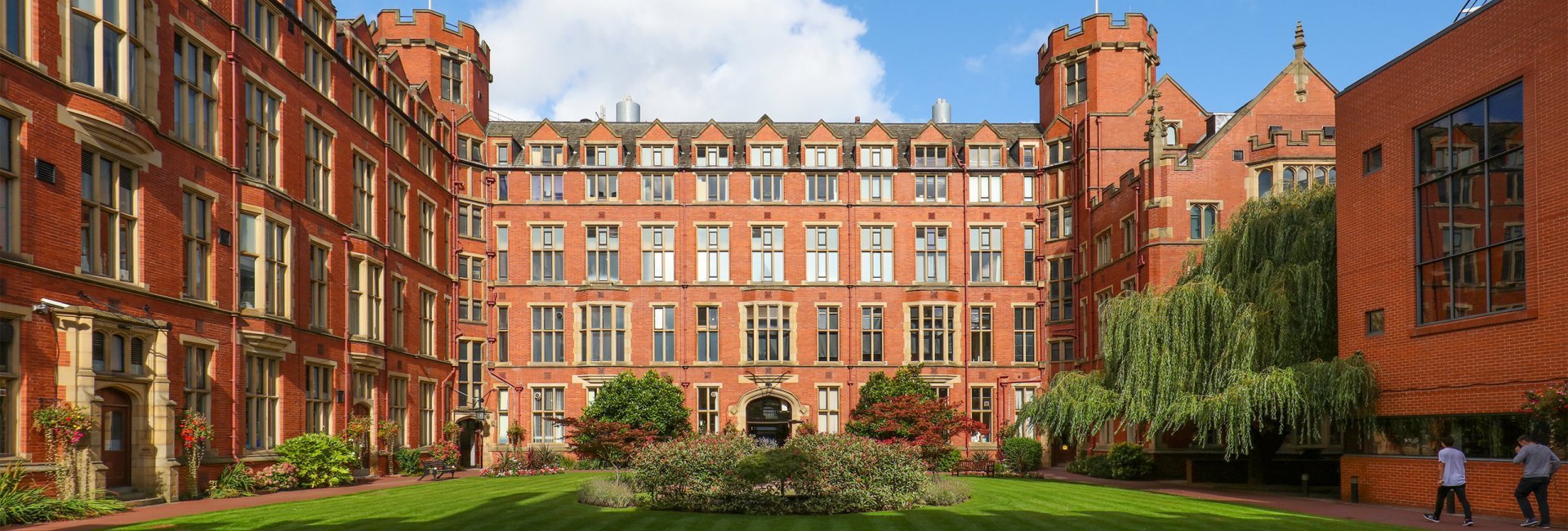
University of Sheffield - undergraduate open day
20 Jun 2026, 09:00
Sheffield

Explore key topics at the cutting edge of modern astrophysics and develop the practical skills used by professional astrophysicists.
Our MSc Astrophysics course explores the formation and evolution of stars, galaxies and the Universe itself.
Our one-year Astrophysics MSc is designed to equip you with the experience required for a successful career. You’ll develop the advanced knowledge and experience needed to pursue a career in research, either at a top university or a research facility. You’ll also master the problem-solving and analysis skills that employers value in a variety of sectors, spanning computing, data science and engineering.
Whether you want to advance your understanding of the topics you found most interesting during your undergraduate studies or gain the skills needed to achieve your goals, you’ll be able to focus on the topics that are most important to you through a range of optional modules. You’ll have the opportunity to advance your understanding of topics such as particle physics, dark matter, quantum mechanics and astrobiology.
One of the biggest parts of your degree is a year-long research project. You’ll investigate an important issue or problem in astrophysics of your choice, under the supervision of an active researcher who is an expert in your chosen area. You’ll review research literature, design and conduct research using qualitative and quantitative research techniques, and handle and analyse data. You’ll also gain experience communicating your findings verbally and in writing.
Examples of recent research projects include:
Sources of hard ionizing photons in Local Group galaxies
Ultraviolet spectroscopic analysis of starburst clusters from CLUES survey
N-body simulations of star-star encounters
Anthropic limits on the IMF
Eclipse Lightcurves of Cataclysmic Variables
Simulating the lives of interacting binaries
Chemically peculiar stars
Shielding protoplanetary discs from destruction
Hunting for signs of stable mass transfer in white dwarf binaries
Measuring the Rømer delay in a white dwarf binary system
The importance of neutral outflows in active galactic nuclei
What drives the outflows in active galactic nuclei?
Searching for Exocomets using high-resolution spectroscopy
Field trip
On our MSc Astrophysics course you’ll have the opportunity to go on a subsidised field trip to the international observatory on La Palma in the Canary Islands. The island is home to a number of world-leading telescopes and is an ideal environment for astronomy, being both close to the equator and 2,400m above sea level. You’ll be trained on how to perform your own astronomical observations using our 0.5m telescope, which can also be remotely operated from Sheffield.
Places on the field trip are limited and are allocated to the first students to register for the 'Observational Astronomy with Field Trip' module.
English language requirements: IELTS 6.5 (with 6 in each component) or University equivalent
Minimum 2:1 undergraduate honours degree in Physics or any degree where Physics is a named component, with relevant modules.
Module requirements
You should have studied at least four modules from the following list:
No fee information has been provided for this course
Tuition fee status depends on a number of criteria and varies according to where in the UK you will study. For further guidance on the criteria for home or overseas tuition fees, please refer to the UKCISA website.
https://sheffield.ac.uk/postgraduate/taught/courses/2026/astrophysics-msc#feesfunding
Western Bank
Sheffield
S10 2TN
Visit our website Visit our course page
Phone:0114 222 8030