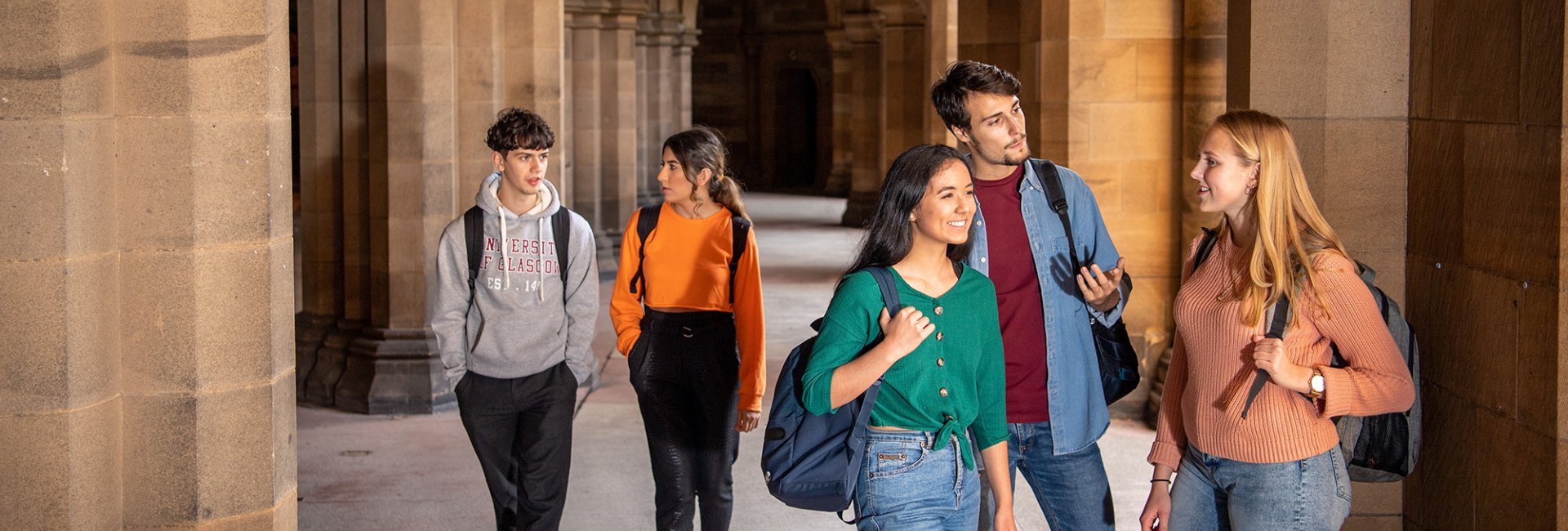
University of Glasgow - Open Day
18 Jun 2026, 08:00
Glasgow

The Masters focuses on the act of making and everything that encompasses: materials, techniques, intentions, context and concept. You will study treatises and other testimonies on artistic practice and reconstruct historical recipes and modern techniques to understand artists' materials, practices and aesthetic choices. You will develop transferable skills and a thorough understanding of the science and conservation that supports the interpretation of artworks. You will learn about the change and preservation of cultural heritage, as well as exploring issues of authenticity. Technical art history is an exciting and rapidly growing field involving art historians, scientists and conservators, which also branches out to economics, social history and philosophy.
WHY THIS PROGRAMME
You will study objects and artefacts, interacting with professionals and academics from the Hunterian Museum & Art Gallery, Glasgow Museums, National Galleries of Scotland, as well as national and international institutions linked to research projects.
You will have access to the Hunterian Study Centre at Kelvin Hall, offering an exceptional opportunity for research-led, object-based learning and cross-disciplinary research.
You have the opportunity to complete a work placement, where you can explore a possible future career while meeting professional practitioners and developing your skills and experience.
You will benefit from guest speakers from technical art history, conservation, artist studios and the museum profession: broadening your horizons, offering you networking opportunities and research contacts.
You will participate in reconstruction workshops of painting techniques, as well as workshops on the reconstructions of pigment recipes and scientific examination techniques.
You can take a study trip to Amsterdam, Madrid or Munich, visiting major museums and their conservation studios and research labs, as well as research institutions working in the field of technical art history
PROGRAMME STRUCTURE
Drawing upon the expertise of an interdisciplinary team, the programme includes taught and research components. You will take five core courses and one optional course, followed by a period of object-based research towards a dissertation.
Core Courses
RESEARCH METHODS AND SKILLS
ART IN THE MAKING: HISTORICAL TECHNIQUES
ART IN THE MAKING: MODERN & AVANT-GARDE TECHNIQUES
THE AUTHENTIC ART WORK: INTERPRETATION, CONSERVATION, PRESENTATION.
TESTIMONIES ON ARTISTS' PRACTICE: DOCUMENTARY AND VISUAL SOURCES
Optional Courses
INDEPENDENT STUDY
WORK PLACEMENT
Dissertation
DISSERTATION
CAREER PROSPECTS
The programme will enable you to work with collections within cultural heritage organisations, or in a commercial environment in the fields of technical art history, curation and collections care. The programme will also prepare you for a further postgraduate education in conservation or academic research.
International applicant information can be found via gla.ac.uk by searching for 'international'.
Discover what it's like to study Art History: Technical Art History, Making and Meaning at University of Glasgow: insights on the course, making friends, personal statement tips, uni prep, and recommended books, podcasts, and videos.

A minimum 2.1 in History of Art or equivalent subject. Applications from science and engineering are welcome and will be assessed on a case by case basis.
You should also submit:
a writing sample of 2,000-3,000 words,
a CV and
a personal statement.
International students with academic qualifications below those required should contact our partner institution, Glasgow International College, who offer a range of pre-Masters courses.
No fee information has been provided for this course
Tuition fee status depends on a number of criteria and varies according to where in the UK you will study. For further guidance on the criteria for home or overseas tuition fees, please refer to the UKCISA website.
All fees are published on the University of Glasgow website.
https://www.gla.ac.uk/postgraduate/feesandfunding/
Sponsorship and funding information can be found via gla.ac.uk by searching for 'scholarships'.
Berkeley Square
Pavilion 3
99 Berkeley Street
Glasgow
G3 7HR
Visit our website Visit our course page
Email:christina.young@glasgow.ac.uk
Phone:0141 330 4515