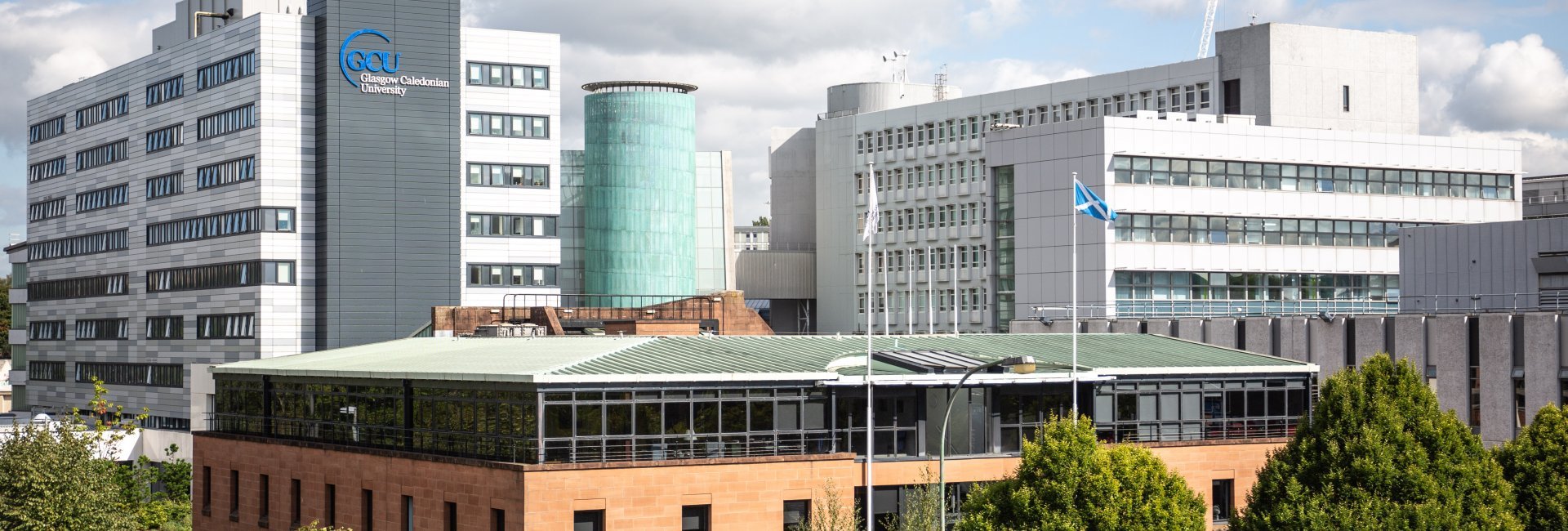
Glasgow Caledonian University - Undergraduate Open Day
4 Sept 2026, 09:00
Glasgow

If you’re looking for a career where science meets people-centred care, optometry could be for you.
Optometrists diagnose and manage a wide range of eye conditions, from everyday vision problems like short sightedness (myopia) to more complex issues like cataracts, glaucoma, and inflammatory eye diseases. They also prescribe glasses, contact lenses, and other visual aids.
Glasgow Caledonian University is a key provider of Vision Science courses. Our MOptom (IP) degree was the first of its kind in the UK to be approved by the General Optical Council (GOC). We’re also ranked 4th overall in the UK for Optometry, Ophthalmics, and Orthoptics (Complete University Guide 2025).
As one of only two courses in the UK to provide training in independent prescribing as part of an undergraduate Optometry programme, this course gives you the chance to gain professional experience that will help launch your career in vision science.
We’re the only UK institution where you can train as an Optometrist, Dispensing Optician, or Orthoptist. This gives you the opportunity to learn within a multi-disciplinary environment and develop teamwork skills.
This course combines academic study with hands-on clinical experience from day one. You’ll build a strong foundation in vision science and clinical care, exploring topics like anatomy, physiology, and optics. You’ll also develop your critical thinking skills and make confident decisions in practice.
You’ll work with patients in our on-campus Vision Centre – Scotland’s only university primary eye care clinic. In Year 5, you’ll take part in extended, paid clinical placements across Scotland. Developed in partnership with NHS Education for Scotland, these placements will help you gain practical skills and the chance to build professional networks.
Why choose this course?
This degree was the first of its kind to be approved by the General Optical Council (GOC) in the UK.
We’re ranked 4th overall in the UK for Optometry, Ophthalmics and Orthoptics (Complete University Guide 2025).
Begin practical and clinical optometry training from Year 1. You’ll also gain real-world experience delivering eye care in GCU’s on-campus Vision Centre, supervised by experienced optometrists.
Complete extended, paid clinical placements across Scotland in your final year, supported by NHS and government partnerships.
Learn from active researchers in GCU's Department of Vision Sciences, where teaching is shaped by current clinical and scientific developments.
Careers
On successful completion of this course, you’ll be eligible to register with the General Optical Council (GOC) as an Optometrist. You’ll also be eligible to join the GOC’s specialty register of independent prescribing optometrists, enabling you to prescribe medicines to manage and treat eye conditions.
Employment prospects for Optometry graduates are excellent and varied. Graduates have gone on to work as Optometrists in high-street practices, hospital eye departments, or specialist clinics.
Others have pursued careers in domiciliary eye care, teaching, research, or within the optical industry as clinical advisors or product specialists.
With an ageing population and growing demand for accessible eye care, Optometrists are needed more than ever. Independent prescribing skills enable you to take on advanced clinical roles and contribute to evolving models of care.
Professionally accredited courses provide industry-wide recognition of the quality of your qualification.
The following entry points are available for this course:
to include 2 from Maths, Physics, Chemistry or Biology. And GCSE Maths and English at 7 or above
Health and Science: Science or
Health and Science: Healthcare Science or
Health and Science: Health
PLUS GCSE Maths at A/7, Double Science at AA/77 and English at B/6
Applied Science with graded unit A. Achieved at first attempt.
including Higher in Essay-based subject, Maths and 2 Sciences from Physics, Chemistry, Biology, Human Biology and Environmental Science.
Science based Access course that includes Maths and Physics
in Applied Science/Science PLUS GCSE Maths at A/7 and English at B/6
Accepted as equivalent to one Higher as part of the overall grade profile of Highers required for entry. Any essential subjects at Higher should still be achieved in addition to the Foundation Apprenticeship
to include English or Essay based subject, Maths and 2 science subjects
SWAP Access to Science and Technology /SWAP Access to Radiography/SWAP ACCESS to Optometry/SWAP Access to Ophthalmics considered would require 75% overall (Distinction) or AAA pass. Must have 80% in Physics module. Must pass SWAP at 1st attempt
Access to Science and Technology considered would require 75% overall (Distinction) or AAA on the first attempt (including 80% in Physics module) Must pass SWAP at 1st attempt
Year two entry subject to availability. Ophthalmic Dispensing Degree at overall 65% and professional exams at first attempt. Applicants in their 3rd year of Ophthalmic Dispensing/ Ophthalmic Dispensing Management can apply for consideration.
Entry requirements for students joining after Year 1: Year 2 - Previous degree level study in a Vision Science field (for example, Ophthalmic Dispensing Management or Orthoptics). Or ABDO (Associate of British Dispensing Opticians) with average grade 75% at first sitting.
Year 3 - Successful completion of 3 years of the BSc Hons Orthoptics programme at GCU with no less than a Merit, or 2:1 degree in Orthoptics.
including Higher in Essay-based subject, Maths and 2 Sciences from Physics, Chemistry, Biology, Human Biology and Environmental Science.
| Test | Grade | Additional details |
|---|---|---|
| IELTS (Academic) | 7 | IELTS of overall 7.0 with 7.0 in speaking and no other element below 6.5 |
This section shows the range of grades that students who received offers were previously accepted on to this course with (learn more).
It is designed to support your research but does not guarantee whether you will or won't get a place.
Admissions teams consider various factors, including interviews, subject requirements, and entrance tests. Check all course entry requirements for eligibility.
We are unable to show previous accepted grades for this course. This could be because the course is new, it's a postgraduate course, there isn't enough historical data, or the provider has opted out of sharing their entry grades data for this course - learn more.
| Location | Fee | Year |
|---|---|---|
| England, Wales, Northern Ireland, Channel Islands & Republic of Ireland | £9790* | |
| Scotland | £1820* | |
| EU & International | £21900* |
* This is a provisional fee and subject to change.
Tuition fee status depends on a number of criteria and varies according to where in the UK you will study. For further guidance on the criteria for home or overseas tuition fees, please refer to the UKCISA website.
Additional costs may apply to students on this programme. Please check the fees and funding section of the programme page on the GCU website for specific details.
International/EU(Year 5 cost: £26,900)
Email:studentenquiries@gcu.ac.uk
Phone:0141 331 8630
Fax: 0141 331 8676
City Campus
Cowcaddens Road
Glasgow
G4 0BA
At Glasgow Caledonian University