Course contact details
Admissions
Email:admissions@plymouth.ac.uk
Phone:+44 (0) 1752 585858
University of Plymouth
Drake Circus
Plymouth
PL4 8AA

Go on a journey through deep time to discover how the evolution of Earth holds the key to our sustainable future.
Top lab facilities
Hone your microscopy skills in one of Europe’s leading 5G connected microscopy teaching laboratories.
Exciting field work
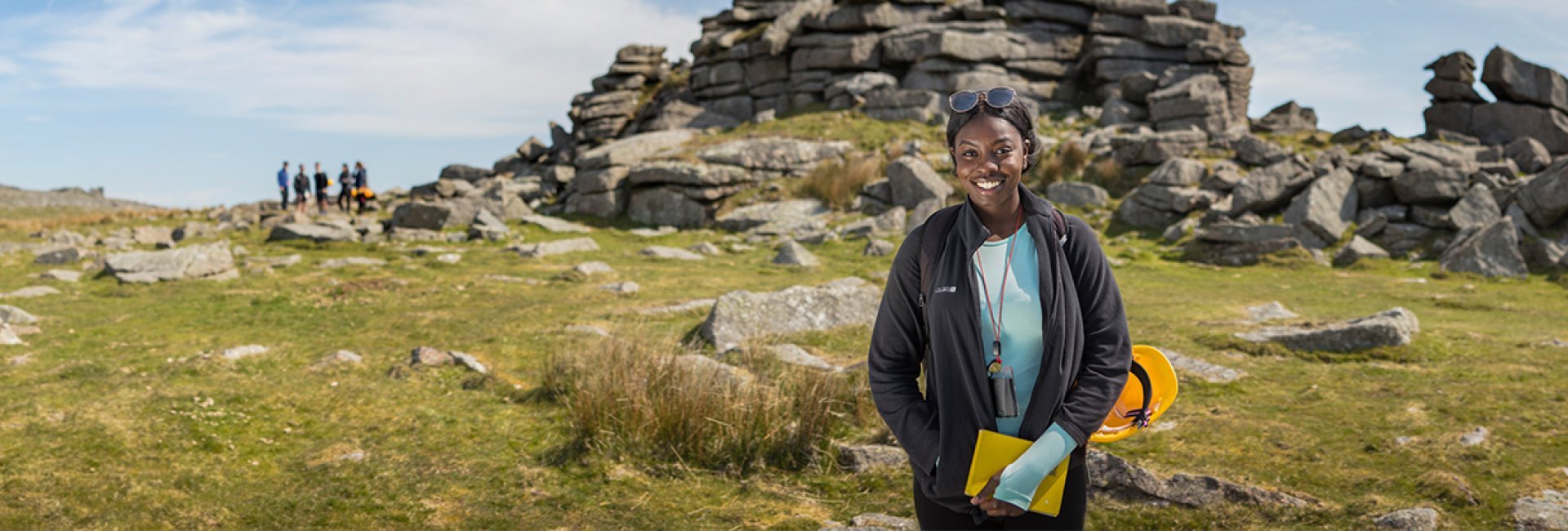
From Pompeii to Death Valley, and numerous local fieldtrips to discover the outstanding geology of the Southwest, our field trips offer exciting hands-on experience.
Career focus
Boost your career prospects though our extensive geo-careers fair, industry placements, and study abroad.
This course is for you if...
you're passionate about rocks, minerals and fossils and want to understand how they hold the key to creating a more sustainable future
you enjoy hands-on experience in the outdoors or the laboratory
you are looking for a friendly and supportive teaching environment with hands-on career support
you thrive in real-world, non-exam-based assessments.
Year 1
From day one you’ll dive into the world of Earth Sciences, laying the foundations of geological knowledge that will set you up for success throughout your university journey. Your first year will equip you with essential skills and core knowledge, empowering you to tackle sustainable development challenges alongside developing an understanding of topics such as plate tectonics, climate change, and evolution. Hands-on learning will be a key part of your experience, as you study minerals, rocks, fossils, and geological structures in our cutting-edge 5G microscope laboratories. Plus, get ready for exciting fieldwork in the stunning landscapes of the UK’s Southwest and Southern Italy, where you'll explore the real-world impact of geohazards.
Year 2
Year 2 takes you on a journey from the Earth’s surface to its core, exploring deep ocean basins and travelling through geological time to uncover key moments in Earth history. You'll sharpen your observational, analytical and interpretive skills, using them to tackle some of the most exciting geological questions. You'll also learn the art of creating geological maps and gain hands-on experience with field techniques, including geophysical equipment. For those looking to broaden their horizon even further, you can seize the opportunity to study your second year abroad in incredible locations like Canada, USA or Europe.
Optional placement year
Take advantage of our optional placement year, giving you the opportunity to develop your geological skills in the workplace and gain valuable experience. Find your perfect placement with the help of our employability service and benefit from specialist workshops and tutorials in your second year, helping you prepare for your year in industry.
Final year
In your third year you will elevate your data analysis skills to a professional level. Your dissertation project will be an exciting opportunity to collect and analyse data independently, whether in the field or the lab. Alongside core modules that deepen your geological expertise, you’ll have the chance to choose from a range of sustainability-focused optional modules, allowing you to tailor your final year to your passions and interests. For those craving adventure, you can take your learning beyond the classroom with advanced fieldwork opportunities in incredible locations like Namibia or Death Valley, USA, where you’ll gain invaluable hands-on experience and refine your professional field skills.
For up to date details, please refer to our website or contact the institution directly.
Professionally accredited courses provide industry-wide recognition of the quality of your qualification.

University of Plymouth has participated in the Teaching Excellence Framework. These ratings were awarded in 2023, for four years.
See why these ratings were awarded
What does this TEF outcome mean?
This course may be available at alternative locations, please check if other course options are available.
Course optionsDiscover what it's like to study Geology at University of Plymouth: insights on the course, making friends, personal statement tips, uni prep, and recommended books, podcasts, and videos.

112 UCAS points from a minimum of 2 A Levels including a relevant science subject: Biology, Human Biology, Maths, Use of Maths, Further Maths, Statistics, Electronics, Physics, Chemistry, Environmental Science, Environmental Studies, Psychology, Computer Science, Computer Programming, Information Technology, Applied Science, Geography, Geology.
Must be a Science Pathway
112 UCAS points from a minimum of 2 A Levels including a relevant science subject: Biology, Human Biology, Maths, Use of Maths, Further Maths, Statistics, Electronics, Physics, Chemistry, Environmental Science, Environmental Studies, Psychology, Computer Science, Computer Programming, Information Technology, Applied Science, Geography, Geology, BTEC Applied Science, BTEC Engineering.
Considered in combination with Advanced Highers
Pass a Science based Access to HE Diploma with at least 33 credits at merit/distinction to include 18 credits in science units
Range from 112 UCAS points to from a minimum of 2 Advanced Highers to include a Grade C in a relevant science subject: Biology, Human Biology, Maths, Use of Maths, Further Maths, Statistics, Electronics, Physics, Chemistry, Environmental Science, Environmental Studies, Psychology, Computer Science, Computer Programming, Information Technology, Applied Science, Geography, Geology.
Considered in combination
Considered in combination
Considered in combination
To include 4 at Higher Level in a Science subject
This would be accepted in combination of other level 3 qualifications
Science/Technology related subject required
112 UCAS points. To include relevant science subject: Biology, Maths/Use of Maths, Physics, Chemistry, Environmental Science/Studies, Applied Science, Geography, Geology or Technology. English and Maths considered within
Considered in combination
Considered in combination
Considered in combination
Considered in combination
This would be accepted in combination of other level 3 qualifications
Considered in combination
Considered in combination
Considered in combination
Considered in combination
GCSE Maths and English Language at a Grade C/4
At the University of Plymouth, we believe in building a welcoming and inclusive community that supports every student to achieve their full potential.
With our contextual offer scheme, we may extend offers below our standard entry criteria to those applicants whose circumstances and experiences could have impacted their education and academic performance. You can check your eligibility for a contextual offer using our online postcode checker.
This section shows the range of grades that students who received offers were previously accepted on to this course with (learn more).
It is designed to support your research but does not guarantee whether you will or won't get a place.
Admissions teams consider various factors, including interviews, subject requirements, and entrance tests. Check all course entry requirements for eligibility.
This course may have Historical entry grades data available, please select a course option to view.
Course optionsThis report uses your grades to show how students with similar results have done when applying to this course in the past. Sometimes, there isn’t data for every possible set of grades. When that happens, universities and colleges occasionally fill in the gaps for sets of grades that are typically accepted.
No fee information has been provided for this course
Tuition fee status depends on a number of criteria and varies according to where in the UK you will study. For further guidance on the criteria for home or overseas tuition fees, please refer to the UKCISA website.
For all information about tuition fees, please visit our fees and funding pages at www.plymouth.ac.uk/study/fees
Email:admissions@plymouth.ac.uk
Phone:+44 (0) 1752 585858
Drake Circus
Plymouth
PL4 8AA
At University of Plymouth