University of Plymouth - Open Day
20 Jun 2026, 08:00
Plymouth

Environmental scientists tackle global challenges. Gain skills to address issues like climate change, pollution and biodiversity loss. With hands-on lab and field training, you’ll graduate ready to lead in conservation, sustainability and more.
Out in the field
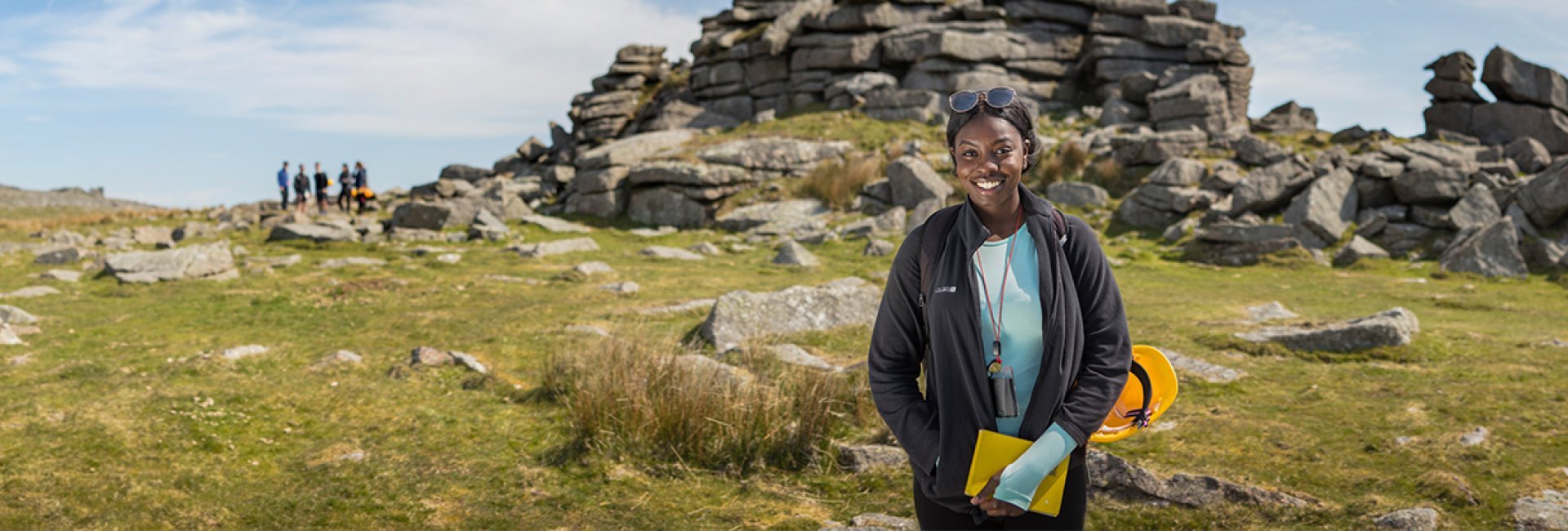
From your very first month, you’ll be out in the field applying what you learn to real-world environments. Through hands-on fieldwork across the UK and overseas, you’ll explore diverse landscapes and tackle local and global environmental, social and geographical issues – turning theory into impactful, practical experience.
50 years of impact
Join one of the UK’s longest-running and most respected programmes in the field. Since 1973, over 6,000 graduates have gone on to shape impactful careers – proof of a degree built on practical learning, innovation and a legacy of real-world influence.
Real-word experience
Combine theory with hands-on learning in labs and the field. Choose a 6-week or 6–12 month placement in the UK, EU, or beyond to gain experience, boost confidence and grow your network through our strong alumni, employer and research connections.
This course is for you if...
you’re passionate about understanding and addressing today’s most pressing global challenges
you’re driven to build a meaningful career and make a impact on people and the planet
you're interested in gaining hands-on fieldwork experience
you want to gain specialist and transferable skills that are in high demand across a range of sectors.
This programme is accredited by the Community for Environmental Disciplines in Higher Education (CEDHE), the education committee of the IES.
Year 1
From the first day you begin your studies we’ll show you how our wonderful world works and how it is also at grave risk from human threats. We’ll explore soils, water and climate. We’ll study species, biodiversity and ecological change. We’ll celebrate a new 21st Century way of thinking – sustainability science – and how we can best deliver a world fit for the future. Then we’ll also begin exploring how humans have polluted the planet and some of the key global threats for which humans must take some responsibility. At the end of year 1 you’ll be ready and impatient to take the next steps to fixing this broken world.
Year 2
Hot on the heels of your planetary exploration in Year 1, this year will develop your skill sets to reach those higher levels of analysis and communication that will allow you to influence and change the world. You’ll develop research skills both in England and abroad. You’ll learn how best to communicate ideas for the purpose of influence. You’ll also begin your journey of choosing your own path. Optional modules become available to you to specialise in those things that really excite you. Take a look at the list below to get some early insight into where you might go!
Optional placement year
An optional placement year is available, providing an opportunity to gain work experience through our extensive network of contacts with our alumni, employers and research links with institutes, companies and government organisations. Environmental programmes at Plymouth began in 1973. We were one of the very first in the UK to teach this subject. With nearly 7000 graduates over 50+ years, our alumni are spread all over the world. You’d be sure to find a placement that meets your interests!
Final year
Be the person you were meant to be! Become the professional. Now, in your final year, you are ready to show us what you can really do. Show us how you research and communicate through your research project. Choose the optional modules that most excite you and follow your nose deeper into the fascinating stories and understanding of the way the world works through specialist content taught by the specialists in those areas. See the list below for where this journey will take you.
For up to date details, please refer to our website or contact the institution directly.

University of Plymouth has participated in the Teaching Excellence Framework. These ratings were awarded in 2023, for four years.
See why these ratings were awarded
What does this TEF outcome mean?
This course may be available at alternative locations, please check if other course options are available.
Course optionsDiscover what it's like to study Environmental Science at University of Plymouth: insights on the course, making friends, personal statement tips, uni prep, and recommended books, podcasts, and videos.

104 points from a minimum of 2 A Levels, at least one science related subject preferred.
Science/technology related subjects.
104 points from a minimum of 2 A Levels one science subject preferred.
Considered in combination with Advanced Highers
Pass an Access to HE Diploma (Science related) with at least 33 credits at Merit and to include at least 12 credits at Merit in a relevant science.
104 points to include a minimum of 2 Scottish Advanced Highers
Considered in combination
Considered in combination
Considered in combination
Maths and English accepted within
This would be accepted in combination of other level 3 qualifications
Relevant Science subject preferred but not mandatory
104 UCAS points - to include a science subject: Maths, Physics, Chemistry, Environmental, Psychology, Geography, Geology, Applied Science, Use of Maths, Biology, Human Biology, Statistics, Design Technology. Maths and English Language considered within
Considered in combination
Considered in combination
Considered in combination
Considered in combination
This would be accepted in combination of other level 3 qualifications
Considered in combination
Considered in combination
Considered in combination
At the University of Plymouth, we believe in building a welcoming and inclusive community that supports every student to achieve their full potential.
With our contextual offer scheme, we may extend offers below our standard entry criteria to those applicants whose circumstances and experiences could have impacted their education and academic performance. You can check your eligibility for a contextual offer using our online postcode checker.
This section shows the range of grades that students who received offers were previously accepted on to this course with (learn more).
It is designed to support your research but does not guarantee whether you will or won't get a place.
Admissions teams consider various factors, including interviews, subject requirements, and entrance tests. Check all course entry requirements for eligibility.
This course may have Historical entry grades data available, please select a course option to view.
Course optionsNo fee information has been provided for this course
Tuition fee status depends on a number of criteria and varies according to where in the UK you will study. For further guidance on the criteria for home or overseas tuition fees, please refer to the UKCISA website.
For all information about tuition fees, please visit our fees and funding pages at www.plymouth.ac.uk/study/fees
Email:admissions@plymouth.ac.uk
Phone:+44 (0) 1752 585858
Drake Circus
Plymouth
PL4 8AA
At University of Plymouth