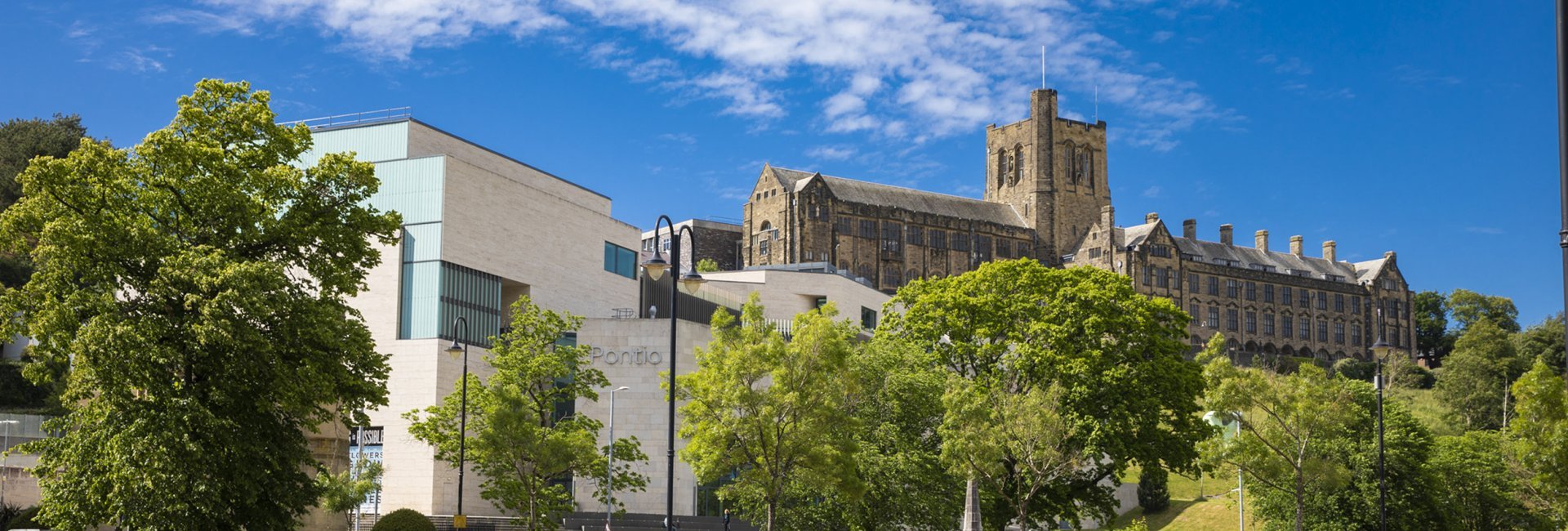
Bangor University Open Day
4 Jul 2026, 07:45
Bangor

This degree focuses on the study of the physics of the ocean and the processes which link it to the atmosphere and the cryosphere. You’ll focus on the roles of the shallow seas, which surround the continents, and on interactions between ice and the oceans. Field work and practical sessions are a key element of this degree. This course places a particular emphasis on gaining skills and knowledge that will be directly relevant to industry in relation to issues such as future climate change, sea level rise, marine pollution and exploitation of marine energy. The fourth year of this degree features taught modules as well as a scientific research project.
We have been teaching Physical Oceanography for over 50 years and are world leading experts in the oceanography of the shelf seas which surround the continents, and also the polar oceans.
On this course we focus on the physics of the ocean and understanding the forces which shape the global climate by moving heat around planet Earth at the present time, and also in the past. You will also study the role of the ocean in regulating global climate and in generating weather.
Physical Oceanographers are in great demand and are required to tackle issues such as predicting climate and sea-level change, marine pollution dispersion, offshore engineering related and exploitation of marine renewable energy. The quantitative and computer modelling skills gained on this course will are also in great demand across wide sectors of industry.
‘Placement Year’ and 'International Experience Year’ options are available for this course. You will have the opportunity to fully consider these options when you have started your course at Bangor and can make an application for a transfer onto such a pathway at the appropriate time. You can find more information about these options on our website and if you have any questions, please get in touch.
If you don’t have the required qualifications for this degree-level course or are looking to re-enter education after time away from study, then a Foundation Year Programme might be the right choice for you. Please see Geological Oceanography (with Foundation Year) F62F.
For module information, please see the full course description on Bangor University's website.
The following entry points are available for this course:
Discover what it's like to study Physical Oceanography at Bangor University: insights on the course, making friends, personal statement tips, uni prep, and recommended books, podcasts, and videos.

Including grades A or B in Maths or Physics and usually in one other science subject (Physics, Maths, Chemistry, Biology, Geology, Environmental Science, Geography, Economics, Psychology); General Studies and Key Skills not accepted.
In Applied Science. (Similar subject areas may be considered on a case by case basis.)
Access to HE Science. Pass required. (Similar subject areas may be considered on a case by case basis.)
Minimum of 5 Scottish Highers - some subject specific grades/Advanced Highers may be required.
Must include: H6 in either Maths or Physics. Plus another science subject.
We will accept this qualification in conjunction with other level 3 qualifications.
Points can include a relevant Extended Project (EPQ) but must include a minimum 2 full A-levels, or equivalent. Please contact us for more information.
Grade C/4 in English, Maths and Double Award Science, if not demonstrated by the Level 3 qualification/s.
In Applied Science. Other subject areas considered on a case-by-case basis.
T Level qualifications are accepted on a case by case basis.
We allow you flexibility in meeting our entry requirements and accept a broad range of qualifications. We are happy to accept combinations of the qualifications listed above, as well as alternative Level 3 qualifications such as City & Guilds, Access and Cambridge Technical Diplomas. We also welcome applications from mature learners and/or those with other qualifications are considered on individual merit. If you cannot find the qualifications that you are studying (or have completed) listed above, please contact us for advice: applicantservices@bangor.ac.uk
If you don't think you'll meet the entry requirements specified, you may be able to gain entry to this course via a Foundation Year route. Please see: Geological Oceanography with Foundation Year (UCAS Code: F62F).
International Candidates: school leaving qualifications that are equivalent to A levels/Level 3 and/or college diplomas are accepted from countries worldwide (subject to minimum English Language requirements), details at: www.bangor.ac.uk/international/applying/entryrequirements
For the most up-to-date information on acceptable English Language proficiency qualifications, please visit our webpage below.https://www.bangor.ac.uk/international/future/englishlanguage
Bangor University is committed to widening participation in Higher Education (HE) and accepts students from a broad range of backgrounds.
To support students into Higher Education, we use a number of indicators to identify students who may be at a disadvantage in their ability to access Higher Education, in order to provide additional support.
Our admissions process involves assessing the entire application to make an assessment based on your grades and individual circumstances.
This section shows the range of grades that students who received offers were previously accepted on to this course with (learn more).
It is designed to support your research but does not guarantee whether you will or won't get a place.
Admissions teams consider various factors, including interviews, subject requirements, and entrance tests. Check all course entry requirements for eligibility.
We are unable to show previous accepted grades for this course. This could be because the course is new, it's a postgraduate course, there isn't enough historical data, or the provider has opted out of sharing their entry grades data for this course - learn more.
| Location | Fee | Year |
|---|
Tuition fee status depends on a number of criteria and varies according to where in the UK you will study. For further guidance on the criteria for home or overseas tuition fees, please refer to the UKCISA website.
Tuition fees and scholarship information for Home applicants can be found here:
https://www.bangor.ac.uk/studentfinance/new-undergraduates
Tuition fees and scholarship information for International applicants can be found here:
https://www.bangor.ac.uk/international/tuition
Email:admissions@bangor.ac.uk
Phone:01248 383717
Bangor (Wales)
LL57 2DG
At Bangor University