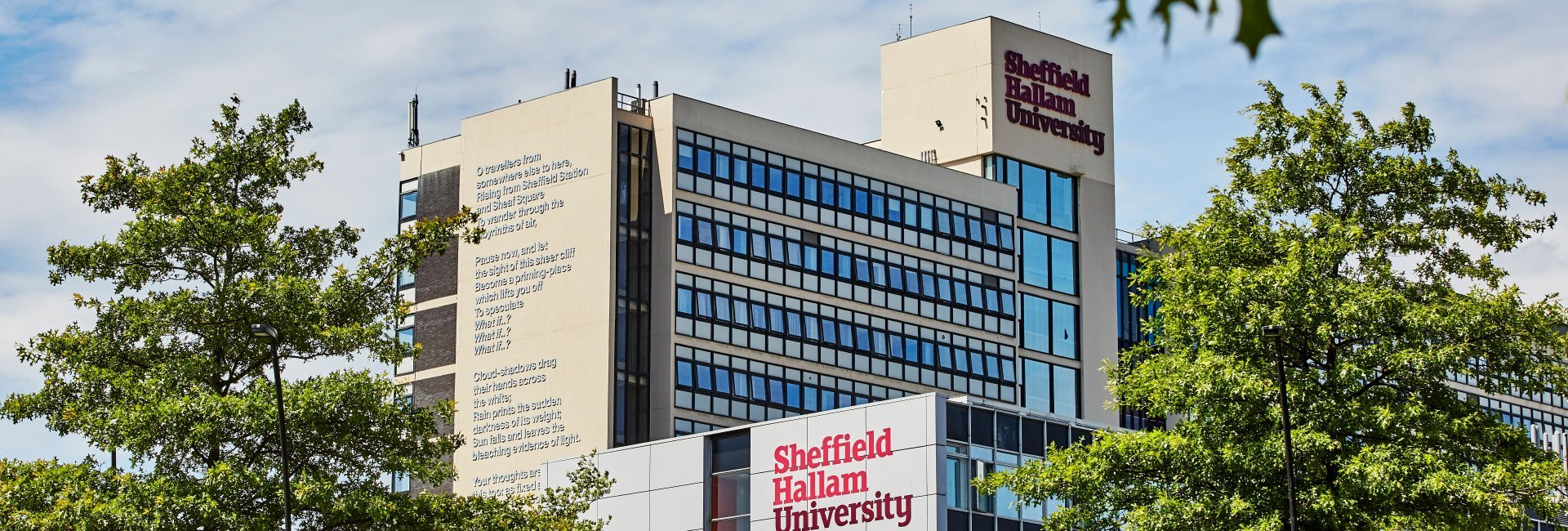
Course contact details
Student Recruitment Operations Team
Phone:(+44) 0114 225 5533
Sheffield Hallam University
City Campus
Howard Street
Sheffield
S1 1WB

Please check the Sheffield Hallam University website for the latest information.
Course Summary
Gain knowledge in key computing topics relevant to the current job market, including cloud technologies, programming, web development, databases, and artificial intelligence.
Develop workplace practice and professionalism by working on industry-based case studies.
Cultivate an adaptable approach towards new and emerging technologies
Develop the skills required to undertake the Microsoft Azure Fundamentals certification
Opportunity to gain up to 12 months of industry work experience as part of the course.
Designed for graduates without a computing background, the course is specially designed to build up your fundamental computing skills required to achieve in the advanced topic of cloud development.
How You Learn
This course starts by helping you develop your fundamental computing skills that are the building blocks of cloud technologies. This includes programming, database development, and web development. These are taught around a professional software development lifecycle using a project-based learning approach with industry-based projects. Through this approach, you will develop both technical and professional skills needed in the industry by taking ownership of your applied projects while being fully supported throughout the learning process. This further embraces and encourages students to contribute their diverse backgrounds to applied projects.
Building upon those foundational skills, you will start to develop your research skills alongside your specialisation into cloud technologies. Cloud technologies is a fast-growing field where you will learn how to develop and deploy techniques and technologies including:
Deployment models
System architectures (N-tier, Monolithic, Microservices)
MVC a design pattern for structuring application code within these architectures
Virtualisation (Virtual Machines and Containerisation)
Frameworks (Django a Python web framework)
User-Interface (React)
Version Control (GitHub)
Microsoft Azure cloud services
The teaching strategy integrates critical thinking, analysis, and synthesis to systematically devise solutions. You will be using industry-based projects to enhance your learning while continuously developing professional skills that prepare you for the real-world challenges in your future career.
Key themes
Through the hands-on learning experience of the course, you will develop the essential cloud computing skills sought-after by employers for the design and development of scalable applications. The development of scalable applications can drive innovation in web, data, and artificial intelligence, at the forefront of technological advancements, empowering you to shape the future through cloud development.
An introduction to Artificial Intelligence is another central part of the course, focusing on machine learning, using your programming skills and concepts to create solutions for businesses. This includes an exploration and understanding of ethical and responsible AI deployment, which is especially important in recognizing data bias in solutions.
The research skills you develop through the course prepare you to undertake a research-led project that showcases the skills and knowledge you have developed . The project is a significant piece of work that facilitates your continued development, for example by further specialising in a particular area inspired directly by the course content or building more awareness in a parallel topic of interest. This is supported by a supervisor and further tailors your learning while reinforcing your confidence in undertaking an independent piece of work.
Module and assessment information for future years is displayed as currently validated and may be liable to change. When selecting electives, your choices will be subject to the core requirements of the course. As a result, selections may be limited to a choice between one of two or more specified electives in some instances.
Modules studied may differ depending on when you start your course.
You will be able to complete a placement year as part of this course. See the modules table below for further information.
Year 1
Compulsory Modules
Cloud-Based Project | Coursework (100%)
Essentials Of Full-Stack Software Development | Coursework (100%)
Postgraduate Work Experience Applied Professional Diploma -
Professional Practices In Software Projects | Coursework (100%)
Research Skills For Computing | Coursework (100%)
Final Year
Compulsory Modules
Computing Research Project | Coursework (100%)
Programming For Artificial Intelligence | Coursework (100%)
Coursework
This is a conversion course for those without a background in computing or IT.
Any 2:2 non-computing degree.
| Test | Grade | Additional details |
|---|---|---|
| IELTS (Academic) | 6 | IELTS 6.0 (Min 5.5 in each area). |
Please click the following link to find out more about English language requirements for this coursehttps://www.shu.ac.uk/courses/computing/msc-computing-with-cloud-technologies-work-experience/full-time
No fee information has been provided for this course
Tuition fee status depends on a number of criteria and varies according to where in the UK you will study. For further guidance on the criteria for home or overseas tuition fees, please refer to the UKCISA website.
Our postgraduate fees vary depending on course, level and mode of study. Each postgraduate course page tells you how much the tuition fees are, and what additional costs you might have to budget for during your studies. Please refer to our website for up-to-date information on costs and fees for both full-time and part-time postgraduate study options.
Scholarships, discounts and bursaries may be available to students who study this course.
Phone:(+44) 0114 225 5533
City Campus
Howard Street
Sheffield
S1 1WB
At Sheffield Hallam University