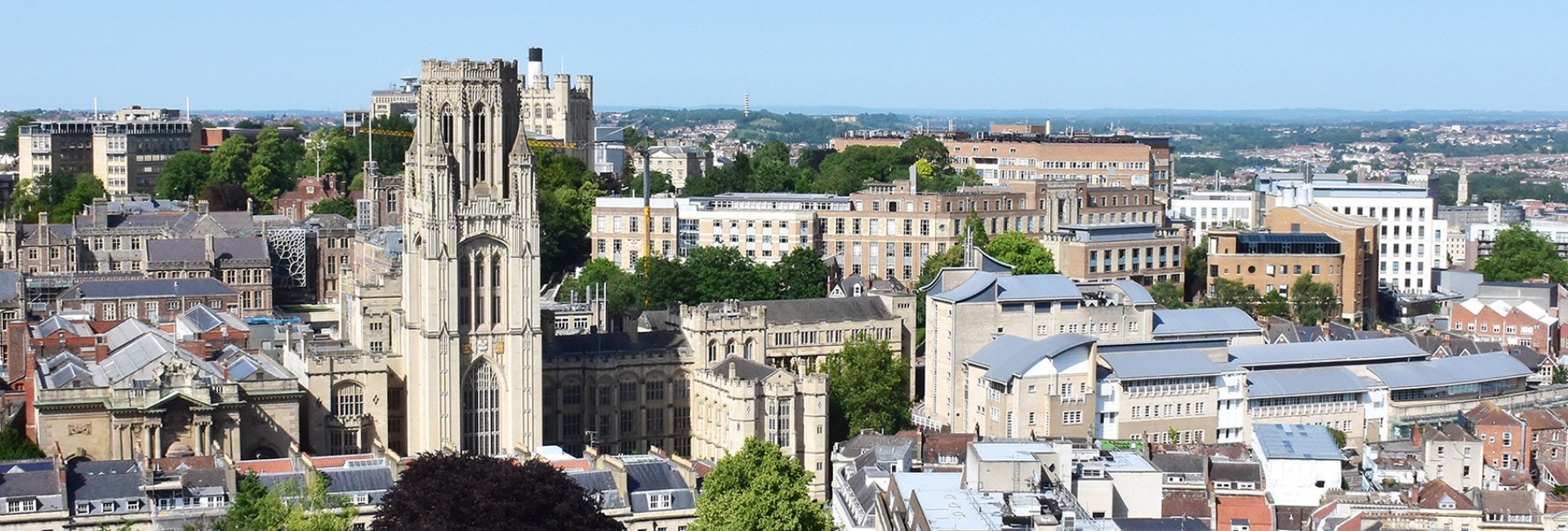
University of Bristol - Open Day 12 June 2026
12 Jun 2026, 08:30
Bristol

The innovators of the 21st century will think across arts, science, engineering, humanities and enterprise to deliver innovative products, services and ways of living. They will be team players with a breadth of skills and qualities that enable them to work across specialisms and cultures.
This course combines in-depth subject specialism at the University of Bristol alongside interdisciplinary, practice-based learning. In conjunction with your electrical and electronic engineering studies, you will apply your subject knowledge by translating ideas into innovative solutions, which may include plans for digital and creative enterprises, both social and commercial.
The course will equip you to use the critical, theoretical and practical skills central to electrical and electronic engineering, allowing you to develop your knowledge and skills across a range of areas. You will gain a grounding in mathematics, computing, analogue and digital electronics, communications, electromagnetics, electrical systems, and control. You will benefit from units which are informed by the latest technological developments and underpinned by research-informed teaching. The diverse range of units allows you to focus on anything from electrical power systems to electronic communications. Your individual research project will also furnish you with essential technical and soft skills which are highly desirable to employers.
Group work is a core component of teaching and learning in Innovation. You will come together with students from other innovation disciplines, such as geography, anthropology and business and management. Each subject contributes a different perspective on a challenge as you identify needs and develop ideas. By drawing on your unique ideas and views on the world, you will learn from your subject and other students to develop innovative solutions together. You will also develop personal skills with opportunities for individual development and pursuit of topics and projects driven by your own interests and values
By the time you graduate, you will have a portfolio of work ranging from live client projects to planning your own entrepreneurial venture. You will have learned how to evaluate the potential of products and services, and how to sustain new endeavours including through financing. Importantly, you will have cultivated a network of peers and advisers who have worked with you through your studies.
For more information visit the Centre for Innovation and Entrepreneurship: bristol.ac.uk/innovation/
This course is not accepting applications at this time. Please contact the provider to find out more.
This is the equal consideration deadline. You can still apply after this date, but your application may not receive guaranteed consideration.

University of Bristol has participated in the Teaching Excellence Framework. These ratings were awarded in 2023, for four years.
See why these ratings were awarded
What does this TEF outcome mean?
This course is not accepting applications at this time. Please contact the provider to find out more.
The following entry points are available for this course:
The University of Bristol welcomes applications from international students, and accepts a wide range of qualifications for undergraduate study. If you studied at a school, college or university outside the UK, please select the relevant page for further information on qualification equivalences, scholarships and details of our education representatives in your country/region: bristol.ac.uk/international/countries/
Standard offer: AAA including Mathematics.
Contextual offer: ABB including A in Mathematics.
Please visit: bristol.ac.uk/study/undergraduate/entry-requirements-qualifications/contextual-offers/ for more information about contextual offers.
DDD in EITHER Engineering BTEC National Level 3 Extended Diploma, plus A in Mathematics at A-level (or equivalent), OR any Applied General BTEC National Level 3 Extended Diploma,plus A in Mathematics at A-level (or equivalent). Applicants taking Engineering BTEC may be invited to take the University of Bristol Maths test in place of A-level Mathematics.
Access to HE Diploma in Engineering, Science, or Computing (or similar titles) with 30 credits at distinction and 15 at merit, and A in A-level Mathematics,
Or
Access to HE Diploma in Engineering, Science, or Computing (or similar titles) with 30 credits at distinction and 15 at merit, including at least 12 credits at distinction in Mathematics (including algebra, calculus and trigonometry), and achieving the required level in the University of Bristol Mathematics Test.
Mature students can contact mature-students@bristol.ac.uk to check the suitability of their Access course.
Standard Higher: AAAAB.
Advanced Higher: AA including Mathematics.
Standard offer: 36 points overall with 18 at Higher Level, including 6 at Higher Level in Mathematics (either Analysis and Approaches or Applications and Interpretations).
Contextual offer: 32 points overall with 16 at Higher Level, including 6 at Higher Level in Mathematics (either Analysis and Approaches or Applications and Interpretations).
Please visit: bristol.ac.uk/study/undergraduate/entry-requirements-qualifications/contextual-offers/ for more information about contextual offers.
Requirements are as for A-levels, where you can substitute a non-subject specific grade for the Welsh Baccalaureate Advanced Skills Challenge Certificate at that grade.
Requirements for principal subjects are as for A-level, where D1/ D2 is A*, D3 is A, M1/ M2 is B, and M3 is C.
European Baccalaureate: 85% overall, with 8.5 in Mathematics.
Find out more about qualification requirements for this course.
We accept a wide variety of qualifications and welcome applications from students of all backgrounds. We consider a large range of contextual factors when making application decisions.
If you receive and accept an offer from the University of Bristol, and you meet the terms of your offer in full, you will be accepted.
This section shows the range of grades that students who received offers were previously accepted on to this course with (learn more).
It is designed to support your research but does not guarantee whether you will or won't get a place.
Admissions teams consider various factors, including interviews, subject requirements, and entrance tests. Check all course entry requirements for eligibility.
We are unable to show previous accepted grades for this course. This could be because the course is new, it's a postgraduate course, there isn't enough historical data, or the provider has opted out of sharing their entry grades data for this course - learn more.
| Location | Fee | Year |
|---|
Tuition fee status depends on a number of criteria and varies according to where in the UK you will study. For further guidance on the criteria for home or overseas tuition fees, please refer to the UKCISA website.
No additional fees or cost information has been supplied for this course, please contact the provider directly.
Email:choosebristol-ug@bristol.ac.uk
Phone:0117 394 1649
Beacon House
Queen’s Road
Bristol
BS8 1QU
At University of Bristol