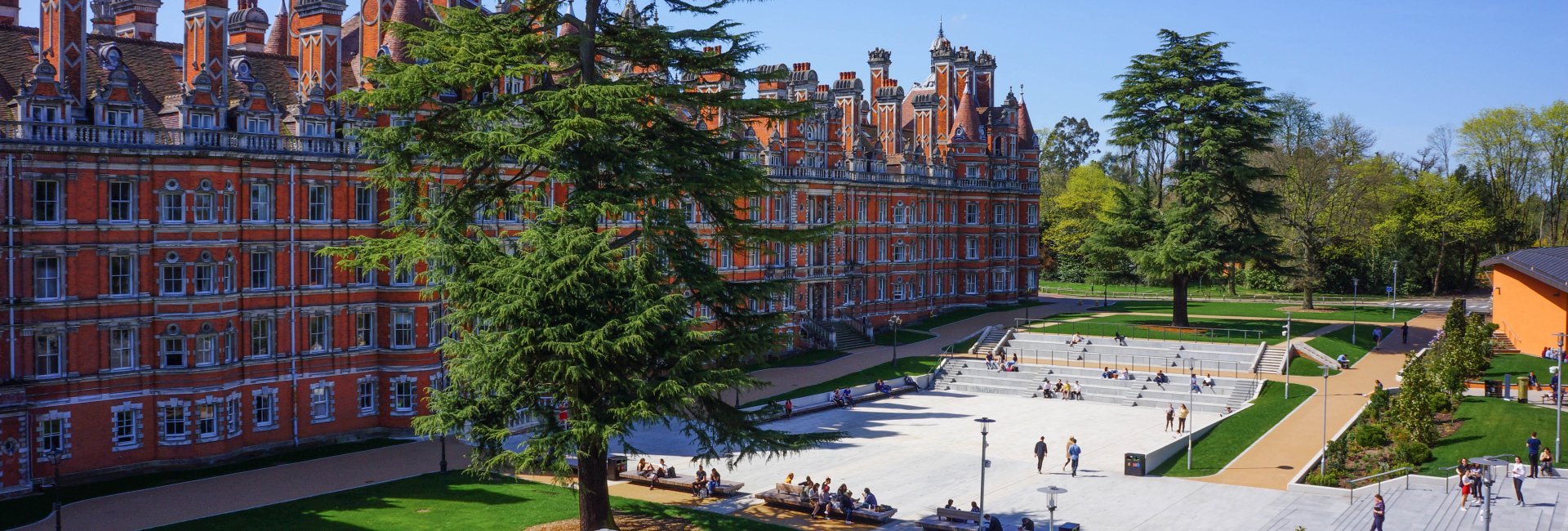
Royal Holloway, University of London - Postgraduate Open Morning (Egham campus)
13 Jun 2026, 08:00
Egham

Your degree course in Ecology and Wildlife Conservation with a Year in Industry is delivered in four stages, each of which, apart from the year in industry, comprises one year of full-time study, during which you must follow modules to the value of 120 national credits. The curriculum is based around a core of mandatory modules running through all three stages providing a broad base of biology and ecology in Stage one, essential training in systematic and quantitative biology and ecological studies in Stage two and a study of biodiversity and ecosystems and an individual project in the final stage.
Stage one comprises a set of mandatory modules that provide the necessary grounding for the study of the subject at degree level. These modules include Ecology and Conservation, Biomes and Ecosystems, Green Planet: Plants and Our Future, Vertebrate Evolution and Biodiversity, Cell Biology, Genetics and Introductory Animal Physiology. In Stage two you take a total of 6 mandatory modules to the value of 90 credits and choose the remaining credits from the options available. These take the students beyond the basic foundations laid in stage one and the choices available enable students to begin to specialise. The mandatory modules include Plant Biotic Interactions and Ecological Networks, Food Security, Sustainability and Green Biotechnology, and Evolution, as well as a solid statistical grounding with Biological Data Analysis and Interpretation. Options include Animal Behaviour, Applications of Molecular Genetics in Biology, Invertebrate Biology and Microbiology. Practical Field Ecology is a mandatory field course for this degree, and the residential field course in Marine Biology, held in the Millport Marine Biology Centre in Scotland, provides another option. A mandatory module on professional skills development helps to prepare you for the Year in Industry and subsequent employment. In Stage 3, you spend a year in a relevant placement setting, to gain valuable experience in the workplace. The assessment from this placement counts as 30 credits which for the purposes of award classification is counted in the final stage. Stage four allows for increasing specialisation as students take 4 mandatory modules to the value of 75 credits and choose further modules from the options available. Most of these modules closely reflect the research interests of members of staff who are all specialists in their fields. The mandatory modules include Conservation Science, Climate Change: Plants and the Environment, and Population and Community Ecology. The modules available as options include Evolutionary Ecology of Vertebrates, Extreme Animal Physiology, and Circadian Biology, as well as the overseas field course in Borneo, the Tropical Rainforest Expedition. Students complete an individual research project providing training in a specialised research area and also in generic skills such as literature searching, report writing, use of word processing, graphics and statistics and in independent work. The project is regarded as your graduate capstone experience, as it is the culmination of your training in experimental design, research techniques, data analysis and presentation.
The course provides coverage across a range of modern ecology topics, and involves training in a variety of practical techniques and skills relevant to research in the biological sciences. The system is also flexible and allows the students to transfer to other degree streams within the Department up to the start of the second term, or indeed to the Biology degree up to the start of the second year. You can also take up to 30 credits outside of the Department of Biological Sciences, but from other Science Departments, during stage two/four. Options are selected in consultation with your Personal Tutor and the Director of Teaching/Department Lead in UG Education.
Becoming a Bioscientist
Cell Biology and the Origin of Life
Genetics
Ecology and Conservation
Green Planet: Plants and Our Future
Vertebrate Evolution and Diversity
Biomes and Ecosystems
Academic Integrity
Invertebrate Biology: Structure, Behaviour and Evolution
Food Security, Sustainability and Green Biotechnology
Plant Biotic Interactions and Ecological Networks
Practical Field Ecology
Biological Data Analysis and Interpretation
Evolution
Individual Research Project
Conservation Science
Population and Community Ecology
Climate Change - Plants and the Environment
Below is a taster of some of the exciting optional modules that students on the course could choose from during this academic year. Please be aware these do change over time, and optional modules may be withdrawn or new ones added.
Chemistry of Life
Biology in a Changing World
Microbiology
Animal Behaviour
Applications of Molecular Genetics in Biology
Marine Biology
Dissertation - Extended Essay
Biology of Parasitic Diseases
Tropical Rainforest Expedition
Marine Ecology and Biodiversity
Evolutionary Ecology of Vertebrates
Extreme Animal Physiology
Circadian Biology
Seed Biology: From Molecular & Conservation Biology to Industrial Applications
Each year you take module worth a total of 120 credits. Most module are worth 15 credits; in the final year, your Individual Research Project is worth 30 credits.
You will attend a mixture of lectures, seminars and small-group tutorials, with class sizes that range from 6 students to 180 students. Practical classes are a major part of all first and second year module and include experiments that are integral to the subject, helping to familiarise you with material and augment your understanding of key topics. These are either laboratory-based or field-based with laboratory follow-up. In your fourth year, you will complete an individual research project supervised by one of our academics, which may lead to you contributing to a published scientific paper. The individual research project is assessed on the basis of a written report, supervisor in-course assessment and an oral presentation.
You will be assigned a personal tutor who will provide support, guidance and advice throughout the four years of your degree programme. You will also have access to the comprehensive e-learning facility Moodle, which features lecture handouts and other supporting materials including lecture slides, self-test quizzes, relevant video clips and scientific papers.
During your first and second year, continuous assessment (based on essays and reports you write during the course unit) makes up 25-30% of your course mark. The remaining 70-75% is based on written examinations. Marks from most fourth year lecture course units are 20-30% by continuous assessment and 70-80% by final examination. Fourth year assignments include a range of activities such as preparation of posters, oral presentations, creation of leaflets and podcasts, coursework essays, mock research grant applications and scientific news-and-views articles, as well as analysis of data from online repositories in mini-research projects.
The first year is formative, while outcomes of your second and fourth year contribute one third and two-thirds of your final degree classification respectively.
Professionally accredited courses provide industry-wide recognition of the quality of your qualification.
This is the equal consideration deadline. You can still apply after this date, but your application may not receive guaranteed consideration.

Royal Holloway, University of London has participated in the Teaching Excellence Framework. These ratings were awarded in 2023, for four years.
See why these ratings were awarded
What does this TEF outcome mean?
The following entry points are available for this course:
Where an applicant is taking the EPQ alongside A-levels, the EPQ will be taken into consideration and result in lower A-level grades being required.
Socio-economics factors which may have impacted an applicant's education will be taken into consideration and alternative offers may be made to these applicants.
Required subject: Biology, plus a Pass in the practical element
T-Level should be in a Science Pathway with Distinction achieved overall, Merit in the occupation specialism and B in the Core Component.
Including Biology.
Including all Biology units at Distinction.
We require English and Mathematics at grade 4/C
Including Biology.
Distinction Merit in BTEC National Diploma plus grade B in A-level Biology. A Pass is required in the practical element of all Science A-levels taken.
5,5,5 at Higher Level OR with a minimum of 30 points overall, including Biology.
Including Biology.
Plus A-levels grade BB including Biology. A Pass is required in the practical element of all Science A-levels taken.
Requirements are as for A-levels where one non-subject-specified A-level can be replaced by the same grade in the Welsh Baccalaureate - Advanced Skills Challenge Certificate.
Applicants with the Cambridge Pre-U are strongly encouraged to apply to Royal Holloway. Offers will be made on the basis of equivalent A-Level grades as can be found on the Royal Holloway website.
Combinations of qualifications will be considered on an individual basis, please contact us on admissions.enquiries@rhul.ac.uk to discuss your situation
At Royal Holloway, we know every student approaches university with different experiences and backgrounds. We look at each application individually, and different factors can affect the exact offer a student receives. For instance, our contextual offer scheme means students from disadvantaged socio-economic background can receive a different offer. For full details please see our website.
Learn more on the Royal Holloway, University of London website
This section shows the range of grades that students who received offers were previously accepted on to this course with (learn more).
It is designed to support your research but does not guarantee whether you will or won't get a place.
Admissions teams consider various factors, including interviews, subject requirements, and entrance tests. Check all course entry requirements for eligibility.
We are unable to show previous accepted grades for this course. This could be because the course is new, it's a postgraduate course, there isn't enough historical data, or the provider has opted out of sharing their entry grades data for this course - learn more.
| Location | Fee | Year |
|---|---|---|
| EU & International | £29900* | |
| England, Scotland, Wales, Northern Ireland & Channel Islands | £9790* |
* This is a provisional fee and subject to change.
Tuition fee status depends on a number of criteria and varies according to where in the UK you will study. For further guidance on the criteria for home or overseas tuition fees, please refer to the UKCISA website.
Other essential costs: Students are recommended to purchase a laptop before starting their course, to assist with their studies. The optional residential field courses incur an extra fee.
*The tuition fee for Home (UK) undergraduates is controlled by Government regulations. This figure is the fee for the academic year 2026/27 and is shown as a guide. The fee for the academic year 2027/28 has not yet been confirmed.
*This figure is the fee for EU and international students starting a degree in the academic year 2026/27 and is shown as a guide. The fee for the academic year 2027/28 has not yet been confirmed.
Royal Holloway reserves the right to increase tuition fees annually for all students. For further information see fees and funding: https://www.royalholloway.ac.uk/studying-here/fees-and-funding/
Email:Admissions.Enquiries@RoyalHolloway.ac.uk
Phone:01784 414944
Egham
TW20 0EX
At Royal Holloway, University of London