Skip navigation
You are viewing our beta course page.

Theatre & Performance

Course details
  • BA (Hons)
  • 3 Years
  • Full-time
  • 14/09/2026
  • Undergraduate
Course location
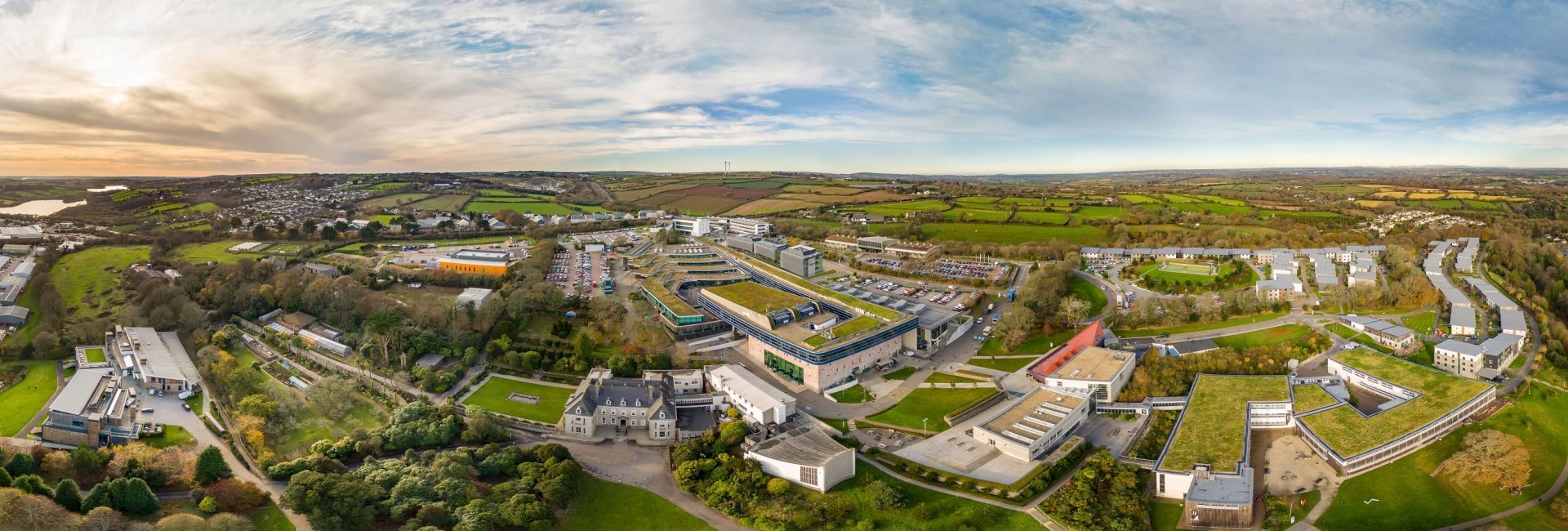
Penryn Campus

Course summary

Create innovative, brave and enthralling work for theatre and live performance.

Help to shape the future of performance as a powerful contemporary artform on this multidisciplinary Theatre & Performance degree. Created to develop passionate hands-on practitioners who want to bring powerful theatre and storytelling to life, you will be supported to become a culturally aware and adaptable live performance artist.

With audiences hungry for innovative and engaging shows, this course responds directly to the industry’s need for collaborative and highly skilled creative explorers. From the start, you'll be trained by makers, practitioners and academics as you develop a diversity of theatre making skills in addition to performance prowess – including devising, directing, writing, scenography and digital technology, building your confidence as an industry-facing professional.

Taught within our Academy of Music & Theatre Arts (AMATA), underpinned by intensive practical work, you will collaborate across disciplines, creating performances that push the boundaries of technology and art and given the freedom to express an individual approach to your practice.

With the emphasis on learning by doing and interrogating all elements of live productions, you’ll graduate as a creatively confident and physically skilled practitioner who can manage, produce, perform and professionally facilitate your own work – ready to build your name in the industry.

Why study this course at Falmouth?
Work with highly skilled and experienced practitioners, artists, academics and creative technicians.
Have access to the latest resources and technologies, including green screen, motion capture and virtual reality resources, as well as an extensive range of technical sound, lighting and recording and editing equipment.
Benefit from AMATA’s year-round performance programme, which attracts top artists and performers across a range of disciplines.
Build industry links through workshops, guest lectures and visits by companies such as Ad Infinitum, Beyond Face, Gecko, Prodigal Theatre, Wildworks, Miracle Theatre and The Royal Shakespeare Company.
Create and take part in a diverse range of collaborative performance projects, including a major immersive production and your own Professional Project.

This course is an accredited degree with Spotlight and Equity. Students are eligible to join Spotlight in the first term of their final year. Inclusive of their membership, they have a wealth of support, content and events tailored explicitly towards this membership group from Spotlight.

Modules

With consistent and in-depth professional skills training, you’ll learn to create and respond to performances. You’ll explore techniques and methods in different environments; from solo performances to full public productions, from work for traditional spaces to site-specific, immersive and unusual contexts. You’ll also develop your vocal and physical abilities, as well as the imaginative, digital, collaborative and reflective skills needed to thrive in the industry. As well as leaving with a Theatre & Performance degree, you’ll gain a unique mix of conservatoire practice, backed up by the experience and knowledge of the AMATA community – a working venue offering year-round theatre, dance and other live events. .

Year one:
You’ll develop essential foundational skills and approaches for voice, body, movement and imaginative practices. You will also develop your knowledge and skills in relation to digital and immersive technologies and explore their potential in making live performances more engaging for modern audiences. We’ll also investigate global issues, historical contexts and modern practice and ideas.

Modules
Performance Skills
Culture & Contexts: Stage and Screen
Play Texts
Making Skills 1
Stagecraft: Physical and Digital Scenography
Ensemble Performance

Year two:
In your second year you’ll take on advanced body-based training and learn about technical theatre, directing, writing and creating drama on stage. You will also develop scenography skills and engage with design thinking, adapting the stage to the story. Alongside this, you’ll create and present a solo performance of your own making, influenced by a range of styles like scripted monologue and stand-up comedy.

Working as part of a theatre company, you’ll create and put on a public production focusing on the relationship between a show and its audience. You’ll also create original material and develop your professional portfolio of skills by studying advanced performance techniques.

Modules
Extended Making Skills: Physical, Vocal, Digital
Immersive and Participatory Theatre
Theatre Futures
Page to Stage: Writing, Directing and Dramaturgy
Show in a Bag
Modes of Making: Socially Engaged Practice

Year three:
In your final year, you will extend and deepen your techniques and making skills, as well as your personal, social and philosophical approach to theatre. You will work towards becoming a proactive, independent and entrepreneurial practitioner, who is resilient, able to transfer your skills to other disciplines and able to manage a sustainable career.

Using your critical and reflective skills, you’ll research and write a paper on an area of theatre making that inspires and interests you. You’ll also develop performance material – individually and in companies – honing creative process skills through delivering scratch work (‘test’ performances) in several different contexts.

You will finish the year developing and performing your own professional work for public production to industry specialists and audiences. You’ll also take on a professional development project, where you’ll prepare for the industry by learning about how its infrastructure functions, and how to develop a career as a performer, theatre maker or company. You will create a professional identity for yourself ready to share on a range of platforms and networks.

Modules
Creating Companies
Professional Development
The Thinking Practitioner: Student-led Research
Master Classes: Physical, Vocal & Digital
Professional Production

As part of our process of continuous improvement, we routinely review course content to ensure that all our students benefit from a high-quality and rewarding academic experience. As such, there may be some changes made to your course which are not immediately reflected in the content displayed on our website. Any students affected will be informed of any changes made directly.

Assessment method

The Theatre & Performance course assessment approach reflects and enables an incremental, developmental learning experience.

The assessment for the Award consists of 100% coursework, including:

Practical Assessment (group, individual) – which includes in-class presentations, discussions, demonstrations/process showings, studio-based practice, productions, and final year performances.
Written and reflective assessment – including essays, research writings, digital/physical portfolios, critical reviews and live discussions.
Regular giving and receiving of feedback during practical work enables effective individual and group critique and reflection.

A range of disciplined practical activities (workshops, demonstrations, seminars, lectures, tutorial supervision) are used to develop skills and abilities and demonstrate outcomes including workshops and lectures with professional performers, companies and directors.

These opportunities will help develop independently minded practitioners and are designed to help you prepare for the range of activities you will engage in as graduates: to be able to demonstrate expertise in negotiation and pursuing shared goals; handling creative, personal and interpersonal issues; and communicating through a variety of media and platforms.

How to apply

Apply by
14 January

This is the deadline for applications to be completed and sent for this course. If the university or college still has places available you can apply after this date, but your application is not guaranteed to be considered.

Application codes

Course code:
238U
Institution code:
F33
Campus name:
Penryn Campus
Campus Code:
P

Points of entry

The following entry points are available for this course:

  • Year 1
  • Year 2
  • Year 3

International applicants

If English is not your first language, you will need to demonstrate English language skills that are sufficiently developed for successful completion of your studies. We accept a range of recognised English language qualifications that are equivalent to the International English Language Testing System (IELTS) Academic minimum score of 6.0 overall, with a minimum of 5.5 in Reading, Writing, Speaking and Listening. Through the award of international scholarships, we aim to support academic enrichment by encouraging diversity and excellence at Falmouth. For details of our international scholarships, and how to apply for them, please visit our website at www.falmouth.ac.uk

Open days

Entry requirements

Qualification requirements

UCAS Tariff - 64 points

A level

We welcome A Levels in a wide range of subjects, especially in those relevant to the course for which you apply.

Pearson BTEC Level 3 National Extended Diploma (first teaching from September 2016)

We accept BTEC Extended Diplomas in a wide range of subjects, especially those relevant to the course you are applying to.

Access to HE Diploma

60 credits (with a minimum of 45 credits achieved at level 3) in a relevant subject.

Pearson BTEC Level 3 National Diploma (first teaching from September 2016)

Acceptable when combined with other qualifications

Pearson BTEC Level 3 National Foundation Diploma (first teaching from September 2016)

Acceptable when combined with other qualifications

Pearson BTEC Level 3 National Certificate (first teaching from September 2016)

Acceptable when combined with other qualifications

Pearson BTEC Extended Diploma (QCF)

We accept BTEC Extended Diplomas in a wide range of subjects, especially those relevant to the course you are applying to.

Pearson BTEC Subsidiary Diploma (QCF)

Accepted with other qualifications

International Baccalaureate Diploma Programme - 24 points

WJEC Level 3 Advanced Skills Baccalaureate Wales

Acceptable with UCAS tariff points from the Supporting Qualifications

Welsh Baccalaureate - Advanced Skills Challenge Certificate (last awarded Summer 2024)

Acceptable with UCAS tariff points from the Supporting Qualifications

Extended Project

Acceptable when combined with other qualifications

Cambridge International Pre-U Certificate - Principal

Accepted

OCR Cambridge Technical Extended Diploma

Accepted

T Level - P

At Falmouth, we recognise excellence in many forms, and we see the whole you.

Our diverse community is creative, innovative and entrepreneurial.

We recognise that these qualities aren’t always shown in academic grades alone. That’s why, while many of our applicants achieve high academic grades, we also welcome those who can demonstrate their potential through an exceptional portfolio or performance.

At a minimum, we typically require the equivalent of 64 UCAS Tariff points for undergraduate courses where we can review a portfolio or audition, or a minimum of 96 UCAS points for those courses that do not require a portfolio or audition. For our Integrated Foundation Year courses, we typically require a minimum of 32 UCAS points for courses where we can review a portfolio or audition, or 64 UCAS points for those that do not require a portfolio or audition.

To support this approach, during a friendly conversation with our academic team, we’ll consider your ideas, your creative output and your ambition to ensure you’ll thrive at Falmouth.

If you are able to demonstrate relevant, current, equivalent experience instead of formal qualifications, we encourage you to apply. Please contact our Applicant Services team before applying, for advice regarding your individual experience and eligibility.

If you are an international applicant and require a Student visa to study in the UK, you must have a recognised English language test approved and vouched for by the University at the appropriate level. You can see what we accept on our website https://www.falmouth.ac.uk/study/international/english-language-requirements Our Applicant Services team can help you with any general questions you may have about study visas or suitable language tests. For more specific advice, we recommend you also consult UKCISA http://www.ukcisa.org.uk/

Find out more about qualification requirements for this course.

Additional entry requirements

Audition
Interview

English language requirements

If English is not your first language, you will need to demonstrate English language skills that are sufficiently developed for successful completion of your studies. We accept a range of recognised English language qualifications that are equivalent to the International English Language Testing System (IELTS) Academic minimum score of 6.0 overall, with a minimum of 5.5 in Reading, Writing, Speaking and Listening

View our list of accepted English language tests and qualifications using the link below https://www.falmouth.ac.uk/study/international/english-language-requirements

Contextual admissions

Universities and colleges consider more than grades when assessing applications and may make offers based on a range of criteria. Learn more about contextual offers.

At Falmouth University, we take a rounded approach to admissions. Instead of focusing on criteria like grades alone, we operate a contextual admissions policy, where we look at you as a person: your talents, your experiences and your potential. Every offer we make is shaped around you and your circumstances, and our conditional offers are always intended to be realistic and achievable.

Learn more on the Falmouth University website

Historical entry grades data BETA

This section shows the range of grades students (with UK A-Levels or Pearson BTEC Level 3 National Extended Diplomas) who received offers were previously accepted with (learn more). It is designed to support your research but does not guarantee whether you will or won't get a place. Admissions teams consider various factors, including interviews, subject requirements, and entrance tests. Check all course entry requirements for eligibility.

Not enough data available

We are unable to show previous accepted grades for this course. This could be because the course is new, it's a postgraduate course, there isn't enough historical data, or the provider has opted out of sharing their entry grades data for this course - learn more.

Student Outcomes

Operated by the Office for Students

75 Employment after 15 months (Most common jobs)

85 Go onto work and study

The number of student respondents and response rates can be important in interpreting the data – it is important to note your experience may be different from theirs. This data will be based on the subject area rather than the specific course. Read more about this data on the Discover Uni website.

Fees and funding

Tuition fees

No fee information has been provided for this course

Tuition fee status depends on a number of criteria and varies according to where in the UK you will study. For further guidance on the criteria for home or overseas tuition fees, please refer to the UKCISA website.

Additional fee information

No additional fees or cost information has been supplied for this course, please contact the provider directly.

Like this page