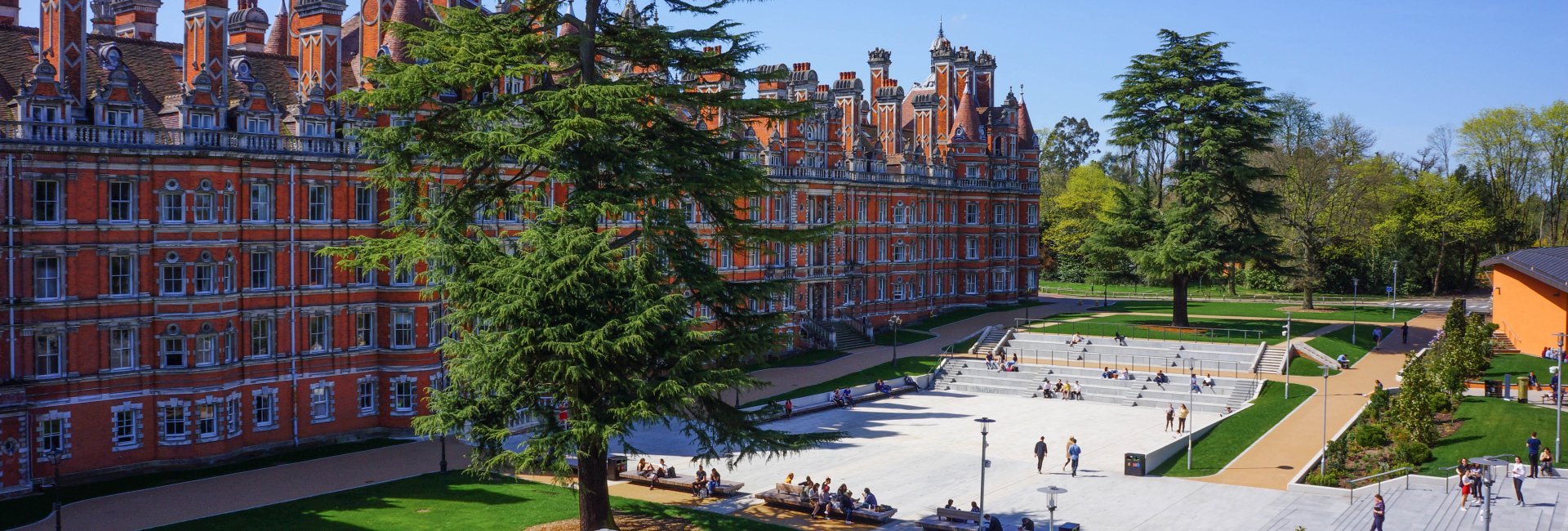
Royal Holloway, University of London - Postgraduate Open Morning (Egham campus)
13 Jun 2026, 08:00
Egham

The innovative and exciting new Department of Electronic Engineering links excellent engineering with the ingenious application of creativity as the starting point for invention. We offer opportunities for cutting-edge research in fields including Microwave Photonics and Sensors, Nanotechnology, Voice, Music and Biosignal technologies, and Power systems.
The Department offers a range of postgraduate study opportunities around current and emerging electronic engineering trends. Research within the Department is structured into four main groups:
Microwave Photonics and Sensor Group: https://pure.royalholloway.ac.uk/en/organisations/microwave-photonics-and-sensors
Dr Shyqyri Haxha: https://pure.royalholloway.ac.uk/en/persons/shyqyri-haxha
Nano-Electronics Group: https://pure.royalholloway.ac.uk/en/organisations/nano-electronics-and-materials-group
Dr Wenqing Liu
Power Systems Group: https://www.royalholloway.ac.uk/studying-here/postgraduate/electronic-engineering/electronic-engineering-phd/
Dr Stefanie Kuenzel: https://pure.royalholloway.ac.uk/en/persons/stefanie-kuenzel
Audio, Biosignals and Machine Learning: https://pure.royalholloway.ac.uk/en/organisations/audio-biosignals-and-machine-learning
Prof David Howard: https://pure.royalholloway.ac.uk/en/persons/david-howard
Dr Clive Cheong: https://pure.royalholloway.ac.uk/en/persons/clive-cheong-took
At the start of each programme, there will be introductory activities on research skills, giving presentations, writing reports and laboratory safety.
From time to time, we make changes to our courses to improve the student and learning experience. If we make a significant change to your chosen course, we’ll let you know as soon as possible.
As Royal Holloway’s newest department, we have designed a brand new building right in the heart of campus, with ample space to grow teaching and research around our strengths, using state of the art commercial software, experimental and laboratories equipment.
Our research groups provide a lively and interactive environment for postgraduates and academic staff. Research group members, and other researchers across other departments and industry, meet frequently and hold research seminars or invite internal and external speakers to present to our students. These groups also serve as a useful forum for discussing current research activities, formulating ideas, sharing resources, discussing journal articles and problem solving. Students are expected to become active members of their relevant research group and to participate in wider Departmental events such as seminars and colloquia.
Students discuss their research skills training needs with their supervisor soon after they start their degree. The College's Researcher Development Programme offers a series of transferable skills courses designed for research students to help them to develop their skills alongside their research.
Students on our Research programmes are able to attend any of the 3rd or 4th year modules taught within the Department’s MEng programme as desired to support their research.
Select a course option at the top of this page to view entry requirement information.
Choose a specific option to see funding information.
Course optionsEmail:Admissions.Enquiries@RoyalHolloway.ac.uk
Phone:01784 414944
Egham
TW20 0EX
At Royal Holloway, University of London